Summary created by Smart Answers AI
In summary:
- Macworld reports that Apple’s OS 27 betas contain three key indicators of a folding iPhone Ultra, including iOS code references to ‘foldState’ and ‘angleDegrees’ variables.
- The new iPhone Mirroring feature allows freely resizable windows while Apple apps demonstrate adaptability for wider aspect ratios, suggesting preparation for foldable displays.
- iOS 27 significantly expands landscape orientation support across built-in apps like Health, Music, and Find My, indicating development of hardware requiring different screen configurations.
Apple just released the first developer beta of iOS 27, macOS 27, watchOS 27, and all the other OS 27 updates. These updates are loaded with all the features Apple announced during its WWDC keynote, but sometimes it’s the things you find that weren’t announced that prove the most interesting.
For some time now, we’ve heard rumors that Apple will, at long last, release a folding iPhone this fall. The apparent name will be iPhone Ultra, and it will feature a book-style fold design with an unusual aspect ratio similar to a passport. Now, the new OS 27 betas feature three very strong clues that this folding iPhone is definitely on the way.
Folding in the code
The strongest evidence of the folding iPhone is also the least visible. Hidden in the iOS 27 code are references to two new status variables: foldState and angleDegrees.
These sorts of status values are typically given to apps to tell them how to operate: a status value would tell an app if you’re holding your phone in landscape orientation, for example, so it can change its layout if it supports landscape mode.
Obviously, there’s no need for these two particular state values on anything but a folding device. We’ve also seen code that suggests that there’s a device on the way that features both Touch ID and Dynamic Island. There’s no such device on the market today, but it would neatly fit the iPhone Ultra rumors.
Resizeable iPhone mirroring
When using the macOS iPhone Mirroring feature (introduced in iOS 18 and macOS 15 Sequoia), you could only select one of three sizes: smaller, actual size, or larger. The actual shape of the mirrored iPhone could never change.
Now, iPhone Mirroring gives you a freely resizable window. With most third-party apps, this simply grows or shrinks the iPhone-shaped window smoothly. But within many of Apple’s own apps, the application itself resizes and refactors itself to allow a wider layout.
Foundry
This is known as “app adaptability” in Apple developer circles; building an app with relative layout controls instead of a fixed layout, so it smoothly adapts to different screen (or window) sizes.
The fact that the iPhone Mirroring app supports this, and that Apple’s iPhone apps feature adaptive layouts, almost certainly signals that an iPhone with a wildly different aspect ratio is definitely on the way.
Lots of new landscape apps
Apple dropped the landscape orientation home screen and most app views back in iOS 14. Since then, a few iPhone apps have added back landscape support over the years, including Maps, Files, Notes, and Mail.
With iOS 27, Apple has added back a flood of apps supporting landscape view: Find My, Fitness, Health, Home, Music, Podcasts, Reminders, Shortcuts, Watch, Weather, Voice Memos, and even Apple TV Remote. Apple has made the Dynamic Island and Live Activities work in landscape view, too.
Foundry
Some of these apps have only partial landscape support–the Now Playing screen in Podcasts and Music work with your phone held sideways, but the main category navigation does not. Also, there’s no landscape home screen view. I suspect later beta releases of iOS 27 will expand this landscape app support.
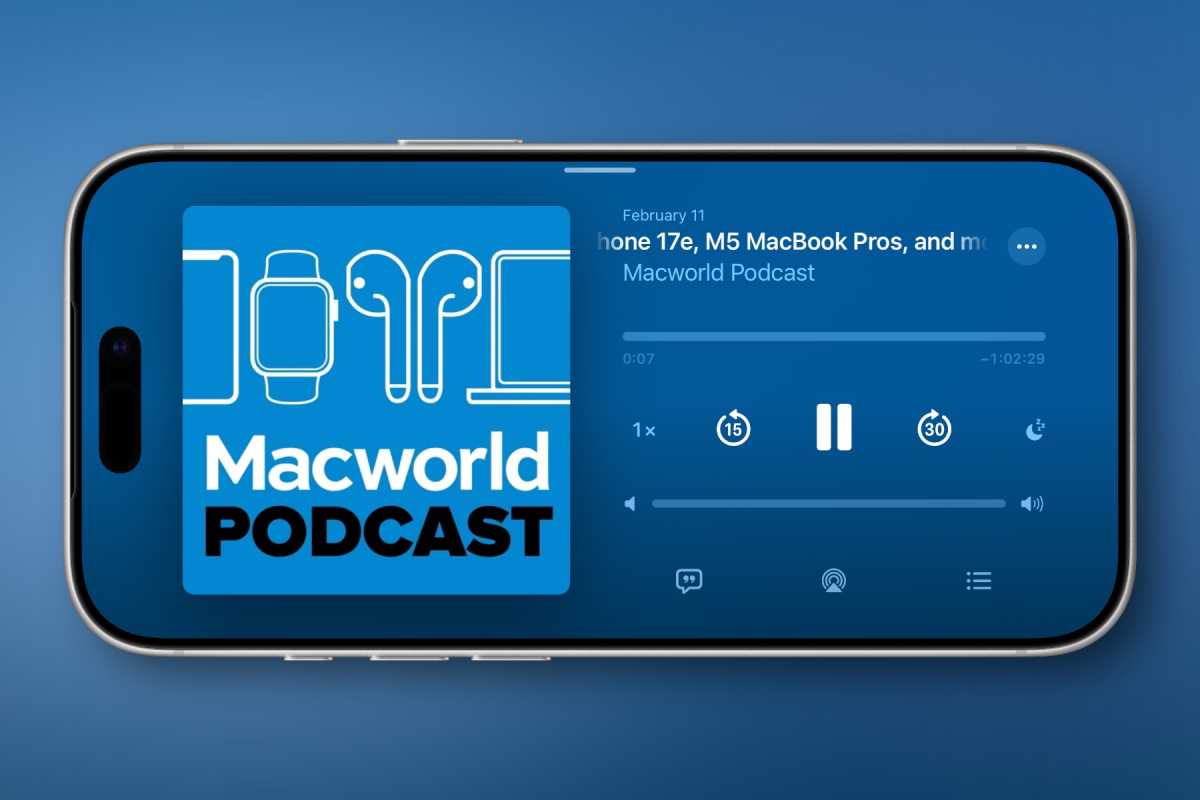
Foundry
Some of this is the natural consequence of Apple building its apps for reactive layouts, but it’s all in service of an iPhone that will obviously have a more horizontal orientation by default.
Related posts:
 Apple’s secret ingredient for making the iPhone thinner just got delayed to 2026
 Rumored iPhone 17e redesign to bring Dynamic Island to Apple’s budget phone
 Apple’s new 40W charger has a secret mode for faster iPhone 17 charging
 Leak reveals details of Apple’s secret roadmap: iOS 26.4, iOS 27, and iOS 28