At a glance
Expert’s Rating
Pros
- Excellent traction on slopes and uneven ground
- Good obstacle detection and avoidance
- No boundary wire required
Cons
- Automatic mapping struggled on a complicated lawn
- Expensive
- Large and heavy for smaller yards
Our Verdict
The Mova LiDAX Ultra 3000 AWD is a capable robot mower for challenging terrain, with excellent traction and dependable performance once its boundaries are established. Its unreliable automatic mapping, however, is a significant drawback at this price.
Price When Reviewed
This value will show the geolocated pricing text for product undefined
Best Pricing Today
Best Prices Today: Mova LiDAX Ultra 3000 AWD

The Mova LiDAX Ultra 3000 AWD is built for the kinds of lawns that can give robot mowers a lot of trouble: medium-to-large yards with slopes, uneven ground, and irregular shapes.
I tested it on a roughly 7,600-square-foot lawn with all three, plus trees, a play structure, bare patches, mulch borders, and a raised strip of grass beside a fence, with a narrow gap below it. At $2,399—discounted from a $2,999 list price—the LiDAX is a premium mower aimed at homeowners whose terrain demands more than a basic model can deliver.
Mova LiDAX Ultra 3000 AWD: Design and specs
The LiDAX Ultra 3000 AWD is a hefty mower, measuring 29.1 × 20.9 × 12.6 inches and weighing 52 pounds. Its UltraDrive system uses four 116-watt hub motors to drive the wheels, while independent suspension and omni wheels help it stay stable on uneven ground and turn in tight spaces.
Controls on top of the mower let you enter its anti-theft PIN and perform basic tasks without opening the app, including starting or stopping a mowing job and sending the mower back to its charging station. A large red stop button provides a quick way to halt the mower in an emergency.
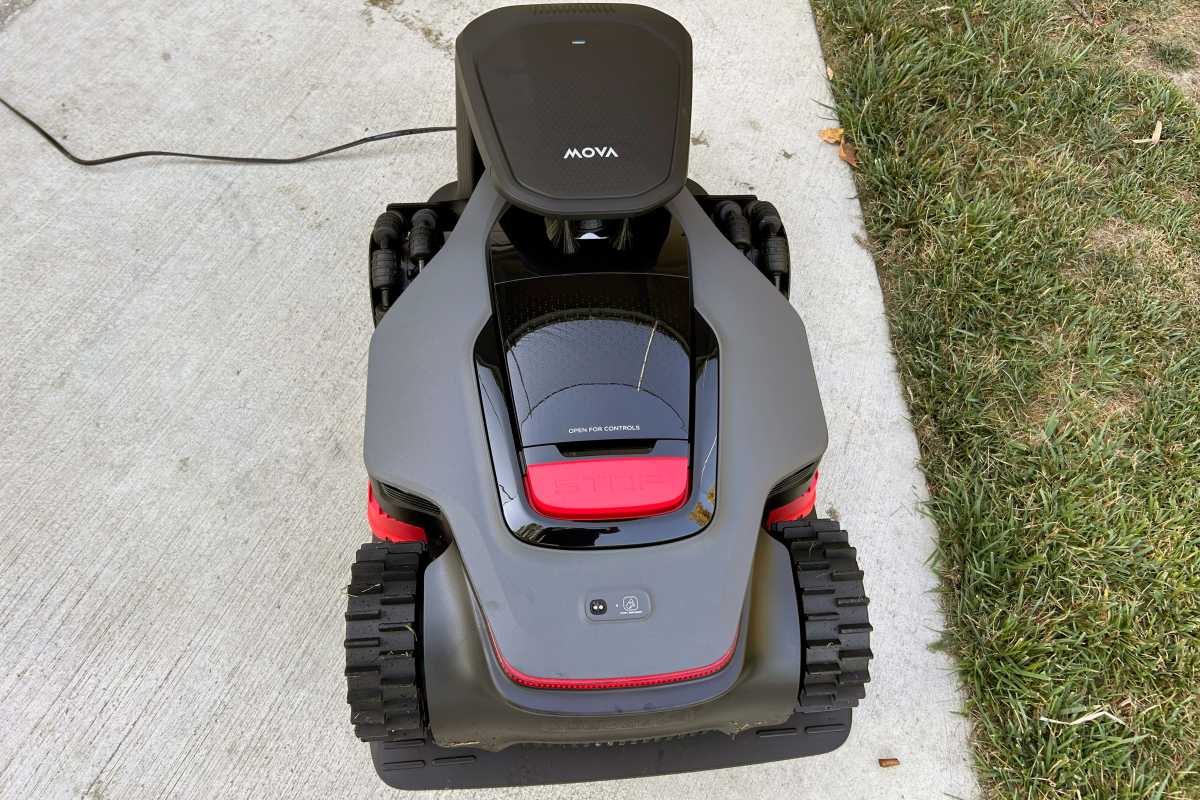
The Mova LiDAX Ultra 3000 AWD uses four driven wheels and a raised LiDAR sensor to navigate difficult terrain without a boundary wire.
Michael Ansaldo/Foundry
A raised 360-degree 3D LiDAR sensor on top of the mower scans its surroundings, while two forward-facing AI cameras identify lawn boundaries and potential obstacles. A physical bumper on the front of the mower provides another layer of detection when something makes contact with it. Together, these systems let the LiDAX navigate without a perimeter wire.
Mova rates the mower for a single lawn up to 0.75 acre. It can store two maps, each covering up to 0.75 acre, and manage up to 150 mowing zones. Its 15.8-inch cutting deck can be adjusted through the app to cut grass from 1.2 to 3.9 inches high. The cutting disc shifts toward the side of the chassis near a raised boundary, which Mova says lets it trim within 1.2 inches of walls, fences, and similar edges.
Mova also says the mower can climb an 80-percent grade and cross vertical obstacles up to 2.36 inches high. Its 7.5Ah battery is rated for 150 to 170 minutes of mowing and 0.2 to 0.25 acre of coverage per charge.
Mova LiDAX Ultra 3000 AWD: Setup and mapping
The mower comes with a charging station and power supply, ground anchors, cable pegs, replacement blades, and the hardware needed to install them. The charging station needs to be placed on level ground with a clear approach so the mower can enter and exit unobstructed. Once I found a suitable spot, I connected the power cable and secured the station and cable with the included anchors and pegs.
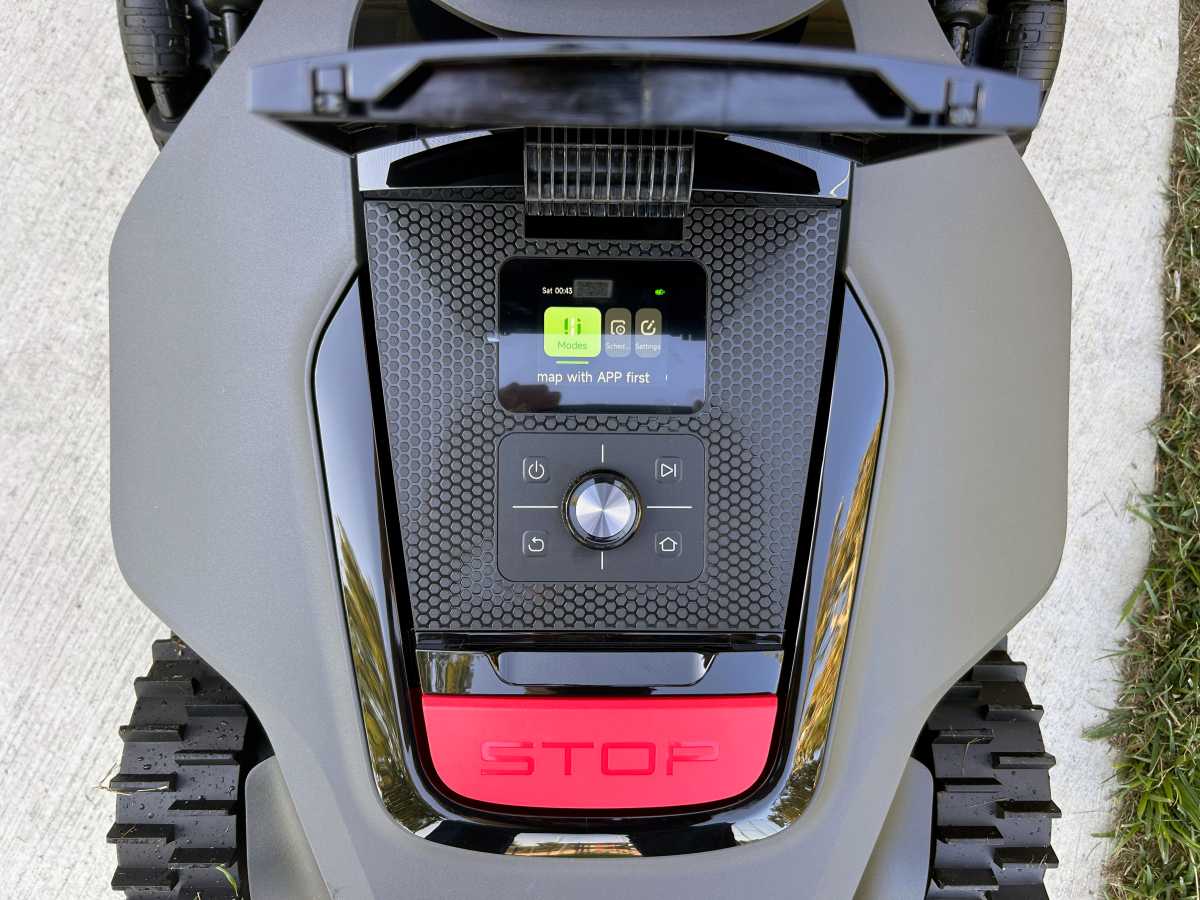
A flip-up panel on the LiDAX Ultra 3000 AWD reveals its onboard display and controls for basic functions, including starting or stopping a mowing job and returning the mower to its charging station.
Michael Ansaldo/Foundry
Connecting the mower to the MovaHome app was even quicker. The app recognized the mower immediately and pairing it with my phone and connecting it to Wi-Fi took only a couple of minutes. The mower arrived locked, so I had to enter its PIN using the onboard controls before proceeding. The app then ran it through a short calibration routine.
The app offers automatic and manual mapping. With AI mapping, the mower identifies the grass and traces the perimeter on its own. Manual mapping requires driving it around the boundary with the app’s virtual joystick.
I started with AI mapping, but the lawn proved too complicated. Where the boundary was irregular or poorly defined, the mower sometimes left the lawn and became stuck. On one attempt, it drove into a broad mulch-covered area beside the play structure. On others, it fell over the raised edge near the fence.
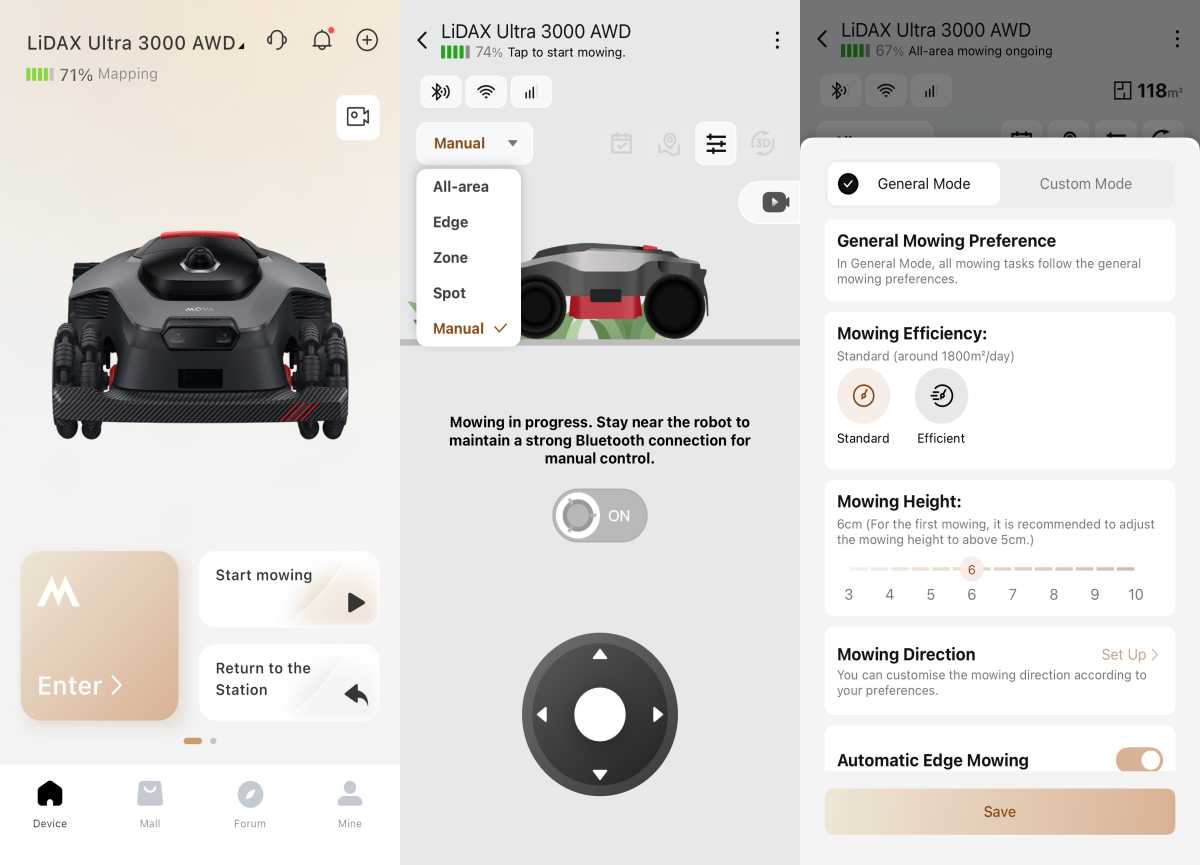
The MovaHome app provides quick access to mowing modes, manual control, cutting height, mowing direction, and other job settings.
Michael Ansaldo/Foundry
After several attempts, I gave up on AI mapping and drove the mower around the perimeter myself. That worked, but it erased much of the setup advantage automatic mapping was supposed to provide. The feature might fare better on a flatter lawn with sharper boundaries. On this property, it wasn’t dependable.
Mova LiDAX Ultra 3000 AWD: Mowing performance
Once the manual map was in place, the LiDAX behaved like a different mower. It traveled systematically up and down the lawn in parallel passes, while the app showed its live position, the area already cut, and its progress through the job.
More important, it respected the boundary I had created. It never wandered onto the mulch or veered off the grass while mowing, even though those same areas had confused it during AI mapping. Its all-wheel drive provided plenty of traction to cross the lawn’s slopes, dips, and uneven patches without wheel-spinning or stalling. It also maneuvered cleanly around the trees, play structure, and other obstacles.
Mova says the LiDAR and cameras can recognize more than 300 types of stationary and moving obstacles. The app can classify detected objects and assign a confidence rating; in one instance, it identified a person with 90-percent confidence. It also lets you report a mistaken identification and, if you enable the feature, capture photos of detected obstacles.
The mower left open areas looking evenly trimmed. I didn’t find obvious missed strips or clumps of poorly cut grass, and it worked close enough around obstacles that little follow-up trimming was needed.
Mova LiDAX Ultra 3000 AWD: App experience
The MovaHome app puts the information you need during a mowing job on one screen. It shows the mower’s battery and connection status, live position, mapped area, completed area, and overall progress. Start, pause, end, and return-to-station controls are also easy to reach.
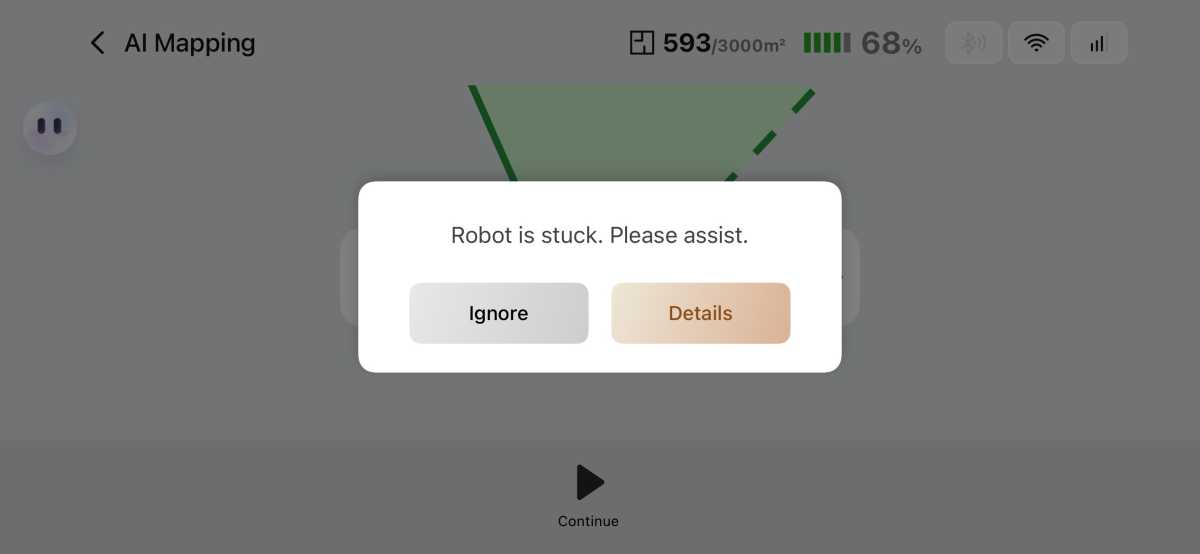
During AI mapping, the MovaHome app alerted me when the LiDAX became stuck and needed assistance.
Michael Ansaldo/Foundry
A drop-down menu allows you to switch between all-area, edge, zone, spot, and manual mowing using the virtual joystick. You can choose standard or efficient mowing, adjust cutting height electronically, set the mowing direction, and enable automatic edge mowing. Settings can apply across the whole lawn or vary by zone, and recurring jobs can be scheduled for specific days and times.
The app also supports rain protection, frost protection, do-not-disturb hours, recharge-and-resume operation, work logs, and maintenance tracking. Despite the number of options, it rarely feels crowded, and the main controls are easy to find.
Should you buy the Mova LiDAX Ultra 3000 AWD?
The LiDAX Ultra 3000 AWD didn’t deliver the automatic mapping experience Mova advertises, at least not on my complicated lawn. Driving the mower around the perimeter to map the boundary manually took more time and effort, but it also solved the mower’s navigation problems. Once the map was saved, the LiDAX stayed on the grass, handled slopes and uneven ground, and traveled along a narrow raised edge that had defeated a smaller robot mower.
That makes it particularly appealing for medium-to-large lawns with difficult terrain, provided you’re willing to take over the mapping if the AI struggles. Buyers mainly attracted by the promise of effortless automatic setup should be more cautious. Its size and $2,399 price are also hard to justify for a small, uncomplicated yard.


