The timing would be fitting. The MacBook Pro celebrated its 20th anniversary in 2026, and Apple could mark the milestone with a feature many believed would never come to the Mac. Touchscreen support would also help further differentiate the MacBook Pro from the MacBook Air and the budget-friendly MacBook Neo.
The redesigned touchscreen MacBook Pro is expected to be a premium model featuring M5 Pro and M5 Max processors, rather than the newer M6 chip. Apple is separately preparing a standard 14-inch M6 MacBook Pro, which is expected to retain the existing design. For more on that model, see our M6 MacBook Pro release date and specs guide.
There are still questions over pricing and availability. OLED panels and ongoing supply-chain pressures could make the touchscreen models more expensive than today’s MacBook Pro, while touch support is expected to remain exclusive to Apple’s premium laptops initially. Read on for everything we know about the touchscreen MacBook Pro’s expected release date, design, specifications and price, including what Apple could announce on October 28.
Touchscreen MacBook Pro release date: When will it launch?
- Apple media experience confirmed for October 28; touchscreen MacBook Pro announcement expected
On October 19, Apple announced a media event, dubbed “Pro and Tell” on October 28, 2026. This is expected to be the introduction of new Macs, including the touchscreen MacBook Pro.
Bloomberg’s Mark Gurman reported on October 8 that Apple plans to announce its first touchscreen MacBook on October 27. The launch will reportedly include an online video presentation and an in-person component for the press on October 28. In his Power On podcast, Gurman said the laptop will start shipping on November 6.
Earlier reports offered a broader launch window and raised the possibility of delays. Speaking in a Power On podcast on October 1, Gurman said he expected the touchscreen MacBook announcement as early as October, potentially slipping to November. The laptops are reportedly being tested with macOS 27.2.
In September 2026, Bloomberg’s Mark Gurman included the touchscreen MacBooks in a list of products that will ship in late 2026/early 2027.
Bloomberg’s Mark Gurman and analyst Ming-Chi Kuo both initially predicted a late 2026 debut, with an October announcement fitting Apple’s traditional MacBook Pro release schedule while also coinciding with the 20th anniversary of the MacBook Pro’s introduction. In January, South Korean blog Naver reported that Samsung had begun production on its new 8.6-generation OLED manufacturing line, which is expected to supply panels for the next-generation MacBook Pro, further supporting that timeframe. Gurman also reported in February that the redesigned MacBook Pro would arrive in the “back half” of 2026.
Gurman’s more recent reporting points to an October announcement and November availability. However, the launch was previously predicted for early 2027. In April, Gurman reported that supply-chain constraints were affecting development of the redesigned MacBook Pro and could push the release into early 2027. He subsequently reported in June that Apple had revised its chip roadmap, with the touchscreen MacBook Pro now expected to launch with M5 Pro and M5 Max chips instead of M6 Pro and M6 Max in an effort to keep the project on schedule.
Which MacBook models will get a touchscreen?
- Current rumours suggest that Apple’s first touchscreen laptop will be a redesigned MacBook Pro with Pro and Max chips
Both Bloomberg’s Mark Gurman and analyst Ming-Chi Kuo have reported that Apple is developing MacBook Pro models with OLED touchscreen displays as part of a major redesign. The feature is expected to debut on the high-end MacBook Pro models powered by Apple’s Pro and Max chips, making them the first Macs to support direct touch input.
Apple is expected to use the touchscreen as a key differentiator for its professional laptops, further separating the MacBook Pro from the more affordable MacBook Air and MacBook Neo.
There is also speculation that Apple could rebrand the flagship model as the MacBook Ultra. According to one report from a source said to be familiar with Apple’s plans, the company intends to expand its “Ultra” branding beyond the Mac Studio and Apple silicon chips. However, this claim has not been corroborated by Bloomberg’s Mark Gurman or analyst Ming-Chi Kuo, so it should be treated with caution.
For now, the technology appears set to remain exclusive to the MacBook Pro lineup. Neither the MacBook Air nor the MacBook Neo is expected to gain touchscreen support in the near term. However, Kuo believes Apple could eventually expand the technology to other MacBook models if the touchscreen MacBook Pro proves successful.
The MacBook Air may be the next candidate for a touchscreen upgrade, but current forecasts suggest this is unlikely before 2028 or 2029. Some reports also indicate that the Air could adopt OLED display technology before then, albeit without touch functionality.
Touchscreen MacBook Pro Design
- Lighter design expected
- Punch hole for the FaceTime camera
Foundry
Apple’s touchscreen MacBook Pro is expected to have a substantially lighter design than current models, but it may not be significantly thinner. Bloomberg’s Mark Gurman has revised his earlier expectations for a slimmer body while maintaining that Apple has redesigned and consolidated internal components to reduce weight.
One of the most significant visual changes could be the removal of the display notch. Reports from display analysts and Bloomberg suggest Apple may replace the current notch with a hole-punch camera cutout, allowing for more usable screen space around the sensor. In early 2026, Gurman went a step further, claiming the new MacBook Pro could adopt an iPhone-like Dynamic Island interface built around the camera cutout.
The touchscreen MacBook Pro is also expected to retain its traditional laptop design, complete with a full keyboard and large trackpad, rather than becoming a hybrid tablet device.
Other rumoured design changes include:
- A lighter chassis, although the latest reporting suggests it may not be thinner.
- OLED display technology.
- A hole-punch FaceTime camera replacing the notch.
- Possible Dynamic Island-style functionality.
- A reinforced hinge designed to minimise screen movement when the display is touched.
These changes would help distinguish the MacBook Pro from the MacBook Air and the entry-level MacBook Neo while giving Apple’s flagship laptop its most substantial design update in years.
Which chip will feature in the touchscreen MacBook?
Early rumors suggested that Apple’s first touchscreen MacBook Pro would feature M6 Pro and M6 Max chips, but more recent reports indicate that Apple has changed its plans. The redesigned OLED models are now expected to launch with M5 Pro and M5 Max processors, with Apple potentially skipping the M6 Pro and M6 Max generation entirely.
According to Bloomberg’s Mark Gurman in June 2026, Apple has revised its chip roadmap to accelerate development of the AI-focused M7 generation. The change could bring the M7 chips to market around six months earlier, with significantly improved on-device AI capabilities. The ongoing DRAM and NAND shortages may also have influenced Apple’s decision, although they are not thought to be the primary reason. Apple has already increased Mac and iPad prices in response to rising memory costs. Read more about Apple’s reported chip roadmap changes.
Separately, Apple is reportedly planning to launch the 14-inch MacBook Pro with an M6 chip.
There has also been speculation that Apple could introduce its own 5G modem to a future MacBook Pro, enabling cellular connectivity without Wi-Fi or an iPhone hotspot. However, there is little concrete evidence that cellular connectivity will be part of the touchscreen redesign.
Touchscreen MacBook Display
- Tandem OLED display
- Touchscreen interface
The display is expected to be the headline upgrade of Apple’s redesigned MacBook Pro. Multiple reports suggest Apple will replace the current Liquid Retina XDR (mini-LED) panel with a touchscreen OLED display, bringing MacBook Pro technology closer to the Ultra Retina XDR display used in the latest iPad Pro.
According to analyst Ming-Chi Kuo, Apple is planning to introduce OLED touch panels in the MacBook Pro in late 2026 or early 2027. The new display is expected to be thinner, more power-efficient, and capable of delivering deeper blacks, higher contrast, richer colours, and improved HDR performance than today’s mini-LED screens.
Reports indicate that both the 14-inch and 16-inch models will use advanced tandem OLED technology, which combines two OLED layers to achieve higher brightness levels while maintaining excellent energy efficiency. Apple first introduced this technology with the M4 iPad Pro and is expected to bring a similar implementation to the MacBook Pro.
The touchscreen functionality will reportedly rely on on-cell touch technology, which integrates touch sensors directly into the display rather than adding a separate layer. This approach helps keep the panel thin while supporting multi-touch input.
If the rumours prove accurate, the move to a tandem OLED touchscreen would represent the biggest display upgrade in the MacBook Pro’s history and one of the most significant changes to the lineup in years.
Brady Snyder / Foundry
Touchscreen MacBook Interface
Foundry
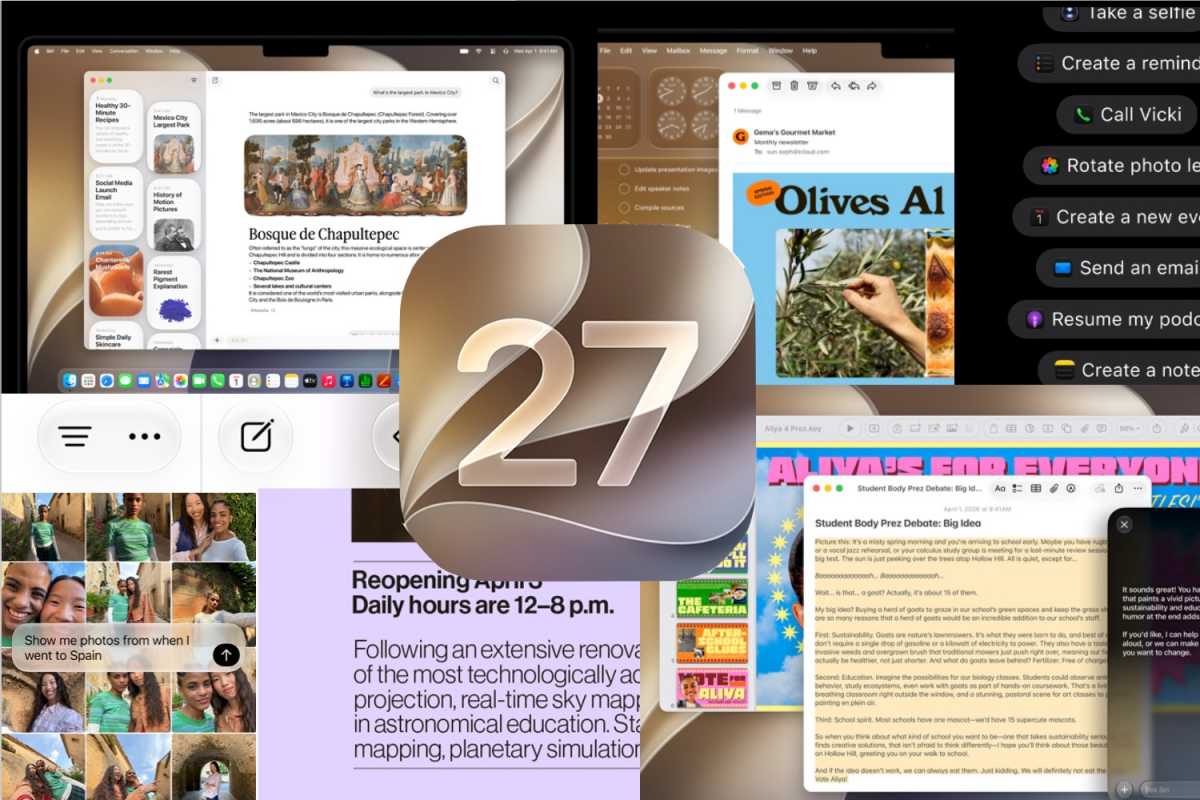
Apple is not expected to turn macOS into iPadOS, but reports suggest macOS 27 could include subtle design changes to make the Mac easier to use with touch input.
Rather than replacing the traditional desktop experience, Apple is reportedly working on a touch-tuned interface that adapts depending on how the device is being used. When touch input is detected, interface elements such as menus, buttons, and controls may automatically enlarge to make them easier to tap. When using a mouse or trackpad, macOS would revert to its familiar point-and-click layout.
The touchscreen itself is expected to support standard gestures such as tapping, scrolling, and zooming, while still allowing users to switch between touch, trackpad, and mouse input.
Further clues appeared in the macOS 27.2 beta on October 5. MacRumors reported new code references to touch gestures in Safari, Photos, Notes and Quick Look. These could support a future touchscreen MacBook, but they could also relate to Sidecar, which allows an iPad to act as a Mac display.
More specific clues appeared in footage shared by itspdfu on October 14. The footage reportedly shows touch-oriented behavior in Safari in macOS 27.2 betas 3 and 4: tabs lift and enlarge while being rearranged, then return to their normal size when dropped into place. Pressing and holding a tab opens a contextual menu that omits the Ask Siri option available with a mouse or trackpad. These changes suggest Apple is preparing Safari for touch input.
Touchscreen MacBook Pro: Connectivity
- 5G connectivity could finally come to the Mac

Apple
Beyond the touchscreen display and redesigned chassis, one of the most intriguing rumours surrounding the next-generation MacBook Pro is built-in cellular connectivity.
Apple has spent the past several years developing its own modem technology, beginning with the C-series modem family. Reports suggest the company has explored bringing 5G connectivity to the MacBook lineup, allowing users to connect directly to mobile networks without relying on Wi-Fi or a smartphone hotspot.
In August 2025, Macworld reported that internal Apple code referenced a MacBook Pro with an M5 Pro chip and Apple’s C1 modem. This suggests Apple has experimented with cellular-equipped MacBooks, althogugh it does not establish that the upcoming touchscreen models will offer 5G.
The redesigned MacBook Pro could also benefit from Apple’s growing portfolio of wireless chips. The company’s N-series networking processors, which handle Wi-Fi, Bluetooth, and Thread connectivity, may eventually replace third-party components throughout the Mac lineup. An updated version of the chip could debut alongside the touchscreen MacBook Pro, improving power efficiency and tighter integration with Apple’s ecosystem.
Touchscreen MacBook Pro: Price expectations
Apple will likely offer similar configurations to the current MacBook Pro models, but it’s unclear how much of a premium a touchscreen OLED display will command. Apple upped the price of the iPad Pro by $200 when it got a tandem OLED, so it’s likely the touchscreen MacBook Pro will have a higher starting price.
Here are the prices for the current standard configurations of the M5 MacBook Pro, which saw prices increase between $300 and $500 in June 2026.
14-inch MacBook Pro
- $1,999/£1,999: M5 with a 10-core CPU, 10-core GPU, 16GB unified memory, 1TB SSD, Thunderbolt 4
- $2,499/£2,499: M5 Pro with a 15-core CPU, 16-core GPU, 24GB unified memory, 1TB SSD, Thunderbolt 5
- $4,099/£4,099: M5 Max with a 18-core CPU, 32-core GPU, 36GB unified memory, 2TB SSD, Thunderbolt 5
16-inch MacBook Pro
- $2,999/£2,999: M5 Pro with a 18-core CPU and 20-core GPU, 24GB unified memory, 1TB SSD, Thunderbolt 5
- $4,399/£4,399: M5 Max with a 18-core CPU, 32-core GPU, 36GB unified memory, 2TB SSD, Thunderbolt 5


