At a glance
Expert’s Rating
Pros
- Great display
- Powerful, full speakers
- Long battery life
- Some improvements to keyboard and trackpad
Cons
- Lags behind in performance
- Few ports
- Expensive
- Keyboard is still problematic
Our Verdict
Dell’s XPS laptops have always come at a premium for their design and build. And though the XPS 16 has made some improvements, it’s unique looks still come with usability drawbacks. It’s a great-looking machine with some solid hardware, but other devices are much more practical, pleasant to use, and (often) more affordable.
Price When Reviewed
This value will show the geolocated pricing text for product undefined
Best Pricing Today
Price When Reviewed
$2,349
Best Prices Today: Dell XPS 16 (2026)
The XPS brand is back, even though Dell didn’t leave it behind for long. That helps make sense of the new XPS 16, which clearly shows its heritage with the unique design that’s been showing up with minor revisions over the last several years.
This model threads a needle with some higher-power componentry and a high-end Tandem OLED display while still emphasizing efficient operation. But to get the package and all its regal wrappings, you’ll pay a premium for the XPS 16, which starts at $1,749 and jumps to $2,349 as tested. That leaves it open to serious competition from laptops like the excellent Acer Swift 16 AI at $1,899 and the portability-minded MSI Prestige Flip 14 AI+ at just $1,299.
The Dell XPS 16 has a few things going for it. Its display and audio are excellent, and when paired with its design, it’s really a pleasure of a laptop to behold. But that’s where the fun ends.
Dell XPS 16: Specs and features
- CPU: Intel Core Ultra X7 358H
- Memory: 32GB LPDDR5x-9600
- Graphics/GPU: Intel Arc B390
- Display: 16-inch 3200×2000 OLED touchscreen, anti-reflection, 20-120Hz
- Storage: 1TB PCIe 4.0 SSD – Kioxia BG7
- Webcam: 8MP + IR
- Connectivity: 3x Thunderbolt 4 / USB-C with Power Delivery and DisplayPort Alternate Mode, 1x 3.5mm combo audio
- Networking: WiFi 7, Bluetooth 6.0
- Biometrics: Windows Hello facial recognition
- Battery capacity: 69 watt-hours
- Dimensions: 13.88 x 9.35 x 0.58 inches
- Weight: 3.75 pounds
- MSRP: $2,349 as-tested ($1,749 base)
At the time of writing, the Dell XPS 16 only came in two preset configurations directly from Dell. The base configuration costs $1,899 and includes an Intel Core Ultra 7 355 processor paired with 16GB of LPDDR5x-7467, a 1TB SSD, and a more basic display. That display has a lower resolution (1920×1200), is not touch-compatible, and does not use an OLED panel or Corning Gorilla Glass Victus. However, it does offer a wider 1–120Hz adaptive refresh rate range. This model also notably lacks Intel Arc B390 graphics.
The configuration tested here costs $2,349 and bumps up the processor to an Intel Core Ultra X7 358H processor with 32GB of LPDDR5x-9600 RAM, a 1TB SSD, and a 3200×2000 Tandem OLED touchscreen with a 20-120Hz refresh rate range. Dell offers a $2,459 model as well, which is physically the same as our test configuration but includes Adobe Express Premium, McAfee+ Premium, and one year of Dell Care Premium.
Dell allows for custom configurations starting at $1,749. The base configuration is almost the same as the cheaper preset configuration, but has an Intel Core Ultra 5 325 and 512GB of storage instead. Dell provides the option of upgrading to as much as 64GB of memory and 4TB of storage, though 32GB of memory and higher only comes with the Intel Core Ultra X7 358H.
Dell XPS 16: Design and build quality
Foundry / Mark Knapp
The Dell XPS 16, sticking to its guns, is about as elegantly designed as ever. It combines premium materials like a CNC aluminum chassis and Gorilla Glass in a sleek frame. Like prior models, it’s quite the looker. This model is a little less sharp than prior ones, with the front edge more square with soft, rounded edges as opposed to the blade-like front edge seen before.
It’s still a fairly thin machine at just 0.58 inches thick. And it’s not much bigger than it needs to be to fit in its 16-inch display. In our configuration, that’s a Tandem OLED panel that sits behind Gorilla Glass Victus, though the non-OLED model doesn’t get this glass cover.
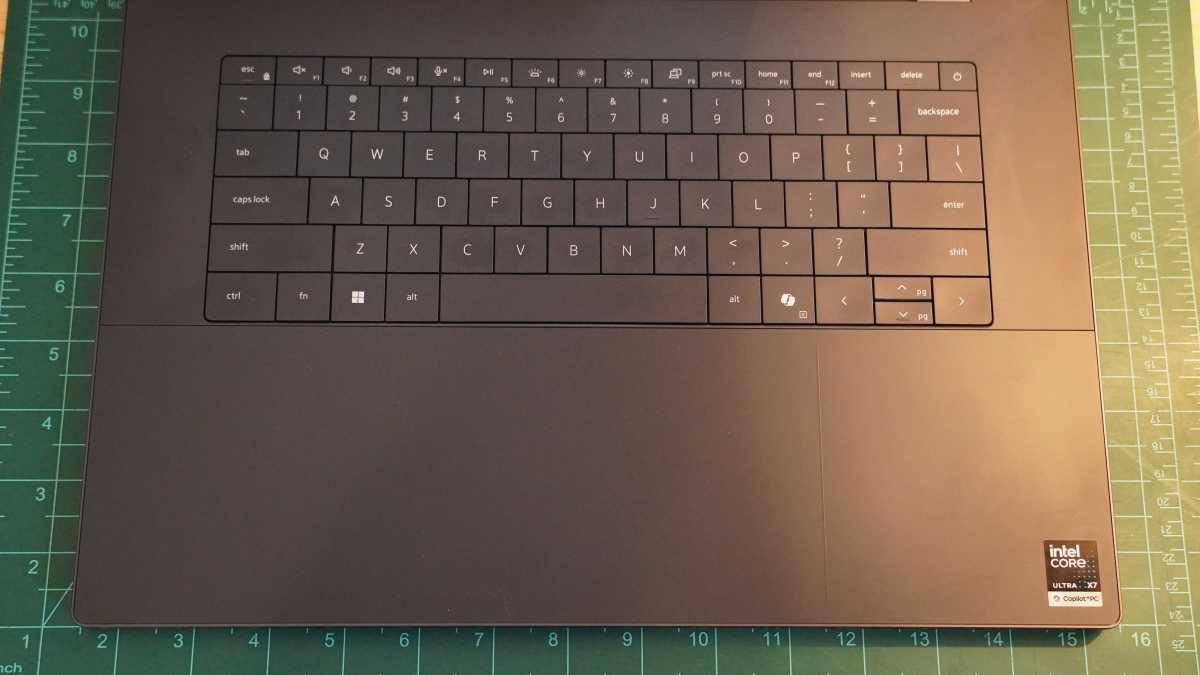
The keyboard deck is sparse. It features a standard keyboard without any number pad. Below that is a wide expanse of Gorilla Glass 3. Dell seems to have listened to feedback (or at least heard my own complaints over prior designs) as now the massive trackpad fitted into that glass expanse is demarcated with subtle ridges at either side. The top and bottom edges aren’t defined, but they’re so close to the keyboard and bottom lip of the keyboard that it almost doesn’t matter.
The keyboard is surrounded by nothing at all. There’s large spaces above and on either side of it. Speakers could have been placed here, but Dell opted for down-firing speakers hidden in long slits at the bottom of the computer.
The system sits on two wide, firm rubber feet that provide good traction, which helps with one-handed opening of the lid. With its premium materials, the XPS 16 ends up feeling pretty sturdy, but the XPS 16 also winds up a bit weighty. It hits 3.75 pounds, which isn’t bad for a 16-incher, but isn’t breaking any records. Dell is using a new 900ED battery tech that purportedly offers higher energy density, but that wasn’t enough to make it impressively light, and the battery is still only rated at 70Wh. The Acer Swift Go 16 was 3.3 pounds, almost a half-pound lighter, and managed to fit a 65Wh battery without this tech.
Dell XPS 16: Keyboard, trackpad
Foundry / Mark Knapp
With the very first XPS laptop to feature the zero-lattice design, I had gripes. The 2026 Dell XPS 16 seems to have made improvements, but I still find it a keyboard that’s more impediment than assistant. The keys aren’t perfectly flat, offering a tactile contour that helps with centering. The stabilization of the keys is great, and that’s paired with a good tactile pop with each press. But the zero-lattice design still provides very little tactile feedback for when my fingers shift too far out of bounds, and I find I struggle to make quick corrections to my finger positioning.
The result: I’m met with a keyboard that could have been excellent but for Dell’s persistence in having almost no gap between the keys. I was able to reach 97 words-per-minute at 95 percent accuracy, but I struggle to go any faster as the design of the keyboard just doesn’t inspire confidence. When I go faster, my accuracy tanks. At least Dell brought back physical function row keys.
As nice as it is to have a big, glass trackpad as smooth as the XPS 16 offers here, I don’t find it too much of a joy to use. Mousing around is great, but when it comes to clicking on things, I’m less satisfied. Tap-to-click is an option and feels fine. But the physical click is a little odd.
Dell brought back haptic motors, which it had unfortunately omitted from the Dell 16 Premium last year (essentially 2025’s version of an XPS 16). But even with the haptics, the physical click feels off. The click feedback is adjustable, but at its lowest level, I didn’t quite feel the response in my finger all that well, and it felt disconnected from how firmly (or not) I was pressing. It may just take a little time to get used to, but I’d kind of hope for a delightful experience right from the jump on a premium product like this.
Dell XPS 16: Display, audio
Foundry / Mark Knapp
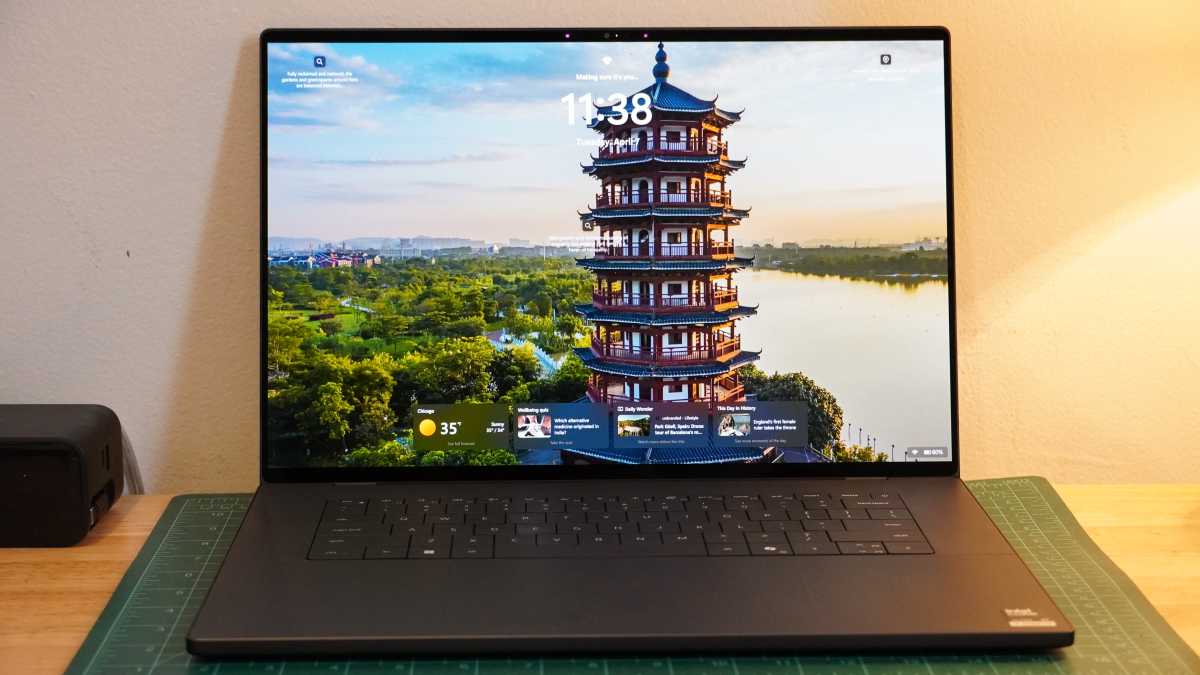
The Dell XPS 16’s display is excellent. At 16 inches, it provides plenty of screen real estate, and its 3200×2000 resolution ensures that it’s plenty sharp. The touch input is responsive and doesn’t have an easily visible digitizing layer to impact clarity. The panel gets decently bright with a measured full screen white a bit over 400 nits and potential for brighter highlights in HDR. The Tandem OLED offers infinite contrast and a wide color gamut covering 100 percent of the DCI-P3 and sRGB color spaces. It also proved accurate with a measured dE1976 average of 0.8 and a max of 1.52, making it viable for creative work. The 120Hz refresh rate helps make visuals smooth while still having the option to dial down to 20Hz for battery savings when displaying mostly static content.
The use of bottom-firing speakers doesn’t hold the Dell XPS 16 back much. Even if the bottom ports are blocked, the sound comes out quite well through the top. And the sound is among the best I’ve heard from a laptop.
The XPS 16 combines dual 2W tweeters with a pair of main speaker drivers that put out great sound. There’s a fullness you almost never get from a laptop that adds a ton of depth to music, and the stereo separation from the speakers is pronounced enough to provide a more dynamic listening experience. Even at higher volumes, the sound is clean as well. The speakers do drop off if you want real low end, failing to deliver much below about 100Hz. But for casual listening, they’re fantastic.
Dell XPS 16: Webcam, microphone, biometrics
The webcam and microphone setup on the Dell XPS 16 is good. The webcam has solid clarity thanks to its high resolution sensor, and it does surprisingly well avoiding noise and weird exposure even in less-than-ideal lighting conditions. That said, the field-of-view is very wide, so it may capture more than you intend if used directly. With the extra resolution and wide field of view, you can leverage auto-framing and cropping tools more effectively though.
The mics capture my voice well, offering a fullness many laptops don’t achieve. It does a passable job isolating my voice from some more hectic background noise, though doesn’t perfectly eliminate the noise.
The Dell XPS 16 brings facial recognition for quick logins through Windows Hello. It’s been largely reliable in my testing. Fingerprint recognition isn’t built in though.
Dell XPS 16: Connectivity
The Dell XPS 16 has capable connectivity, but it’s still disappointing in its variety. The system has two USB-C ports on the left side and one on the right. All three are Thunderbolt 4, providing loads of bandwidth for peripherals and supporting hi-res display output and charging input. But beyond these, there’s just a single 3.5mm audio jack. If you need to use HDMI or a USB-A device, you’ll be looking at a dongle or adapter. There’s no SD card support, either. It’s all the more a shame to see so few ports when Dell’s design hasn’t even prioritized ultra-slim edges.
Wireless connectivity is solid, at least. The system supports Wi-Fi 7 for fast and stable networking and Bluetooth 6.0. Both have worked quite effectively in testing with no issues.
Dell XPS 16: Performance
The 2026 Dell XPS 16 shifts away from being a performance powerhouse like the Dell 16 Premium, which went a bit thicker and heavier to incorporate discrete graphics. With an Intel Core Ultra X7 358H, it’s certainly promising capable speeds, and the Intel Arc B390 is a serious step up for integrated graphics even if they don’t quite meet the levels offered by low-tier discrete graphics. But Dell is more focused on efficiency here, and that shows in the default power plan which opts for Windows’ Balanced mode even when plugged in.
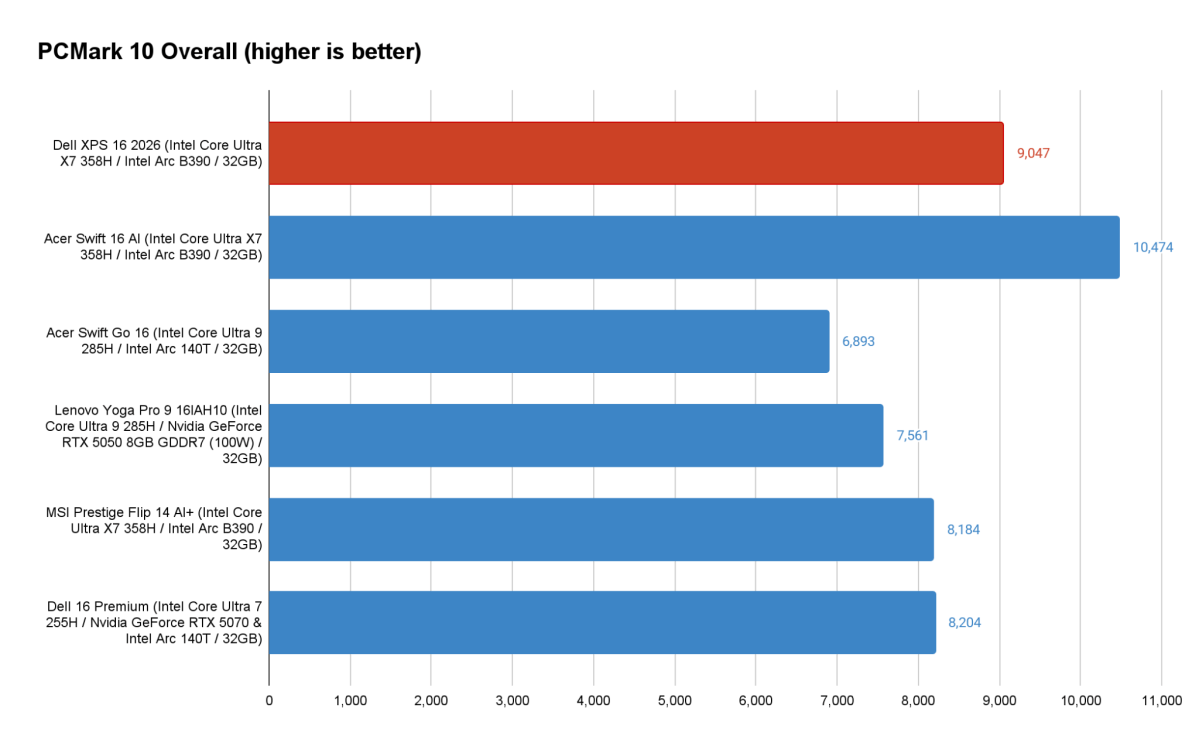
The XPS 16 still offers capable performance for everyday computing. In PCMark 10’s holistic test, the XPS 16 proves amply capable of most common office tasks. Its score of over 9,000 is excellent and keeps up with even heavy-hitting gaming laptops. Computers at this level aren’t likely to let average users down, but PCMark 10 doesn’t delve too deep into heavier compute loads.
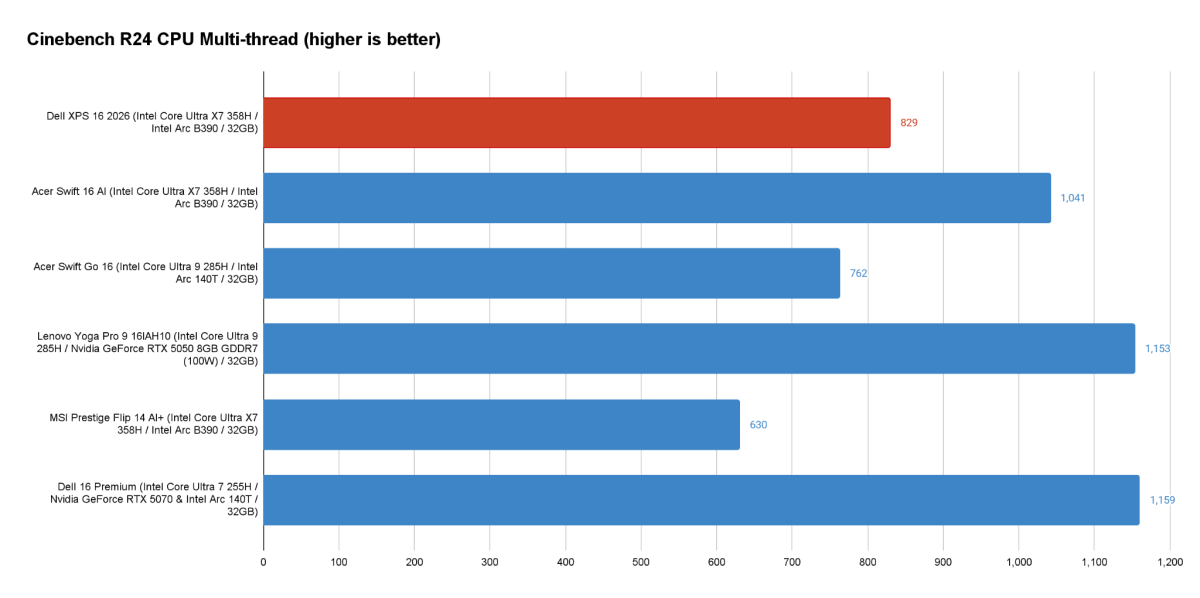
Cinebench is more demanding on the CPU and better highlights how much the Dell XPS 16 is capable of in heavy workloads. Here, Dell’s prioritization of efficiency holds it back against some of its competition.
It consistently falls behind the Acer Swift 16 AI running on the same processor and by sizable margins. It could also struggle to show up prior-gen Intel Core Ultra 9 285H processors as found in the Acer Swift Go 16 and Lenovo Yoga Pro 9 16IAH10. Even Dell’s earlier Dell 16 Premium came ahead with its Intel Core Ultra 7 255H processor. The XPS 16 can regain some ground if switched over to a Performance power plan, jumping up to 944 points in Cinebench 24, but it still lags behind some competitors and hardly outdoes smaller machines like the MSI Prestige Flip 14 AI+, which similarly jumps to 942 points in this test when using Windows’ Performance power plan.
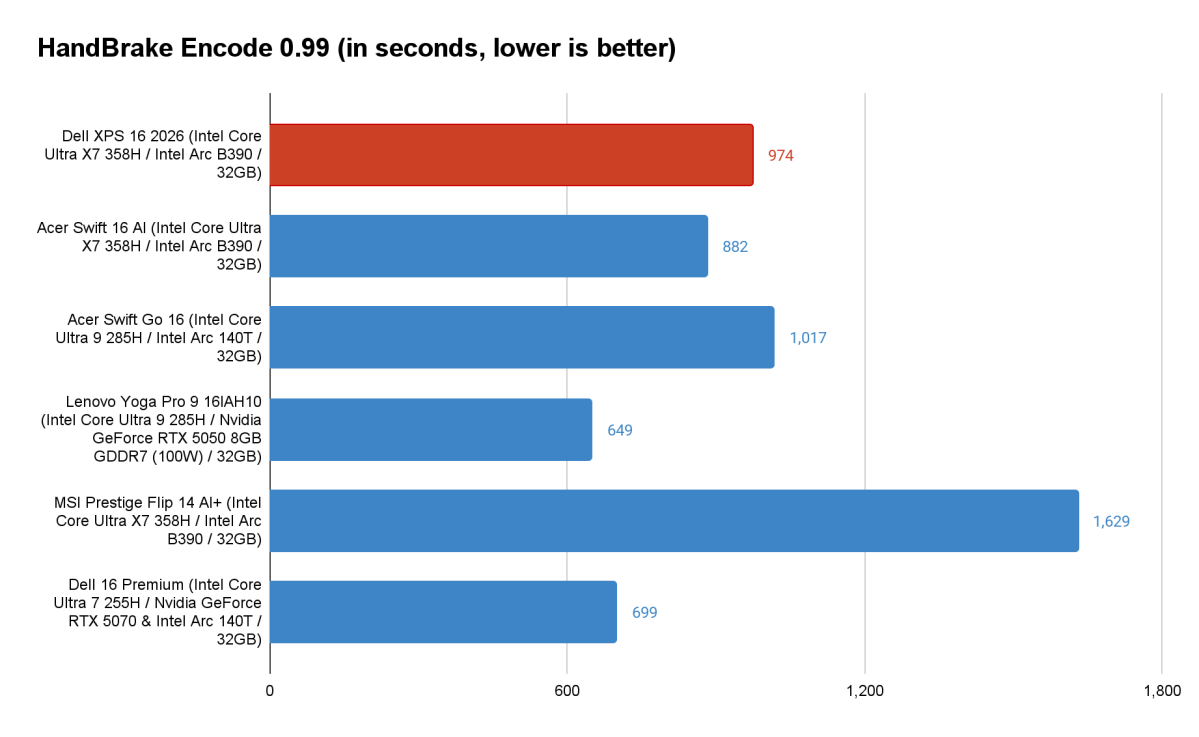
Part of what appears to be holding the XPS 16 back is thermals. It prefers to stay cool and quiet rather than operate at full tilt, and that can see it slow down in heavy workloads. Our Handbrake test has computers encode a large 4K video, which takes time and builds up heat in the process. Systems that handle that heat better can avoid throttling.
The XPS 16 appears to accept throttling and thus takes over 16 minutes to complete the test even where the Lenovo Yoga Pro 9 16IAH10 and Dell 16 Premium could complete it in closer to 11 minutes on older hardware with the same amount of cores. Dell’s cooling appears to hold out better than a smaller laptop like the MSI Prestige Flip 14 AI+ though, as the two computers performed similarly in shorter tests but were miles apart here.
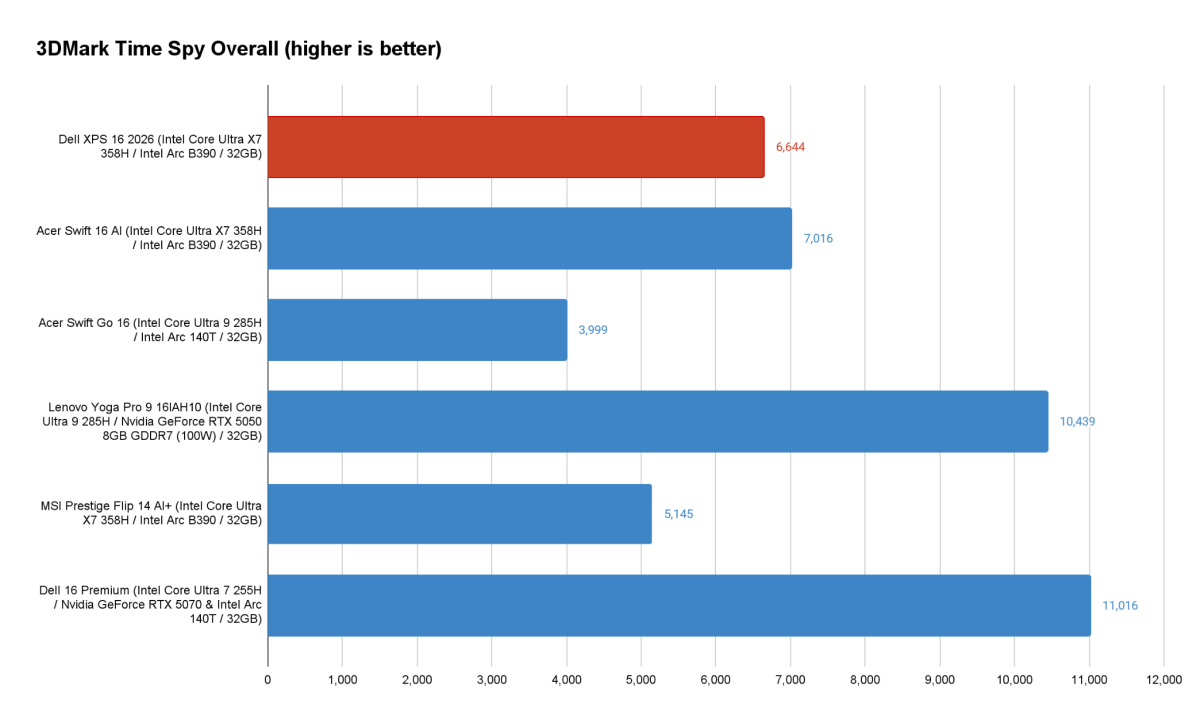
The Dell XPS 16’s inclusion of Intel Arc B390 graphics is a bonus in some respects, but also a step back in other ways. We can see clear uplift against earlier Intel Arc graphics as in the Acer Swift Go 16. Dell even shows a clear edge against the MSI Prestige Flip 14 AI+, which operated at slower speeds (at least until both level out in Performance mode). Still, when the XPS 16 is put next to the Lenovo Yoga Pro 9 16IAH10 with an RTX 5050 or the earlier Dell 16 Premium with an RTX 5070, the difference is clear. As great as Arc B390 is for integrated graphics, it doesn’t keep up with recent discrete graphics for raw performance.
Dell XPS 16: Battery life
With so many benchmarks showing the XPS 16 lagging behind because of its emphasis on efficiency, we had to expect strong results in battery life, and the XPS 15 didn’t disappoint. In our battery test, which runs the laptop in Airplane mode with the display set to 250 nits of brightness and running a full screen video, the XPS 16 ran on for an impressive 20 hours and 35 minutes.
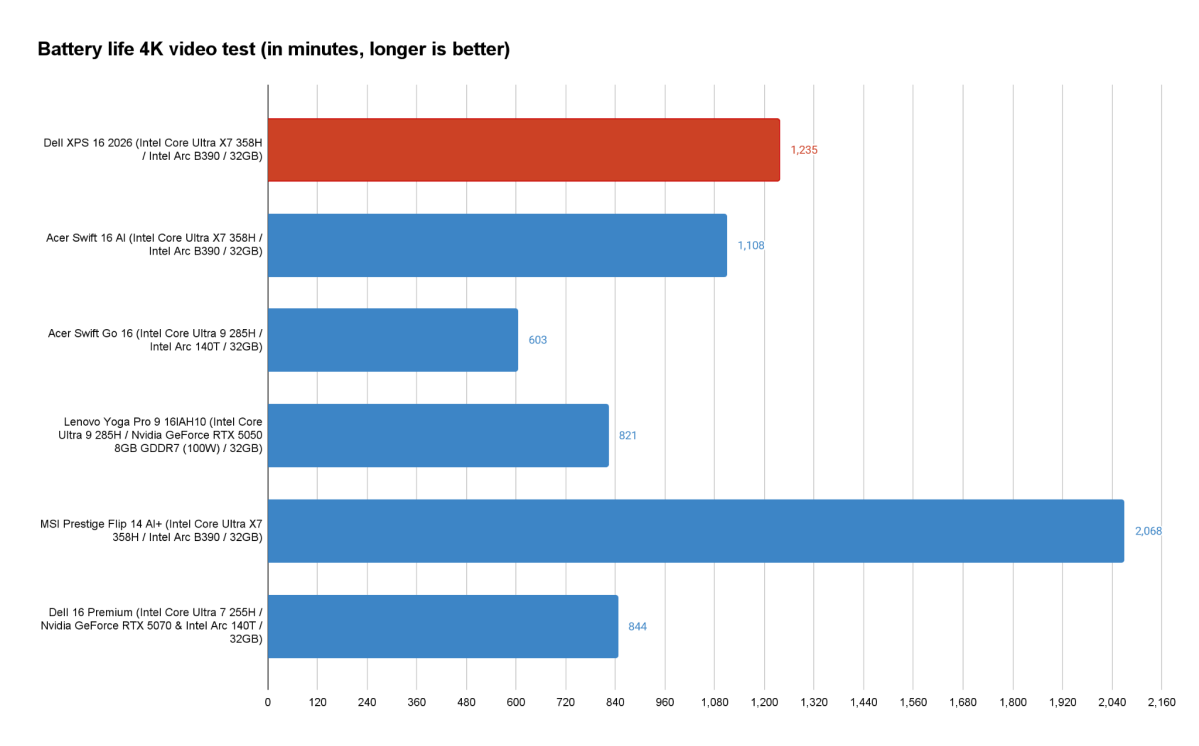
That’s an impressive result for a laptop with such a large screen, and it suggests there’s some extra efficiency to the Tandem OLED panel and its variable refresh rate. The Acer Swift 16 AI had a similar OLED panel size with lower resolution and used a similar battery capacity, but fell two hours short of the XPS 16. This gives the XPS 16 an advantage over the laptops that had otherwise been topping it in performance, except the MSI Prestige Flip 14 AI+, which leverages a smaller, lower-res screen and (surprisingly) a bigger battery to run 67 percent longer, topping 34 hours.
In everyday use, the XPS readily lasted through the workday with charge to spare even while keeping the brightness dialed up to that 250-nit level. That said, it wasn’t getting 20 hours of office use.
Dell XPS 16: Conclusion
The Dell XPS 16 has a few things going for it. Its display and audio are excellent, and when paired with its design, it’s really a pleasure of a laptop to behold. But that’s where the fun ends.
Even though the XPS 16 is powerful, it’s not impressively so and often fails to outpace contemporaries and even prior models. Its opting for integrated graphics helps save some weight and boost efficiency, but comes with a clear hit to graphics performance over discrete options. All this makes for a performance profile better suited to more standard office and productivity use cases, but the hardware itself just doesn’t feel so great to use and lacks helpful utility items like a number pad, USB-A, and HDMI ports. Ultimately, the XPS 16 sticks to its heritage as part quality laptop and part status symbol.


