Summary created by Smart Answers AI
In summary:
- Macworld analyzes Apple’s upcoming March 4th media experience, expecting at least five new products including a budget MacBook, iPhone 17e, and updated Studio Displays.
- The anticipated low-cost MacBook may feature A18 Pro processor and target the $599-799 Chromebook market to attract new users.
- Key uncertainties include whether iPhone 17e will retain the notch, M5 chip configurations for MacBook Pro, and delayed Siri 2.0 features.
In recent years, Apple has increasingly reserved its media events for major announcements, such as flagship iPhone launches. Iterative product updates with chip bumps now often get the “silent press release” treatment, as the advancements are too insignificant to warrant hour-long keynotes.
On March 4, Apple is hosting what it’s calling an “experience” for select members of the media. It’s neither a full-scale keynote nor a mere press release drop. During that week, the company is expected to unveil at least five new products, including a cheaper MacBook, the iPhone 17e, boosted iPads and Macs, and maybe more. While the rumors have given us a solid idea of what to expect from each device, a few key questions remain unanswered.
1. Will the iPhone 17e still have a notch?
A year ago, Apple introduced the iPhone 16e, retiring its SE smartphone branding. The rebrand came with some pretty exciting changes, including a superior camera, display, and overall design—plus a not-so-exciting price hike. In a few days, Apple will reportedly launch the iPhone 17e, featuring the A19 and MagSafe compatibility. But what about the notch?
Some rumors have suggested that the iPhone 16e’s successor will drop the notch in favor of the more futuristic Dynamic Island. Other relevant leakers have contradicted this claim, stating that the notch is here to stay. Unfortunately, there’s no way to tell for sure which route Apple will take.
Apple
On one hand, the iPhone SE notoriously maintained its prehistoric look for many years, so redesigning the second-gen “e” iPhone sounds unlikely. On the other hand, the “e” iPhone, despite costing more, offers fewer features than certain budget smartphones, so Apple may want to make it more enticing by adopting the Dynamic Island. Both options sound plausible.
2. Will Apple tease any unreleased AI features?
During WWDC24, Apple previewed Siri 2.0, featuring on-screen content awareness and personal context understanding. The company failed to meet its original deadline, and, eons later, the tools are still nowhere to be found. While we recently expected them to debut with iOS 26.4, the upgraded Apple Intelligence features may have been delayed, yet again, till a future OS release.
Apple
Certain reports now suggest that Apple will launch the new AI features as part of iOS 26.5. If true, it would be safe to assume that the engineers currently have working test software. In this case, will Apple tease these AI features during the March 4 experience to reassure its users and shareholders, or has it learned from its previous mistake not to make promises about unfinished technology? We’ll find out soon.
3. How cheap will the new MacBook be?
The low-cost MacBook will likely be the March 4 experience’s headlining release. According to credible leakers, Apple plans to compete with Chromebooks and other budget-friendly laptops by offering a comparable MacBook model. The notebook will possibly feature the iPhone 16 Pro’s A18 Pro processor in a vibrant 12.9-inch chassis. This would make it ideal for customers who don’t have the budget for a $999 MacBook Air or need the power of an M-series chip. But how “cheap” will it actually be?
While some reports suggest that the new MacBook will start at $599, others indicate that it could fall in the $699-799 range. For reference, the Google Store sells Acer Chromebooks that cost as little as $179, with mid-range models costing around $300-600, and higher-end editions going for no more than $800. Taking this into consideration, it would make more sense for Apple to target the mid-range Chromebooks with a $599 price tag. This would lure students and young adults, potentially winning them as lifelong customers through the ecosystem lock-in. But Apple pricing doesn’t always make sense—ahem, iPhone 16e—so a higher price of $799 wouldn’t exactly surprise us.
4. What M5 chip variants will we get?
Beyond the affordable MacBook, Apple could announce new M5 MacBook Pro and Mac Studio models within the next week. The MacBook Pro will likely get M5 Pro and M5 Max configurations, following last year’s vanilla M5 debut. Will customers get to configure the CPU and GPU? Certain reports, along with the online Apple Store’s updated Mac purchasing flow, suggest that users will finally get to pick the number of CPU and GPU cores separately. Meanwhile, Apple has a long history of limiting the variety of SKUs and maintaining a simple product approach. As such, we can’t really tell.
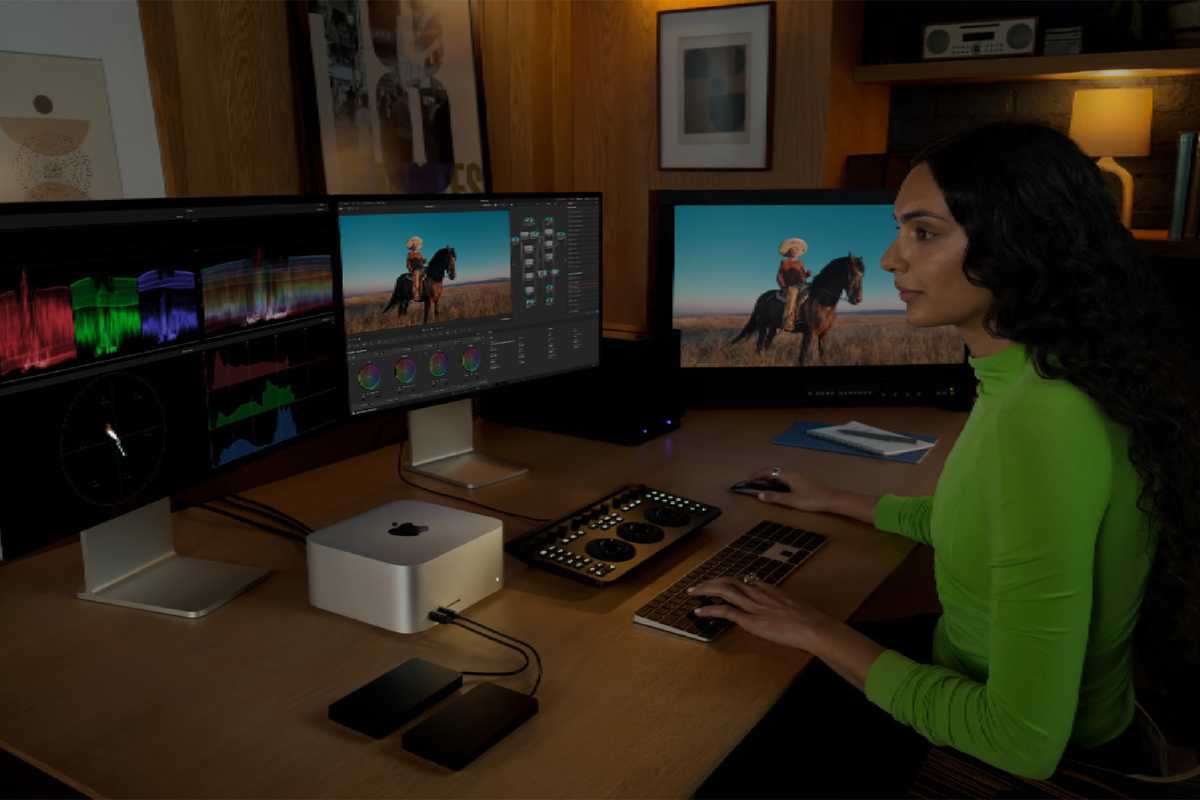
In the Mac Studio department, it remains unclear if Apple will release an M5 Ultra edition. The current Mac Studio comes in M4 Max and M3 Ultra variants, and Apple has stated that not every M-series chip will get an Ultra tier. So, Apple could offer the M5 Max as an option, along with either the unreleased M4 Ultra or all-new M5 Ultra. We’ll have to wait and see.
Apple
5. Will Apple raise prices?
The surge in demand for AI slop generation has led to a RAM shortage and subsequent price increases. Does this mean Apple will also start charging more for its products? Well, it’s hard to predict. CEO Tim Cook recently stated that the RAM crisis won’t significantly hurt Apple in the second quarter of the year, but he didn’t rule out a price hike, either.
6. What’s the second Studio Display tier all about?
Apple first launched the Studio Display four years ago, and a refresh is overdue. While we’ve long expected the company to release a Studio Display 2 in the near future, macOS code reveals that there will actually be two new Studio Displays, not one. At least one of them is rumored to adopt support for HDR content and a 120Hz refresh rate. Will the second model miss out on these premium perks and cost way less, or will it differ in size to cater to more customers? We’ll get some answers soon.

Apple


