The hottest company on the planet right now is a memory supplier called CXMT, a name barely anyone outside of China had even heard a year ago. It’s making headlines in financial markets on a massive stock debut, predicated on the idea that it’s going to fill the hole in the DRAM market (the kind of memory that goes into consumer PCs) as the big three make bank on “AI.”
Well bully for CXMT (ChangXin Memory Technologies), I suppose. This is, undeniably, good news if you’re looking for DRAM in mainland China. But while the Chinese market often affects technology across the world, it can also be insular, changing only itself — a potential customer base of 1.4 billion people can occupy even the biggest mega-corps, after all. So my question in this week’s newsletter is, will the rise of CXMT actually lower memory prices for the broader market, and potentially lessen the nightmare that is PC buying and building in 2026?
Welcome to the Boost Mode newsletter, Every week I share my insights on PC gaming, desktop setups, and hardware optimization. I also track down some of the most interesting PC and nerd news from around the web, plus a PC game pick you might not have seen elsewhere. Want this newsletter to come directly to your inbox? Sign up on our website!
CXMT arrives at the perfect moment
We’re talking about a relatively small and young company. The EE Times reported that it completed its first domestic memory fabrication plant in Hefei in 2019, at the time the first and only manufacturer of memory in China. It’s now the fourth-largest memory manufacturer in the world…though the first three are Samsung, SK Hynix, and Micron. That fourth-place ribbon is so small it’s about the length of a DRAM module.
Even so, the excitement around a new memory supplier in an unprecedented market crunch is palpable. CXMT performed an initial public offering to the Shanghai stock exchange last week, instantly shooting up nearly 500 percent and raising the equivalent of $8.6 billion USD. According to its IPO, its DRAM served 7.67 percent of the global market last year, even with output primarily focused on China.
In layman’s terms: CXMT is making bank and banking RAM. Though this chip production push was initially subsidized by the Chinese government, the amount of money we’re talking about here could easily make Chinese chip production wildly profitable all on its own. It’s worth pointing out that CXMT is aiming to stick to desperately needed DRAM production at the moment, leaving the more profitable HBM (the kind that goes into data centers) alone. And plenty of people outside of China are taking note.
Chinese RAM is showing up in hardware
Dell, Acer, and HP are all investigating CXMT as a supplier with an eye to easing their memory woes and soaring prices. Lenovo, the largest PC manufacturer in the world, is already using the company’s DRAM in at least a few models. Apple is looking into adding the company as a supplier, at least for its China-bound products. CXMT’s DDR5 desktop modules are now compatible with most motherboards, though you may need a BIOS/UEFI update before you install it. Major consumer suppliers like Corsair are starting to use CXMT memory in their retail modules.
Dell
(Incidentally, I checked an Alienware 15 review unit I happen to have at the moment to see if I could spot some CXMT memory in the wild. Nope, the 16GB SO-DIMM module is SK Hynix.)
CXMT’s RAM isn’t amazing. Initial testing by experts found it to be fine, but somewhat lacking if you want to overclock it for maximum performance. It’s also older in technical design, consuming more power compared to the Big Three’s latest offerings. But in a world where prices for high-performance memory are five times what they were last year — the memory in my desktop would cost over $1000 if I bought it today! — it’s hard to see a major, rising supplier as anything but an unambiguous good.
Like Micron, which sells sold consumer-branded memory under a different name, you’re unlikely to find CXMT-branded memory on store shelves or in an Amazon listing. As a B2B supplier it’s selling primarily to China, but as we can see, it’s showing up in hardware all over the world already.
Eight percent of the market isn’t incredible, especially with most of it going to Chinese sources. But it’s enough to move the needle, and many hope that it offers up some much-needed competition against the Big Three. Those suppliers have already been accused of conspiring to keep prices high as they rake in hundreds of billions in profit. (There’s no evidence of that so far…though it wouldn’t be the first time.)
All this is positive. More supply in a market that’s choking on “AI” is, inarguably, good. But here’s the 64-billion-byte question: Can CXMT actually lower prices for RAM and PCs? And if so, when can they do it?
Can CXMT actually lower prices?
Prices look flat, trending slightly upward, so far. Broad retailer-level analysis from PCPartPicker shows the rapid, terrifying spike in prices late last year, and slow but steady rises over 2026, leaving us with prices approximately 4-5 times higher than they were in July 2025.
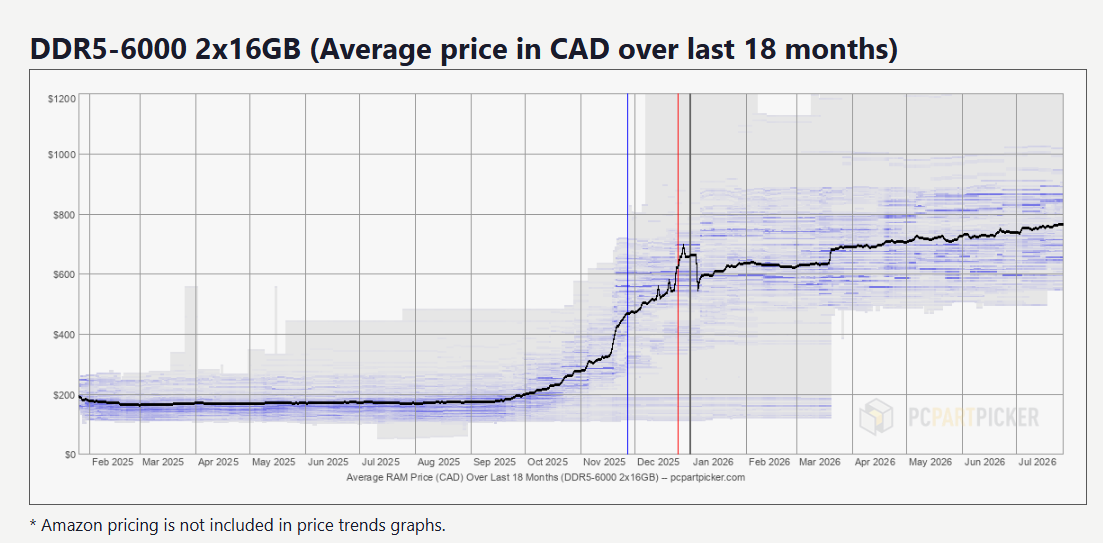
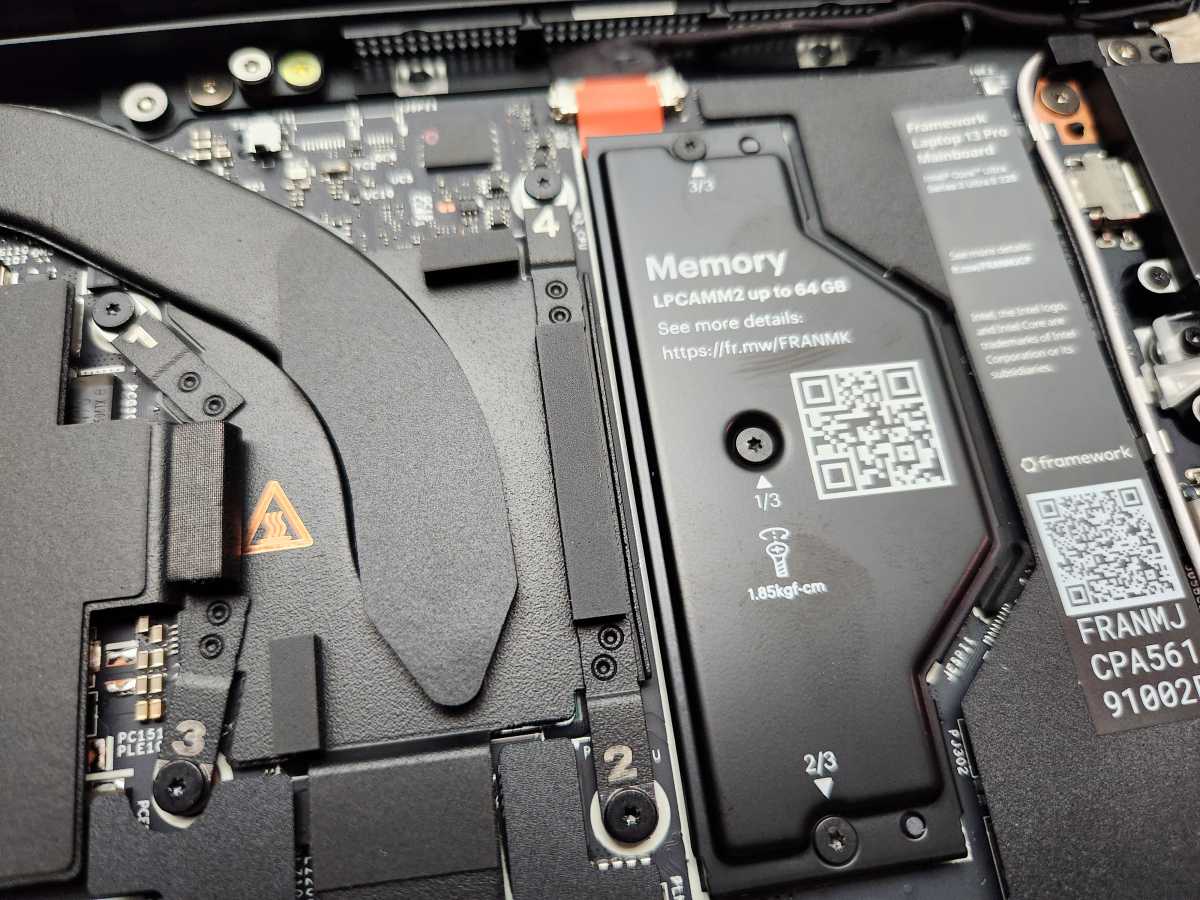
That’s for DDR4 and DDR5 RAM sold directly to consumers. RAM sold to giants like Dell and Lenovo won’t be quite that high — throwing billions of dollars around gets you a hell of a volume discount. But even these companies are struggling, with prices on laptops and desktops rising, and memory and storage dropping lower on base models. A good middle-of-the-road metric is Framework, which is barely above consumers in terms of market power, and is openly sharing its many supplier woes with its buyers. Valve, a big company but a small hardware player, is facing similar problems.
Here in late July, it doesn’t look like an expanded supply of DRAM is moving the market. We can charitably speculate that expanded DDR5 options, initially subsidized by investment from the Chinese government, are keeping the RAM crisis from becoming even worse. That would be true even if CXMT (and fellow domestic brand Yangtze Memory Technologies, YMCT) were only selling to the massive market for electronics in China alone. And as we’ve seen, CXMT has ambitions far beyond that.
On the manufacturing side, the memory market doesn’t move in individual months, or even seasons. The massive spike in prices we saw in late 2025 and early 2026 was a result of a combination of several factors: an unfortunate low point in the memory supply pipeline post-COVID, a sudden boom in data center construction planning for “AI,” and chip makers suddenly shifting production output to far more profitable HBM chips for those data centers.
So even if CXMT plans to stick to consumer-grade DRAM to satisfy massive current demand, leaving the data center customers to the Big Three, it could take a long time for that expanded supply to become evident in prices we can see on the shelves and on laptops.
Averting disaster
That leaves me with a maddening answer to my initial query: “We don’t know yet.” Again, more DRAM from a newly ascendant supplier can only be good in the current market. But the current market is so, so bad that it might only end up as a slightly less horrible disaster. The most optimistic guesses have the shortage lasting for another year or two. More doomful predictions say we’re looking at a decade of elevated prices and low supplies, reversing the trend towards more powerful, affordable hardware in the 21st century.
That’s assuming that the current “AI” boom holds and the bubble doesn’t burst, which is an entirely different discussion. Suffice it to say that CXMT won’t be bringing prices down on RAM or general PC hardware single-handedly anytime soon. But filling the supply almost abandoned by the more established memory manufacturers, focusing on the part of the industry that’s bleeding, might stop the collapse of the consumer PC market.
Mark Hachman / Foundry
That outlook could improve if other suppliers crop up in China and elsewhere. But even in the best-case scenario, where investors and/or subsidies were motivated to move quickly and not scared off by the risk of a supply glut on the other side, it would take multiple years to return us to the prices we enjoyed just one year ago.
Cool stuff from around the web
- The PlayStation Vita is now an Xbox: Modders got Sony’s second-gen handheld PlayStation, beloved by fans but flopped versus Nintendo, to play Xbox Game Pass streaming titles. It’s a pretty neat way to make the 2011 hardware relevant.
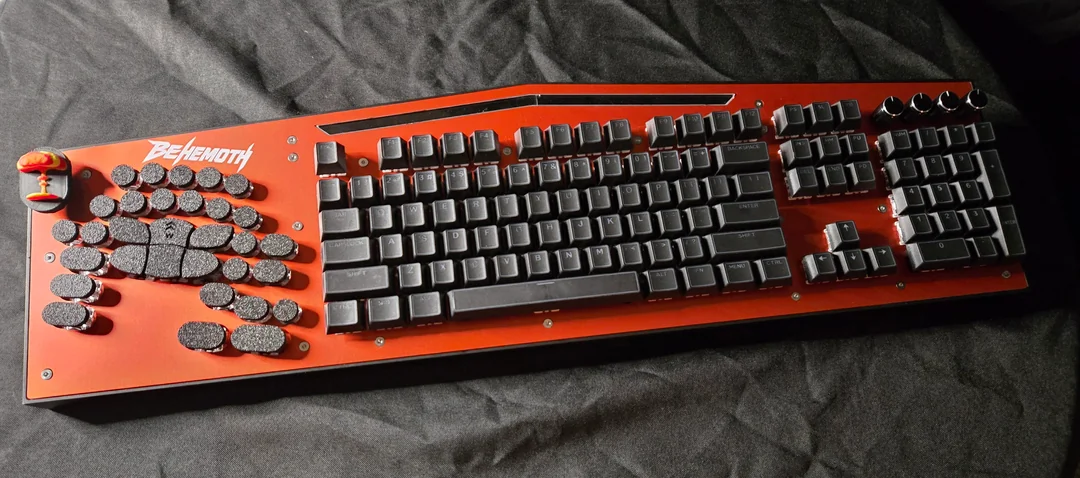
- This monster custom keyboard includes a full gaming pad: I love me some custom keyboards, and this one is right up my alley. The “Behemoth” custom mechanical design is basically a modern version of older designs from brands like Wolfking and Ideazon.
- Noctua has a mouse with a tiny fan in it: Noctua continues its co-branding spree, this time with a mouse from Pulsar with an itty-bitty 40mm fan inside. It’s for cooling your sweaty hands, not your mouse, complete with dedicated hardware controls.
- The Steam Machine is selling 15K a week: Valve has never been very open about its hardware sales, but a bit of knowledge on how the Steam sales chart works and a lot of math offers some guesses on how many it’s actually selling. If you like a good puzzle, check out the report from Boiling Steam.
- Lenovo’s new IPS, 280Hz monitor is just $100: If you’re on a super-tight budget but still have the need for speed, this 24-inch, 1080p monitor can hit blistering speeds for the same price as more typical “office” monitors. Right now it’s exclusive to China, where it’s 669 yuan, about $100 USD. Hopefully it spreads to more markets soon.
Game pick of the week: Denshattack!

Undercoders
There’s something pure and wonderful about a 90s-style X-treme sports game. Zone out, do tricks, listen to some great music, and just generally have a grand old time. Now do it all on a train. Sorry, let me be more specific: do it as a train. What?
Denshattack! is a lot of things. It’s a love letter to Jet Set Radio and other classic Japanese cel-shaded games, oozing with style and art. It’s a blistering assault on the senses, with a speeding rocket ride around post-climate-disaster cities as you grind on train rails and perform tricks. And it’s absolutely ridiculous, and it knows it.
Give this game a try if you love Tony Hawk and the later, 3D Sonic the Hedgehog games, and want to see what happens when they make an indie baby. It’s on Steam and Game Pass in early access.
That’s all for this week. To get my editorials, news picks, and game recommendations delivered straight to your inbox, you can sign up for Boost Mode on the PCWorld Newsletter hub. Check out The Full Nerd, Prompt Mode for “AI” tips, and Safe Mode to keep your PC and gadgets secure.


