At a glance
Expert’s Rating
Pros
- Class-leading battery life
- Slick build
- Colorful and accurate display
- Good port selection
Cons
- Dismal 3D performance
- Display isn’t very bright
- So-so performance for the money
Our Verdict
The Dell 14S isn’t a very exciting laptop, and it leaves a lot of performance on the table by opting for Intel Graphics in most configurations, but it’s a well-built machine with a quality display and exceptional battery life.
Price When Reviewed
This value will show the geolocated pricing text for product undefined
Best Pricing Today
Price When Reviewed
$1,469
Best Prices Today: Dell 14S
The Dell 14S is a new, understated productivity laptop from the manufacturer. It skips the ostentation of the XPS line and has a bit more in common with older Inspiron models, but it’s still built with premium materials and a clean aesthetic. It also aims for a more modest price point while still providing the hardware specs necessary for general office use, though the current market doesn’t quite allow the price to get very low.
Ultimately, it’s a fine machine with generally respectable qualities, though a few of those stand out beyond its exceptional battery life. All of this makes it more of a middle-of-the-road option while more exciting hardware, like the MSI Prestige Flip 14 AI+ or Acer Swift Edge 14 AI, can still stand out.
Dell 14S: Specs and features
- CPU: Intel Core Ultra 7 355
- Memory: 16GB LPDDR5x-7467
- Graphics/GPU: Intel Graphics
- Display: 14-inch 1920×1200 OLED touchscreen
- Storage: 512GB PCIe 4.0 SSD – Kioxia EG7
- Webcam: 2MP + IR
- Connectivity: 2x Thunderbolt 4 / USB-C with Power Delivery and DisplayPort 2.1, 2x USB 3.2 Gen 1, 1x HDMI 2.1, 1x 3.5mm combo audio
- Networking: WiFi 7, Bluetooth 6.0
- Biometrics: Windows Hello facial recognition
- Battery capacity: 69 watt-hours
- Dimensions: 12.35 x 8.82 x 0.61 inches
- Weight: 3.28 pounds
- MSRP: $1,469 as-tested ($1,269 base)
The Dell 14S comes with a few different configuration options. It starts at $1,269 with an Intel Core Ultra 5 322 processor, Intel Graphics, 16GB of memory, 512GB of storage, and a basic 1920×1200 LCD display. Our test unit upgrades the CPU to the Intel Core Ultra 7 355 and the display to an OLED touchscreen, raising the price to $1,469, though it was discounted to $1,199 during testing.
Dell also offers upgrades to the Intel Core Ultra X7 358H, Core Ultra 9 386H, 32GB of memory, Intel Arc graphics, and up to 1TB of storage. Only the Core Ultra X7 configuration gets Arc graphics, and it bumps the storage and memory up as well, raising the price considerably. Dell’s specifications also mention a 2560×1600 non-touch WVA panel with a 48-120Hz refresh rate, but it was not available at the time of this writing. The Dell 14S also comes in two colors: a dark Celestial Blue and a light Frost Blue.
Dell 14S: Design and build quality
Foundry / Mark Knapp
The Dell 14S offers a sleek and simple design. Its exterior is all aluminum with smooth edges, clean seams, and great rigidity to both the display and keyboard deck. It’s a solid machine, as it should be. At 3.28 pounds and 0.61 inches thick (plus a little extra height from its rubber feet), it’s not threatening the more extreme thin-and-light systems out there. Still, it’s readily portable at this size and weight.
The design keeps things quite plain. You won’t find false speaker grilles around the keyboard anywhere. The display hinge is a single bar that holds the screen firmly in place with minimal wiggle and flexibility to 180 degrees. The lid has no jutting bits for easier opening, but it’s easy to open all the same and the hinge is just loose enough that it doesn’t lift the base while you open the lid. The lid lacks a webcam shutter and there’s no toggle elsewhere on the system, so privacy-minded folks may be looking for a different solution.
The system sits on two rubber feet in the front and a wide one in the back. These hold it quite steady on desks and tables. A large grille underneath handles air intake, and hot air exhausts near the hinge. This system doesn’t have a lot of room for serious airflow or powerful cooling, though.
Dell 14S: Keyboard, trackpad
Foundry / Mark Knapp
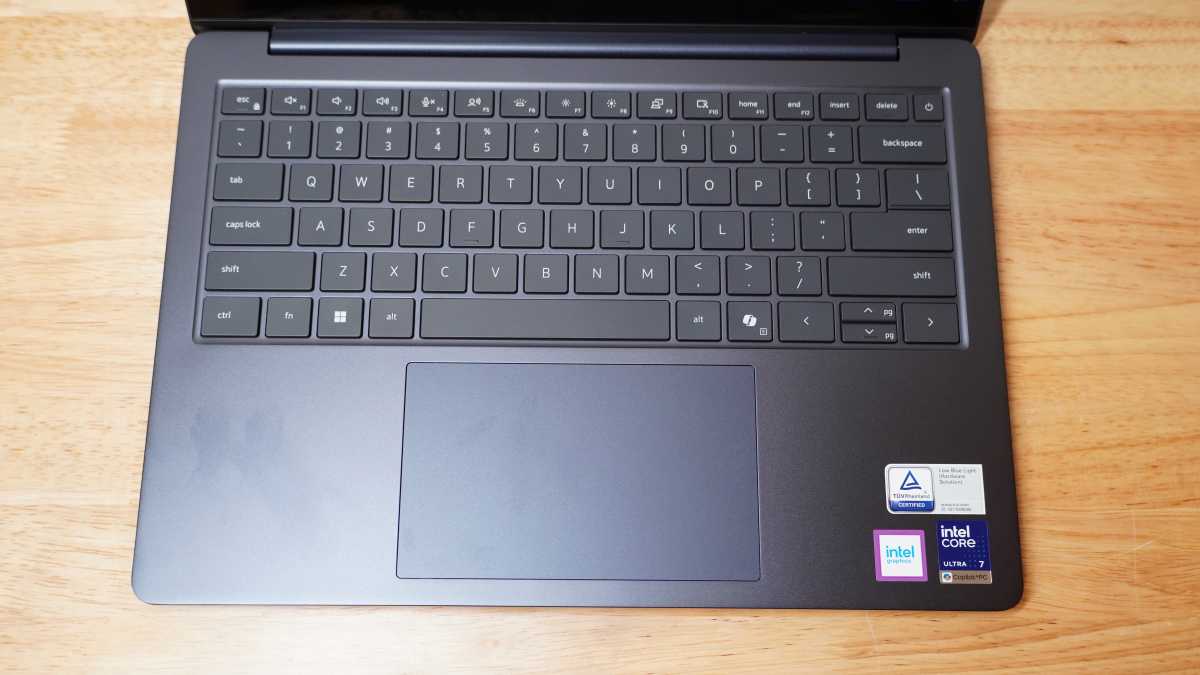
The keyboard on the Dell 14S continues to keep things fairly plain. It features largely square keycaps with virtually no contour and simple but effective white backlighting. Thankfully, there’s a bit of a gap between the keys. They’re well stabilized and they have a firm press, so they’re a little more predictable and easy to type on than earlier XPS laptops. I was able to get around 115 words per minute in Monkeytype with 97 percent accuracy. I found the lack of a dish and firm press kept me from my best speeds at high accuracy.
The trackpad is modest in size and has a smooth glass surface that’s pleasing to swipe around on. It has a mellow but distinct physical click that’s been reliable in testing. During testing, I didn’t run into any issues with palm rejection and the trackpad confines right-clicks to a small section in the bottom right of its surface, so accidental right-clicks were also rare for me.
Dell 14S: Display, audio
Foundry / Mark Knapp
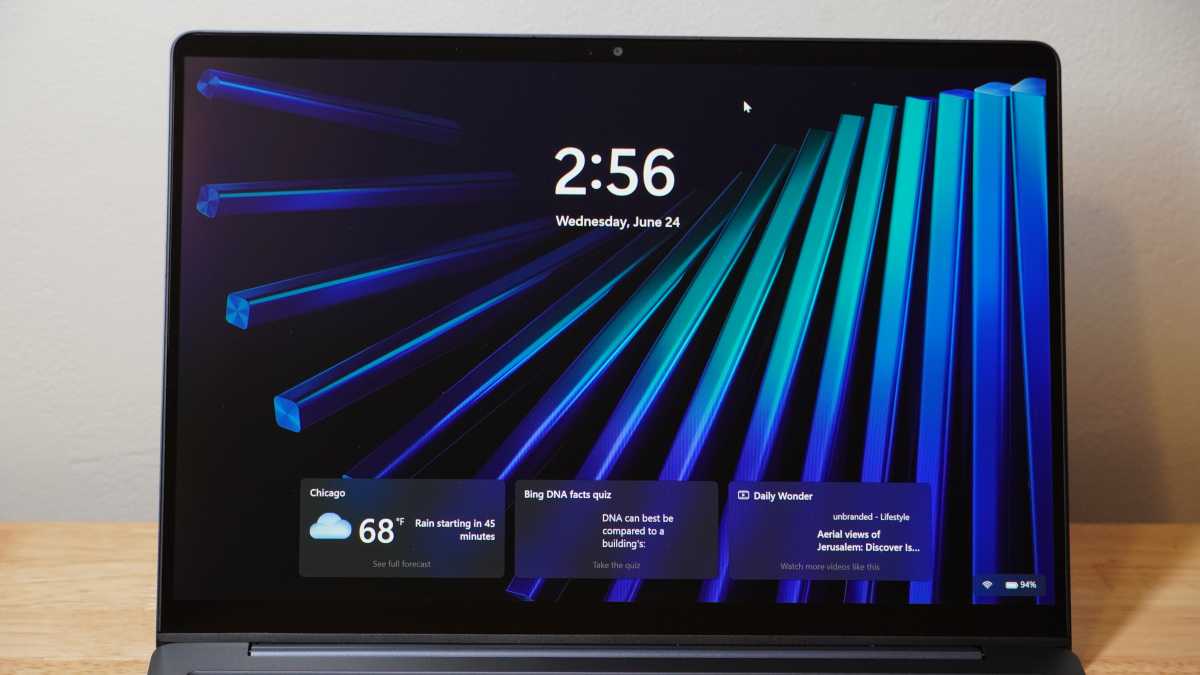
The display on the Dell 14S is decent. The OLED panel on our test unit is miles better than the base configuration would have offered. It achieves 100 percent coverage of the sRGB and DCI-P3 color spaces for vivid visuals while the base display was only offering 45 percent of NTSC (dramatically less). The display achieves infinite contrast and has a max dE1976 of 1.15 for simply stunning color accuracy. That’s where the stunning ends, though, as the screen only reaches a peak of 289 nits and is glossy, so it can struggle with glare.
The display also tops out at just 60Hz. Considering many systems, even more affordable ones, have offered 90 or even 120Hz displays for a while, the slow 60Hz panel feels a little dated. The 1920×1200 resolution is fine and reasonably crisp at this size at least.
The Dell 14S’s display is a touchscreen. This offers an effective and intuitive way to navigate. I found it quick and responsive. But the touch layer adds a gritty look to the display when looking closely.
The system combines two down-firing, two-watt speakers for good volume output and decent frequency range. The speakers don’t sound too thin thanks to just enough bass depth. At full volume, the speakers can distort a little, so best to run them a little below maximum for music. But for spoken content, the speakers work great. The placement of the speakers can interfere with sound output when using the laptop on your lap, though.
Dell 14S: Webcam, microphone, biometrics
The webcam on the Dell 14S is decent. It captures a fairly crisp 1080p with good, natural exposure. It can look a little grainy in anything but bright lighting conditions. I’ve seen far worse, though. The camera supports Windows Hello facial recognition as well, and it has been prompt to turn on at startup and login quickly.
The mic array on the Dell 14S proves itself quite capable. Even with some nearby fan noise, the mics focus in on my voice alone and capture it with impressive fullness and minimal compression. The mics even hold up in a busy café environment, cancelling out the hubbub while still picking my voice up intelligibly. The mics work to isolate my voice so thoroughly that I could even snap my fingers in front of my face while talking into them, and they’d still only capture my voice.
Dell 14S: Connectivity
Foundry / Mark Knapp
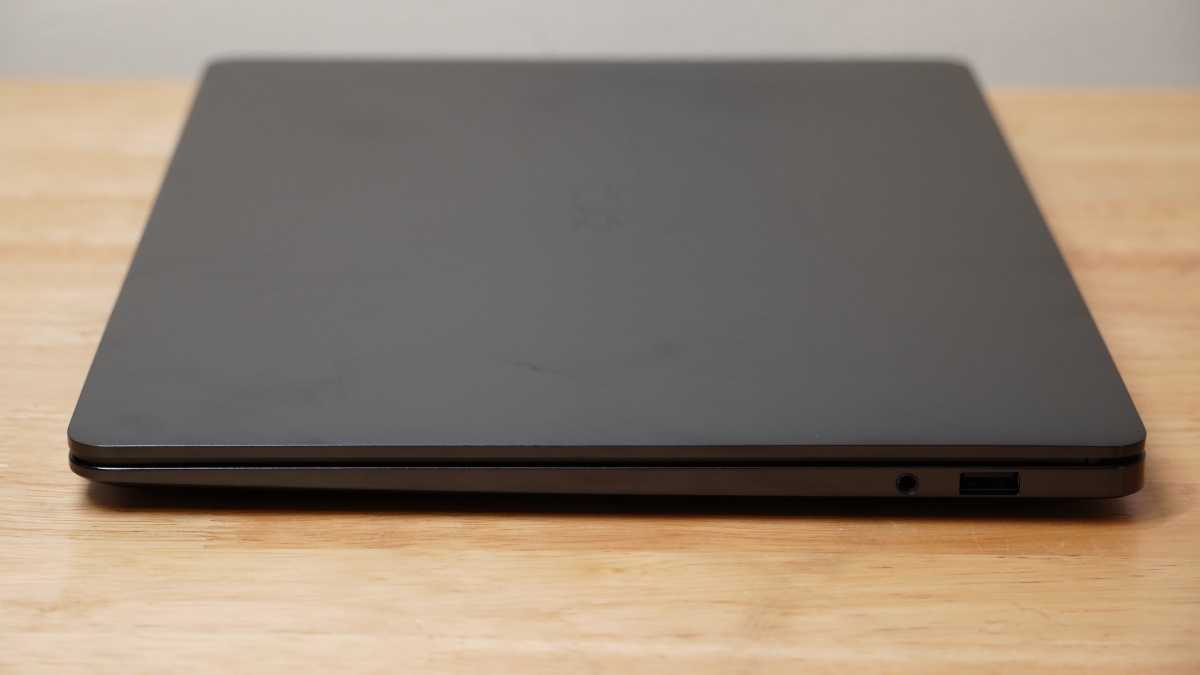
The Dell 14S supports a respectable range of connection options. You’ll find two Thunderbolt 4 ports on the left edge to handle heavy data transfer, power input, and display output. There’s also an HDMI 2.1 port nearby. Both sides get USB-A ports, but they top out at 5Gbps. Finally, the right edge includes a 3.5mm jack. This is about as robust as you’ll find from 14-inch laptops, with plenty opting for fewer ports.
The wireless connections are also solid with Wi-Fi 7 and Bluetooth 6.0. I was able to enjoy stable Wi-Fi while using the Dell 14S, and audio to Bluetooth headsets was clear and consistent. Even walking away from the laptop around a co-working space with plenty of RF interference, I was able to continue listening to music at a good distance with only some crackle when too many walls stood in the way.
Dell 14S: Performance
The Dell 14S isn’t geared up to be a high-performance machine, no matter what the “Ultra” in the processor name suggests. It has an eight-core CPU and four of those cores are Low Power Efficient-cores. This is still enough to see it keep up with everyday computing, though.
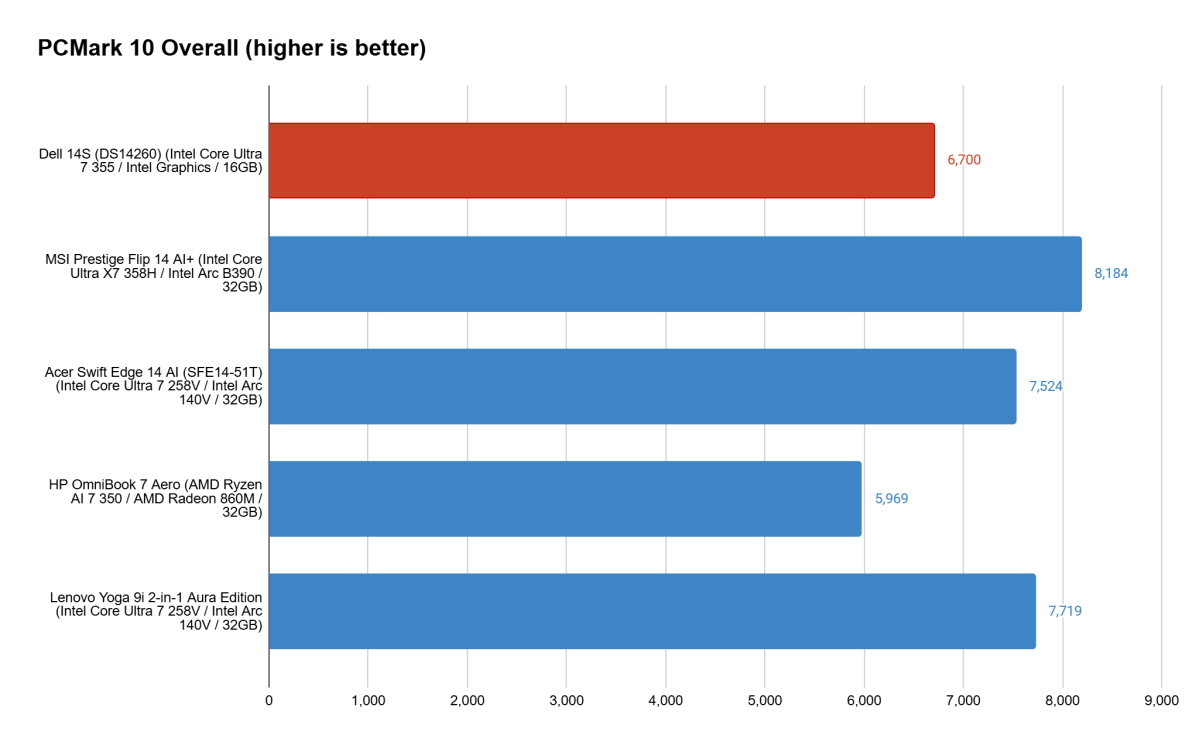
The Dell 14S earns a modest score in PCMark 10’s holistic system benchmark, which evaluates performance across a wide range of office tasks from browsing and video conferencing to image and video editing. The Dell 14S performs quite respectably in basic office tasks, but its inclusion of just basic Intel Graphics holds it back considerably in the digital content creation portion of the test, which sees its overall score sag.
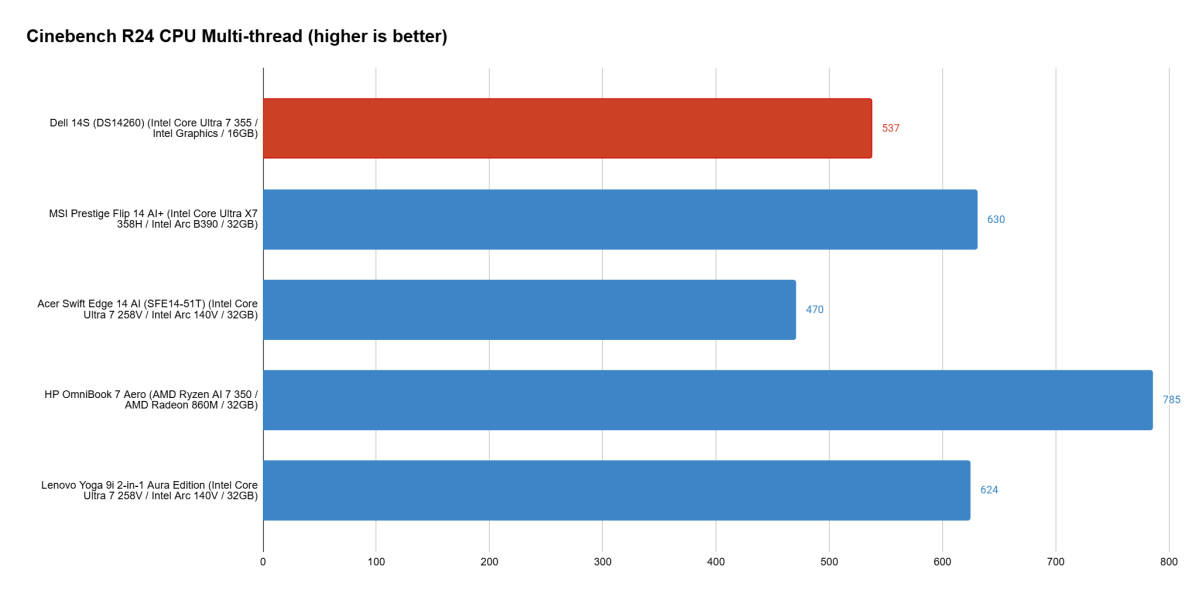
The CPU is decent, but not a powerhouse. It enjoy fast single-core performance thanks to its newer Intel architecture, helping it keep up with the other systems here and remain snappy in general use. But when hit with a heavy multi-core workload, it won’t dazzle. It falls behind the competition here, even against some prior-gen chips.
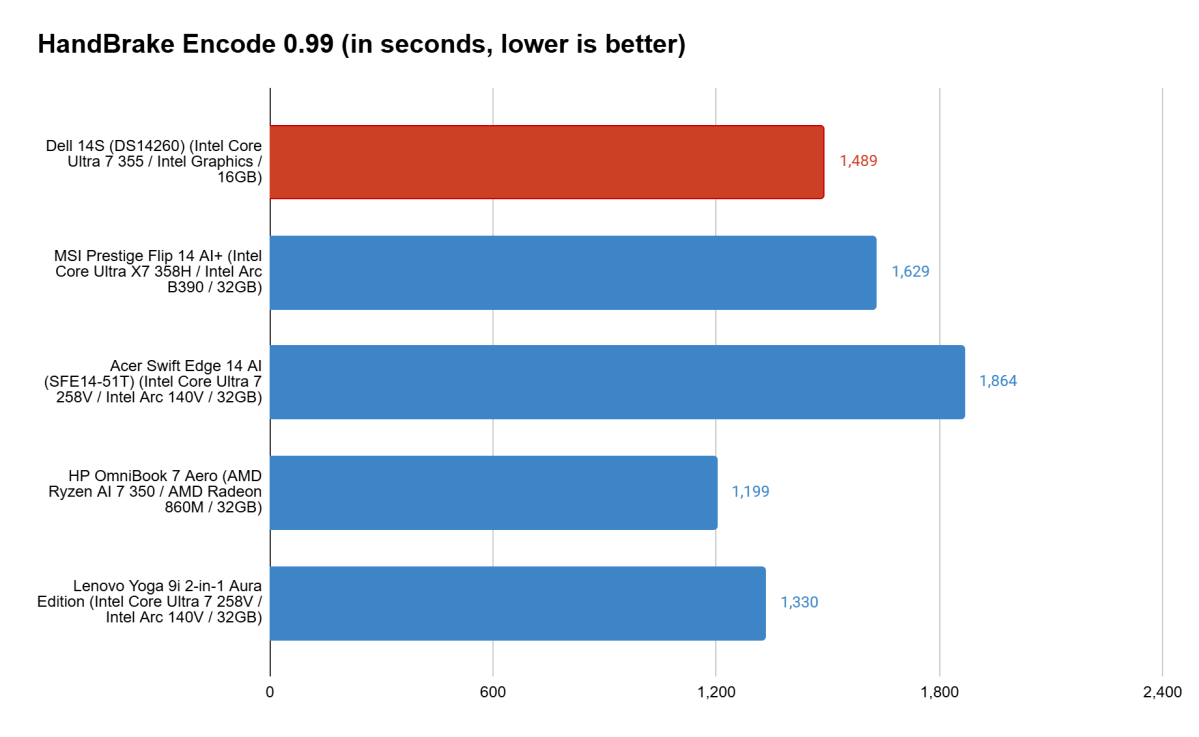
Though Dell has gone for a thin system, it seems to have done a good job with the cooling. In long, sustained workloads like our HandBrake test, which encodes a large video file into a lower resolution, the Dell 14S performed well next to its competition. Despite losing to the MSI Prestige Flip 14 AI+ in Cinebench, the Dell 14S pulled back ahead in this encoding test. It also came a lot closer to the Lenovo Yoga 9i 2-in-1 Aura Edition. Of course, this test again shows the advantages of an AMD-powered system for CPU horsepower.
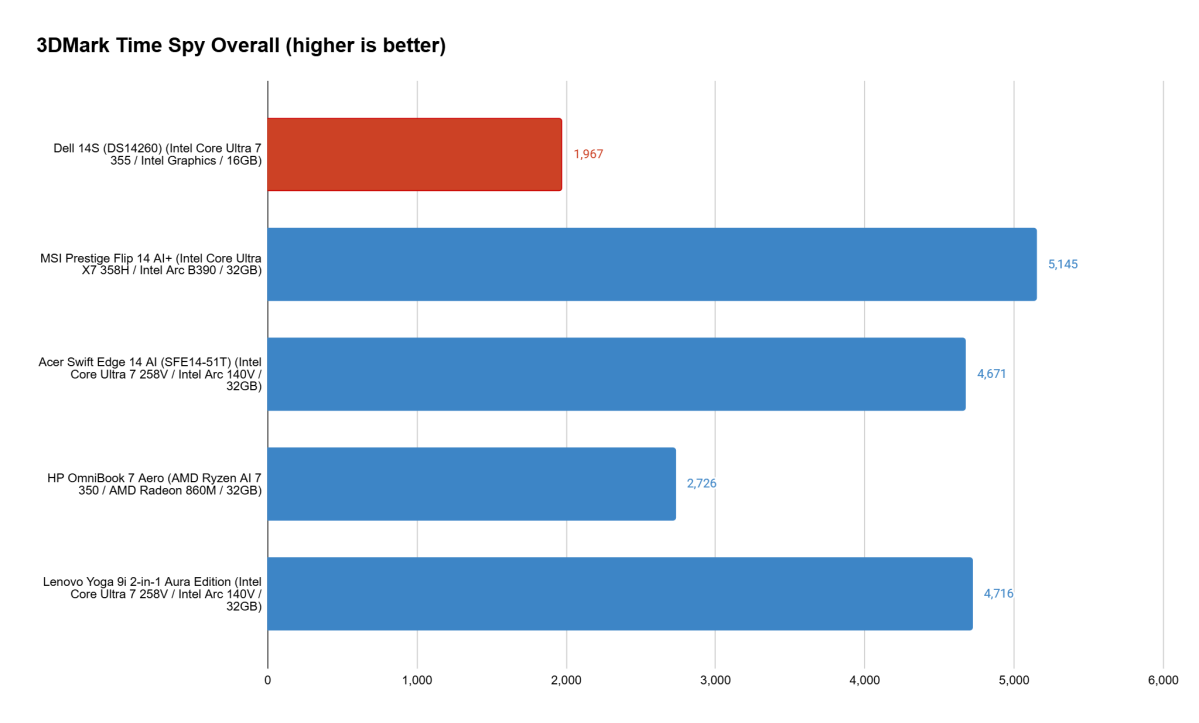
Shamefully, when turning back to 3D performance, the Dell 14S cedes all ground. In 3DMark graphical tests, the Dell 14S’s CPU performance remains modest and a ready rival to these other systems, but its GPU performance is a fraction of these other systems. The GPU consistently fails to even hit half the performance.
Dell 14S: Battery life
The Dell 14S may have made some concessions with the resolution and refresh rate of its display and its overall performance, but it makes up for those a good bit when looking at its battery life. In our offline 4K video playback test, which runs a local copy of Tears of Steel on loop with the display brightness set to 250 nits, the Dell 14S lasted nearly 36 hours, letting it leap past by the recent record-setting MSI Prestige Flip 14 AI+ by over an hour even while wielding a smaller battery. In a space where breaking 20 hours is still a rare feat, breaking 35 is wild.
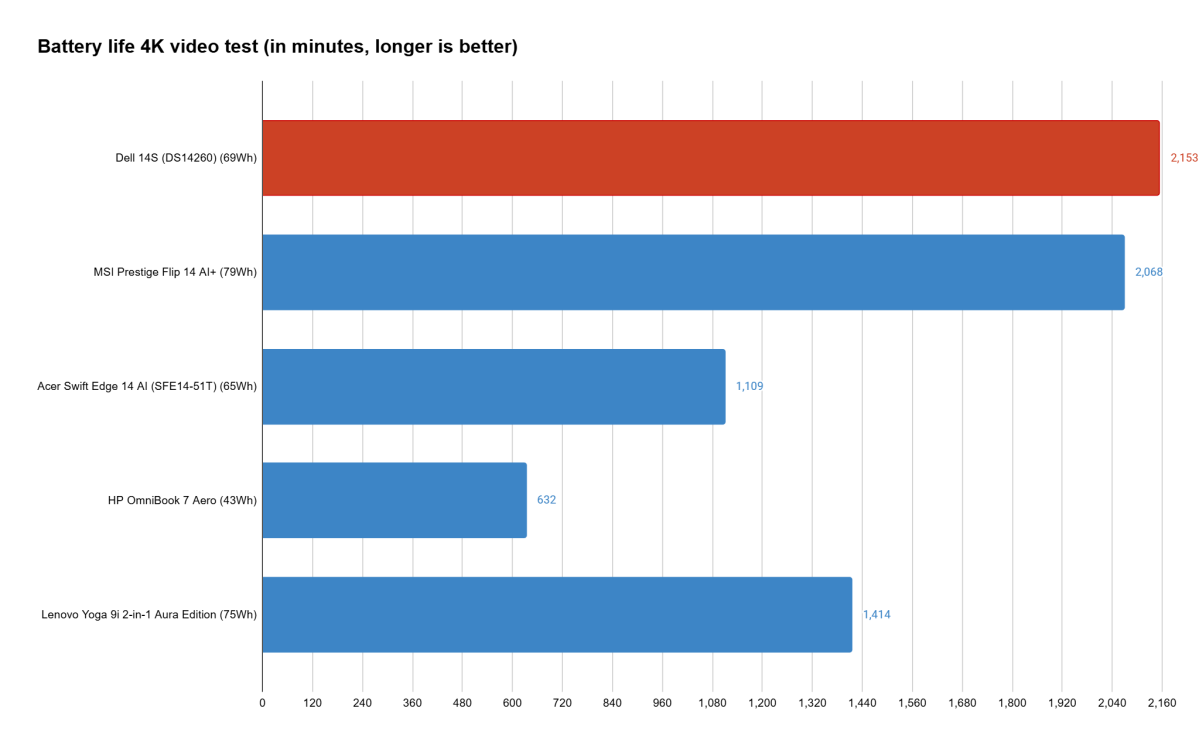
Actual runtime using the laptop for work will vary considerably from that test, though. In my regular office use with Chrome and at least a dozen tabs open, a Bluetooth headset connected, and music streaming, I tended to be on track for about 10 hours of runtime.
The system also ran PCMark 10’s built-in battery benchmark with the same 250-nit whitepoint and Wi-Fi on for 21:59, again beating the class-leading MSI Prestige Flip 14 AI+’s 18:14, though when battery saver engages for the last 30 percent of its charge, the Dell 14S display’s brightness drops to 67 percent, which is only 117 nits.
Dell 14S: Conclusion
The Dell 14S is a decent, middle-of-the-pack machine. It doesn’t offer exceptional performance or an eye-catching design, but its modesty doesn’t hurt it much either. It still packs a lovely display, even if it could stand to be brighter. The performance could be faster, but generally keeps up with everyday office duties and browsing. And the design is plenty portable while still offering ample cooling to the hardware.
Most impressively, the Dell 14S runs efficiently, offering the longest battery life I’ve seen in offline video playback, even if actual office runtimes fall back into the realm of reason with closer to 10 hours of uptime. If all you’re after is simple quality, the Dell 14S fits the bill, but I’d be much more inclined to get the similarly priced MSI Prestige Flip 14 AI+ thanks to its extra memory, storage, graphics performance, flexibility, and lighter design or the Acer Swift Edge 14 AI for its display alone.


