At a glance
Expert’s Rating
Pros
- ProLeap climbing system helps it clear barriers that strand many robot vacuums
- Strong vacuuming and mopping performance
- Automatic mop removal is genuinely useful for rugs and carpeted areas
- Excellent navigation and obstacle avoidance
Cons
- Expensive
- Large dock requires dedicated floor space
- App can feel dense
- Best feature is less useful in homes with mostly flat floors
Our Verdict
The Dreame L60 Pro Ultra is a pricey but highly capable robot vacuum whose ProLeap climbing system makes it especially worthwhile for homes where floor barriers routinely interrupt automated cleaning.
Price When Reviewed
This value will show the geolocated pricing text for product undefined
Best Pricing Today
Price When Reviewed
$1,399.99
Best Prices Today: Dreame L60 Pro Ultra
For all the advances robot vacuums have made over the last few years, many still get tripped up by ordinary household barriers: a raised sliding-door track, a thick bathroom threshold, or an uneven transition between hardwood and tile. One moment they’re cleaning, the next they’re stranded with a wheel spinning in the air.
The L60 Pro Ultra aims to solve that problem with Dreame’s ProLeap system, a pair of retractable robotic legs that lift the vacuum over obstacles that commonly stop robot vacuums.
That capability alone wouldn’t justify the L60 Pro Ultra’s $1,399.99 price. Dreame also includes the expected flagship features: strong suction, spinning mop pads, hot-water mop washing, AI-assisted obstacle detection, and a dock that handles much of the daily maintenance. But ProLeap is the feature that most clearly sets it apart.
Dreame L60 Pro Ultra: Design and features
The L60 Pro Ultra pairs a 13.78 x 13.78 x 3.50-inch robot vacuum with a 13.39 x 17.95 x 23.23-inch multifunction dock that handles automated dust collection, clean- and dirty-water storage, mop washing and drying, and water refills.
The Dreame L60 Pro Ultra uses a retractable LiDAR turret to lower its profile when cleaning under furniture.
IDG/Foundry
The Pro Ultra’s defining feature is its ProLeap system, which is rated to cross thresholds up to 3.47 inches in a two-step configuration. For a single-step obstacle, the listed maximum is 1.77 inches. Instead of repeatedly bumping into these obstacles and rerouting around them, the robot raises itself and climbs over.
It also uses a retractable LiDAR turret to reduce its height when necessary. In open areas, the sensor rises for 360-degree mapping. When the robot approaches low furniture, the sensor lowers automatically so the vacuum can slip into spaces as low as 3.5 inches.
Obstacle detection is handled through a mix of sensors, including an AI-assisted RGB camera, dual structured-light sensors, and built-in LED illumination for dark rooms. The system is designed to identify more than 280 objects, including common household hazards such as cables, socks, shoes, and pet bowls.
The cleaning hardware is similarly high-end. The L60 Pro Ultra is rated at 35,000Pa of suction power, backed by a 300ml onboard dust box and a 3.2L dust bag in the base station. It uses dual brush rollers made of rubber and bristle designed to resist hair tangles, while an extendable side brush swings outward up to 1.58 inches to reach corners and baseboards.
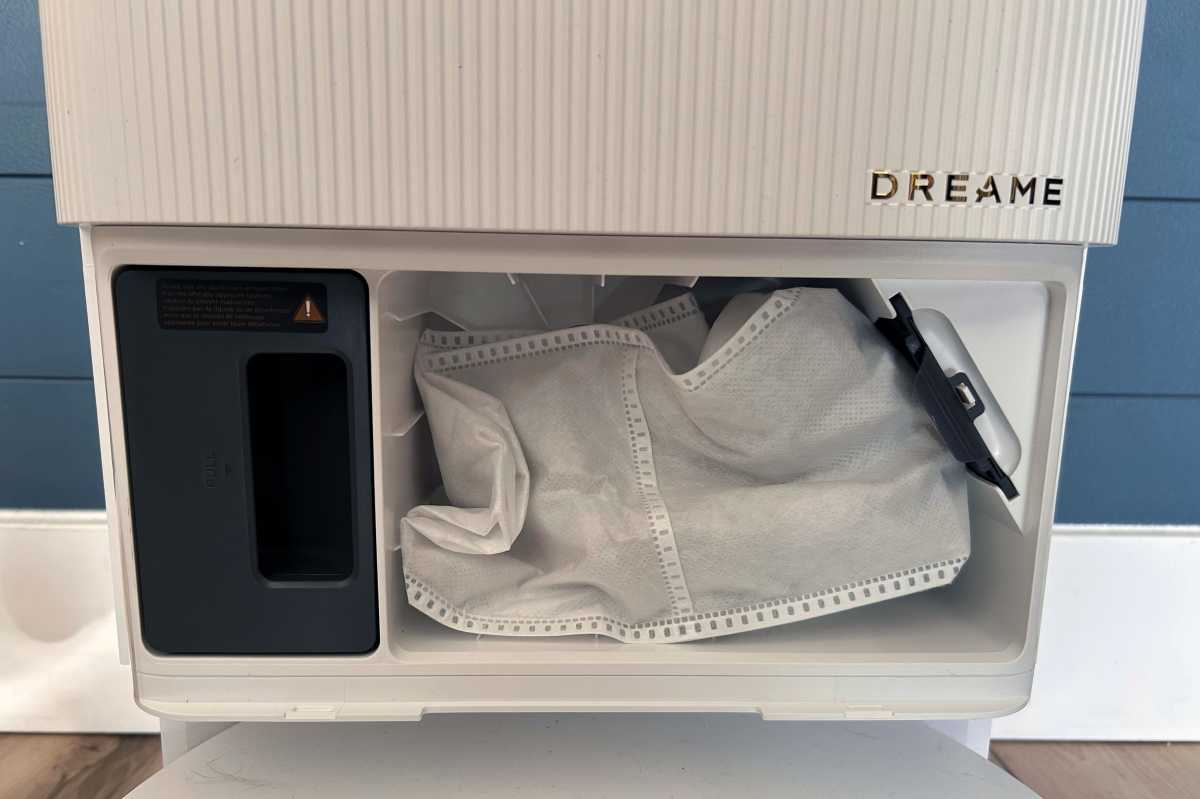
The dock’s disposable dust bag holds debris collected during automatic emptying.
Michael Ansaldo/Foundry
The mop system takes a similar approach. Dreame’s MopExtend RoboSwing feature pushes the spinning mop pads outward so they can clean closer to walls and around furniture legs instead of leaving the thin strip of floor many robot mops still miss.
The mopping system is also built for automation. The robot can lift its mop pads 0.41 inches when crossing low-pile carpets, and it supports automatic mop removal and carpet avoidance depending on how you want it to handle rugs. During mopping, the pads spin at 165 rpm, and their temperature can peak at 104 degrees shortly after hot-water washing.
The dock handles most of the mop maintenance automatically. It washes the pads with water heated up to 212 degrees F, dries them with hot air, refills the robot’s water tank, and adds cleaning solution during cleaning. The clean- and dirty-water tanks hold 4.5L and 4.0L, respectively, which helps explain the dock’s size. The goal is to reduce the daily upkeep that still makes many robot mop systems feel semi-automated rather than truly hands-off.
Dreame L60 Pro Ultra: Setup and performance
Setup is straightforward, and the Dreamehome app walks you through every step. After plugging in the dock, you’ll need to attach its ramp extension plate, insert the cleaning solution cartridge, fill the clean-water tank, attach the mop pads, and connect the robot to your Wi-Fi. The app currently requires a 2.4GHz network.
Once connected, the app prompted me to install a firmware update and perform an initial fast-mapping run. The process took only a few minutes and produced an accurate floor plan of my home, marking obstacles the robot identified with icons for objects such as cords, shoes, and other potential hazards.
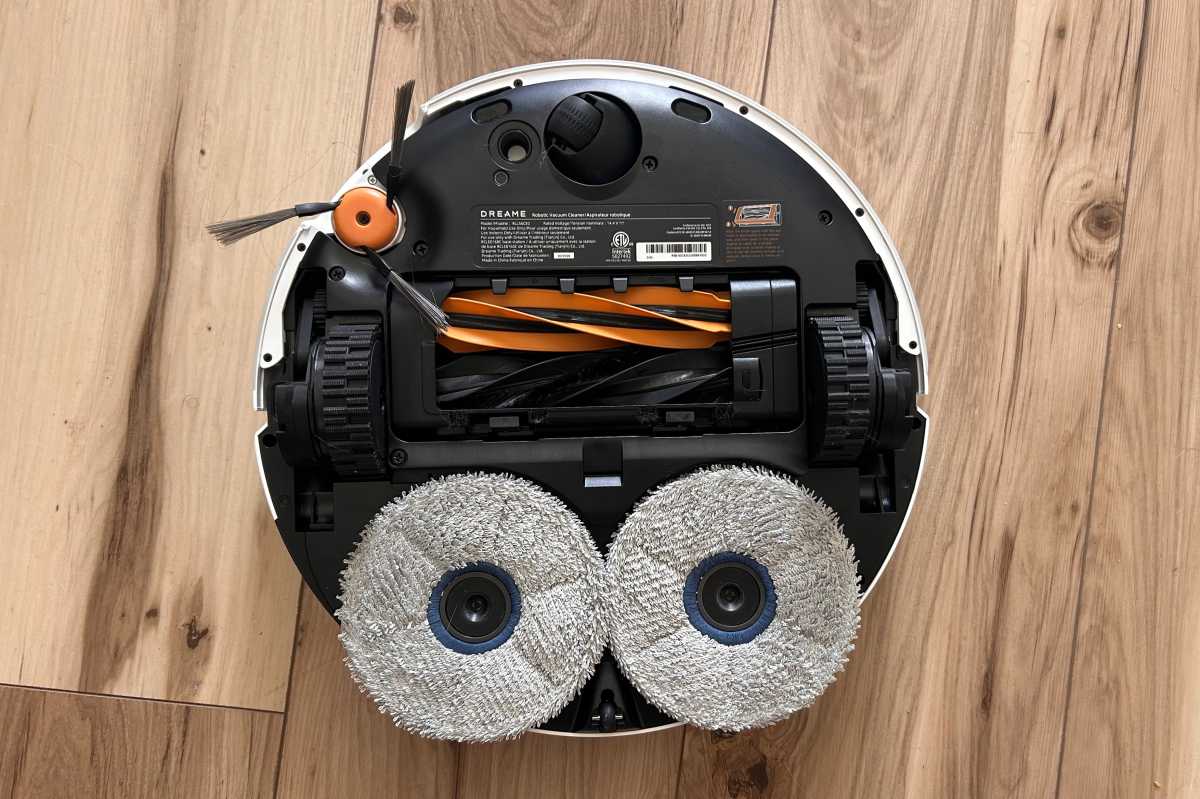
The underside of the L60 Pro Ultra includes dual brush rollers, an extendable side brush, and two spinning mop pads.
Michael Ansaldo/Foundry
The Dreamehome app gives you several ways to tailor cleaning. You can choose dedicated Vacuum, Mop, Vac & Mop, or Mop after Vac modes, then adjust settings within each one. Vacuuming options include Quiet, Standard, Intense, and Max suction levels, plus a separate Max Suction Power toggle for one-time deep-cleaning runs when the robot is fully charged. Mopping options include adjustable mop wetness, mop-washing frequency, and Quick, Standard, Intensive, and Deep route settings.
On hard floors and carpet, the L60 Pro Ultra collected dust, pet hair, food crumbs, cereal, and dry pet food in my testing. Automatic mop removal was particularly useful. Mop pads on hybrid robot vacuums often catch on the edge of my living room area rug and get pulled off during vacuuming. The L60 Pro Ultra avoided that by leaving the pads behind before vacuuming runs. The extendable side brush also helped improve pickup along walls and in corners, areas where robot vacuums often struggle. And even with three cats at home, I never had to cut tangled hair from the dual-brush rollers.
The L60 Pro Ultra also handled mopping well. Its spinning mop pads removed dried spills and everyday kitchen grime with little trouble, though deeper dirt and sticky messes required more aggressive settings. In my jelly test, the robot needed a higher mop wetness level and a more intensive route to fully remove the residue. The extending mop mechanism reached noticeably closer to baseboards and furniture legs than fixed-position designs. Carpet detection worked reliably, with the robot lifting its mop pads when crossing rugs to avoid soaking them.
The robot’s climbing ability is the rare premium feature that can dramatically change how well and reliably a robot vacuum cleans.
With two teens in my house, the cleaning paths on my floors are rarely unobstructed, but they were no match for the Pro Ultra’s navigation system. The robot consistently avoided the shoes, socks, backpacks, and other household clutter while still cleaning close enough around them to maintain good coverage. Its retractable LiDAR turret also helped it clean under furniture that would normally block robot vacuums equipped with a fixed turret. With the sensor lowered, it was able to reach those areas without becoming disoriented or losing its position on the map.
ProLeap’s usefulness depends on your floor plan. In a home with mostly flat flooring and standard transitions, it may rarely be needed. But when the L60 Pro Ultra encounters raised thresholds, sliding-door tracks, and uneven transitions, it pauses, lifts the front of its chassis, rocks forward, and pulls itself over instead of backing away or rerouting. The motion is a little ungainly and adds some noise, but it worked reliably throughout testing and the robot never tipped, stalled, or appeared at risk of getting stuck.
The dock made the L60 Pro Ultra feel closer to hands-off than many hybrid robot vacuums I’ve tested. After cleaning runs, it emptied the dustbin, washed and dried the mop pads, and refilled the robot’s water tank without any extra input from me. It doesn’t eliminate maintenance entirely, though. You’ll still need to empty the dirty-water tank regularly to prevent odors, periodically refill the clean-water tank, replace consumables, and wipe down the dock. Even so, those chores came up far less often than they would with a less automated system, which made the L60 Pro Ultra easier to live with day to day.
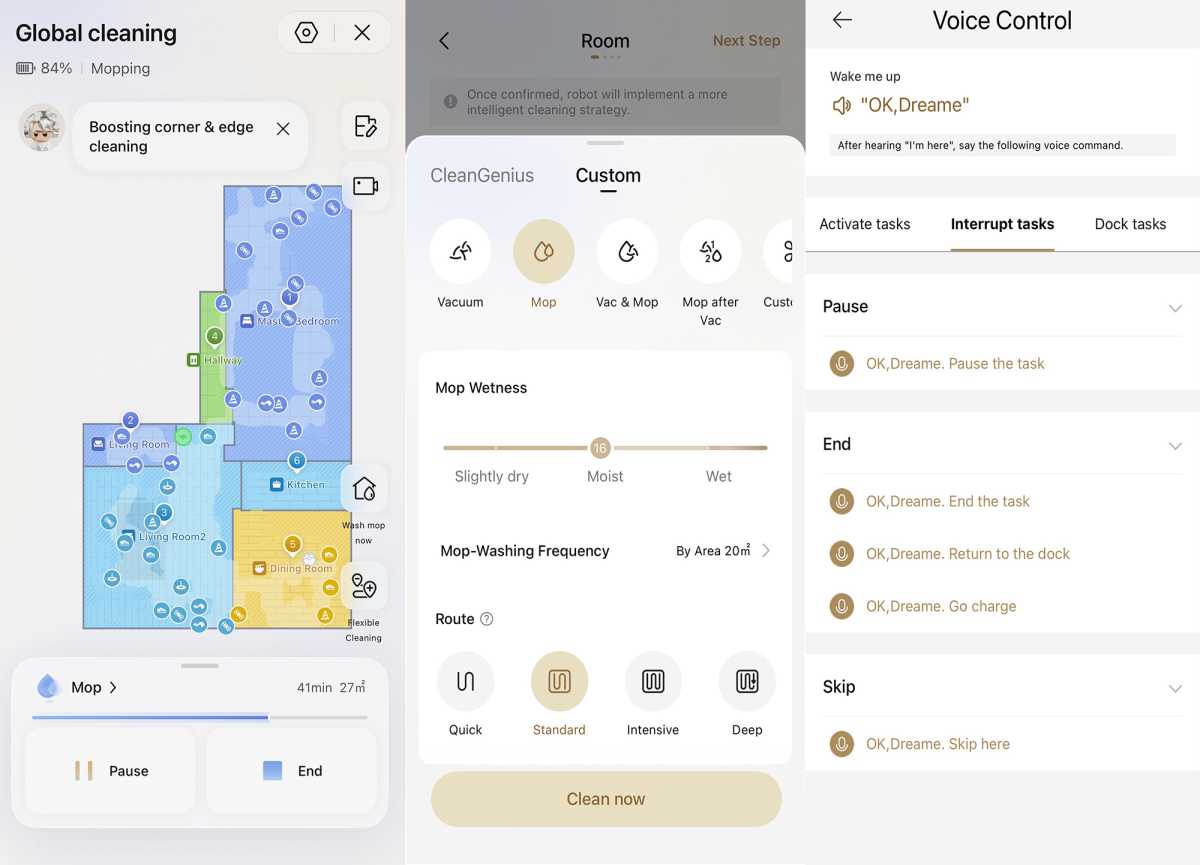
The Dreamehome app provides a live cleaning map, detailed mopping controls, and onboard voice-command options.
Michael Ansaldo/Foundry
The Dreamehome app is generally intuitive, but dense. Beyond basic scheduling, room selection, and map editing, it gives you granular control over cleaning behavior, including suction strength, mop wetness, route intensity, edge cleaning, pet settings, and sleep-mode routines. There’s also a Scenes tab for simple automations such as return-home, exit-home, and scheduled sleep-mode changes. That depth is useful if you like fine-tuning a robot vacuum, though it can feel like a lot at first.
The robot also has an onboard voice assistant that responds to “OK, Dreame.” The app lists commands such as “OK, Dreame, pause the task,” “OK, Dreame, return to the dock,” “OK, Dreame, go charge,” and “OK, Dreame, skip here.” I found myself using the app far more often than voice control, but the built-in assistant is useful when your hands are full or your phone isn’t nearby.
Should you buy the Dreame L60 Pro Ultra?
The Dreame L60 Pro Ultra is a premium robot vacuum with a premium price, and its value depends largely on whether ProLeap solves a real problem in your home.
If you have sliding-door tracks, uneven room transitions, or other barriers that regularly impede robot vacuums, it’s easy to recommend. The robot’s climbing ability is the rare premium feature that can dramatically change how well and reliably a robot vacuum cleans.
It’s harder to justify for homes with mostly flat floors and standard transitions. In that case, a less expensive hybrid robot vacuum can likely deliver a similar day-to-day cleaning experience.

