At a glance
Expert’s Rating
Pros
- Fast 80Gbps performance
- Four NVMe slots
- RAID 0, 1, 4, 5, and 10
- Built solid as a tank
Cons
- RAID is software only
- Only 20Gbps performance for individual drives
- Minor fan noise
Our Verdict
Run in RAID 0, the 4M2 Ultra is capable of over 7GBps reads. Good stuff for this handsome, 4-bay 80Gbps NVMe enclosure..
Price When Reviewed
This value will show the geolocated pricing text for product undefined
Best Pricing Today
Price When Reviewed
$449.99 (case only; no SoftRaid software)
Best Prices Today: OWC 4M2 Ultra 80Gbps 4-disk RAID enclosure
OWC’s 80Gbps 4M2 Ultra is a four-slot RAID enclosure that lets you build your own high-capacity, super-fast external storage using NVMe SSDs.
Depending on the RAID mode you use, you can saturate the 80Gbps Thunderbolt 5/USB4 bus to the tune of 7GBps sequential transfers. You can also safeguard your data with mirroring or parity, which a single external SSD enclosure won’t allow.
What are the OWC 4M2 Ultra’s features?
The 4M2 Ultra is a black, mostly aluminum box measuring around 4.75-inches tall, 4.5.inches deep, by 2.35-inches wide. Unlike the 40Gbps 4M2, the sides are finned to create more heat-shedding surface area. Nice. On the back are two Thunderbolt 5 ports (one marked as the computer port), a Kensington lock port, and the AC adapter jack…
You didn’t think you could run four SSDs on bus power alone, did you? Well, being curious and considering that Thunderbolt 5 is required to deliver 140 watts (240 watts optionally) I pulled the power jack with the 4M2 Ultra attached to my M4 Max Studio. No blue power light. Sigh.
I was a bit surprised to see the 4M2 Ultra open like a flower when I removed the screw-down backplate. The backplate holds the two side plates (keyed for reattachment) in place, so both fell to the side, revealing two 2280/2242 M.2 slots under each.
Thermal strips are pre-attached to the side plates, which is thoughtful, though mine didn’t have any protection on them. Before I realized that, I’d minimally damaged one by stacking one side plate on the other. Easily repairable, so no big deal.
The 4M2 Ultra’s dual PC board, chips and fan are sandwiched between the two dual-drive bays. The front of the 4M2 Ultra is perforated to allow air flow through the unit to the vents on back.
You can hear the fan when it kicks in. It’s not loud, but if such things bug you, you’ve been informed. I find the sound reassuring in that the 4M2 Ultra isn’t allowing your SSDs to fry.
The Intel JHL9480 (Barlow Ridge) controller allocates each of the 4M2 Ultra’s M.2 slots a single PCIe 4.0 lane, which amounts to around 2GBps of bandwidth per slot. Hence, while you could run the four SSDs singly, you’ll only get 80Gbps (or 40Gbps) performance with all four drives combined in RAID 0 (fastest) or RAID 10 (next fastest).
To operate the Express 4M2 Ultra in RAID, you need software. OWC provides a license for its handy cross-platform SoftRAID, though the inlcuded Pro license expires three years from the date of purchase. However, the core functions (operation and rebuilding arrays) remain eternally functional.
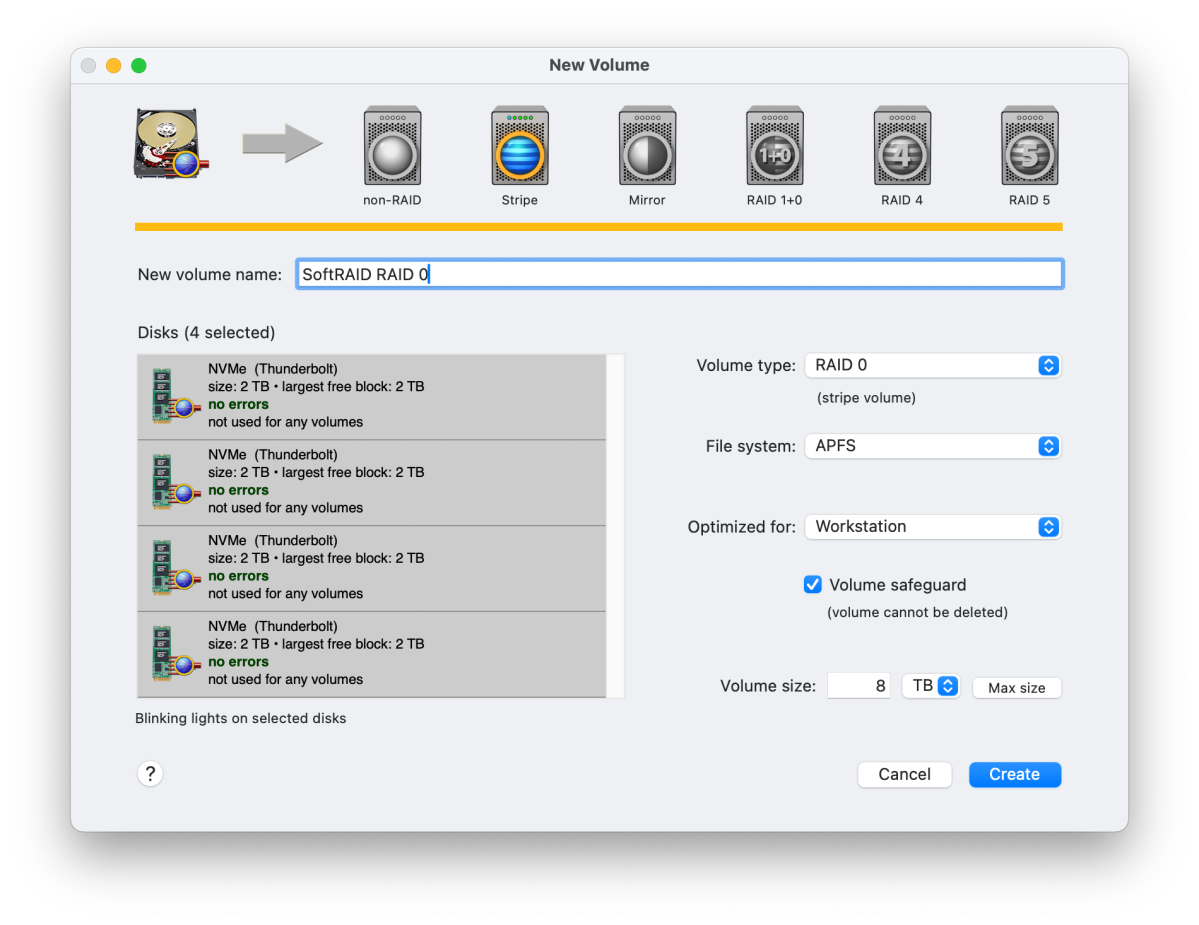
If expiring software makes you nervous, there’s always macOS RAID or Windows Storage Spaces. Sadly, Windows Storage Spaces is pathetically slow, but macOS RAID 0 was competitive with SoftRAID
The 4M2 Ultra is warrantied for two years, however, given the quality of the construction it should last well beyond that.
How fast is the 4M2 Ultra?
When running four SSDs in RAID 0, the 80Gbps 4M2 Ultra is a very fast reader, up to 7GBps (Windows). It’s a considerably slower writing at a little over 2GBps according to most of our tests.
The 4M2 Ultra is also significantly faster in every RAID mode than the older 40Gbps 4M2 — hardly surprising given twice the older unit’s 40Gbps bandwidth. Note that all RAID tests were done while using OWC’s SoftRAID in RAID 0.
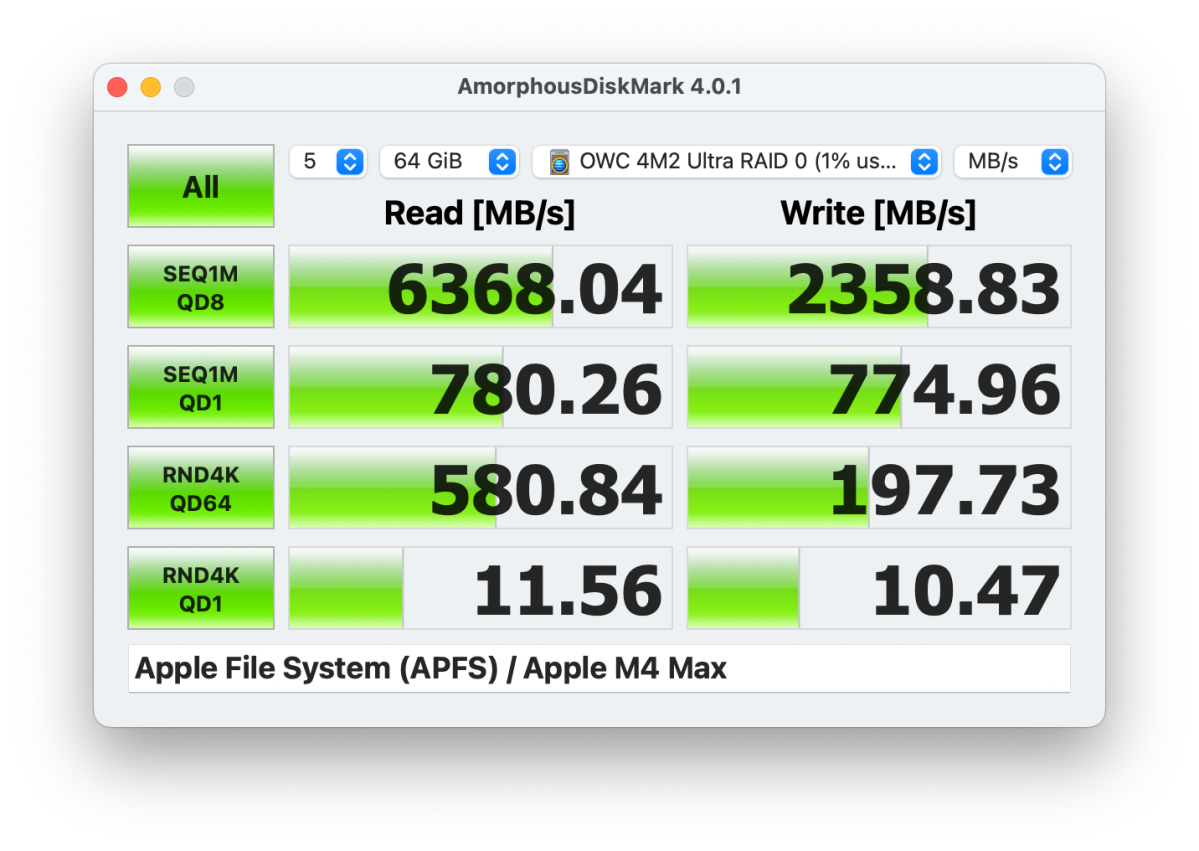
AmorphousDiskMark had the 4M2 Ultra at 6.35GBps reading, and 2.35GBps writing.
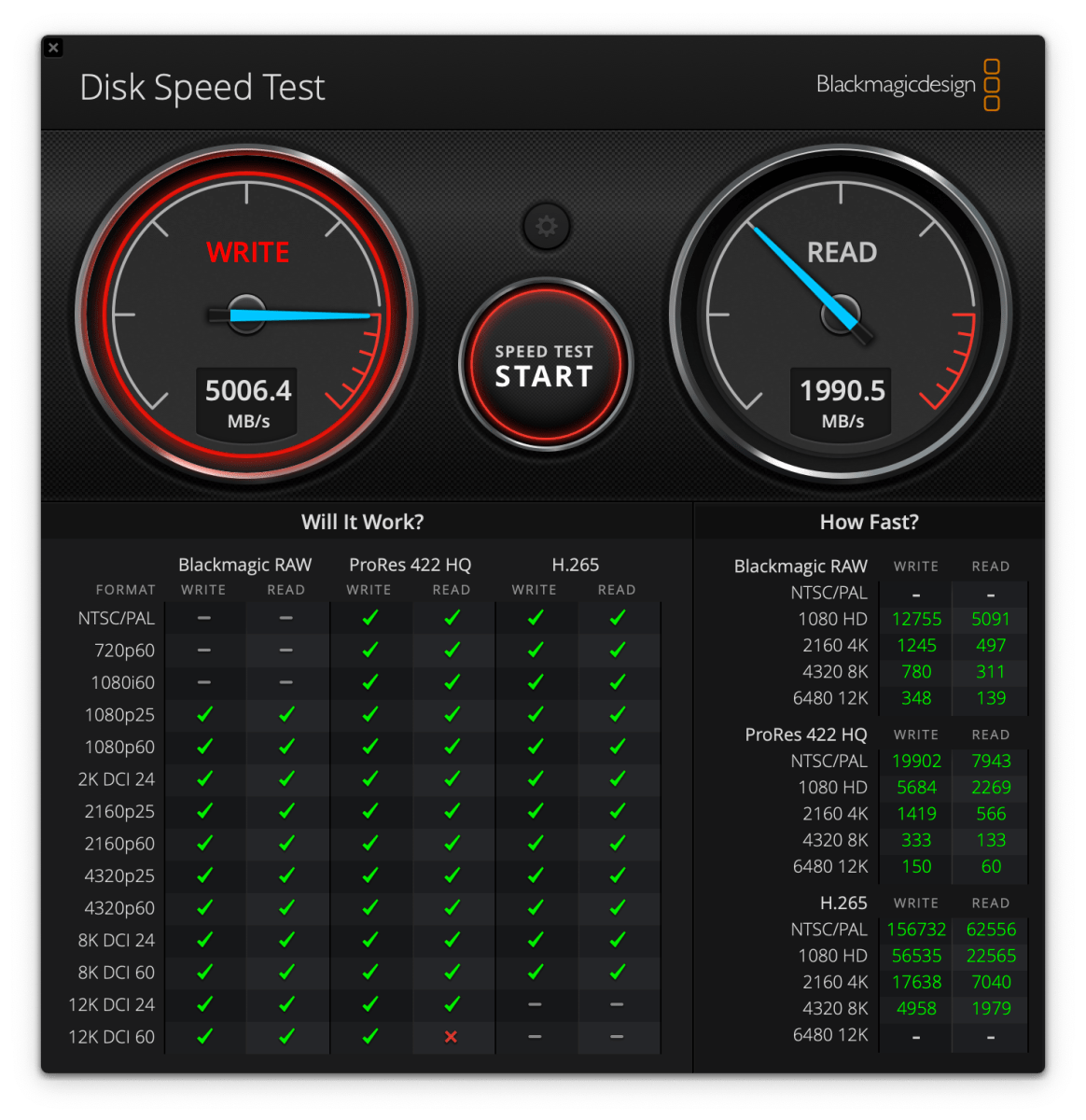
Disk Speed Test from Blackmagicdesign wasn’t quite as giddy as AmorphousDiskMark, and for some reason, likely a much smaller data set, showed 5GBps writing and only 2GBps reading.
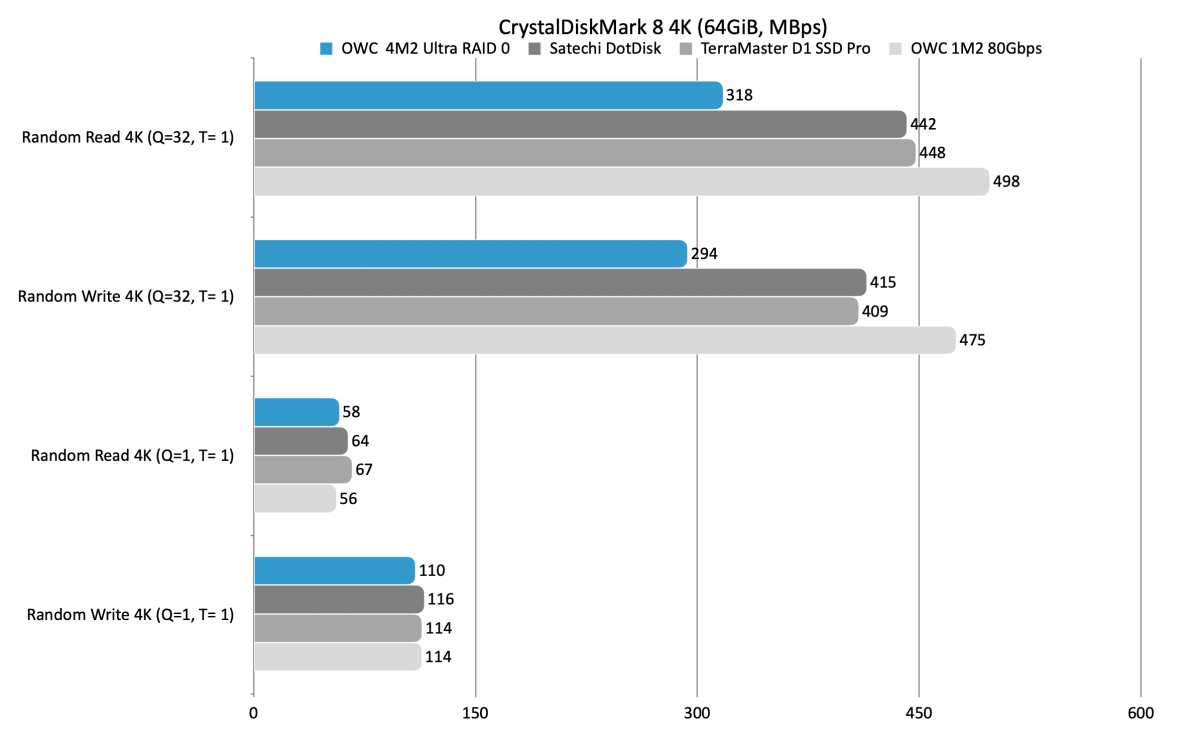
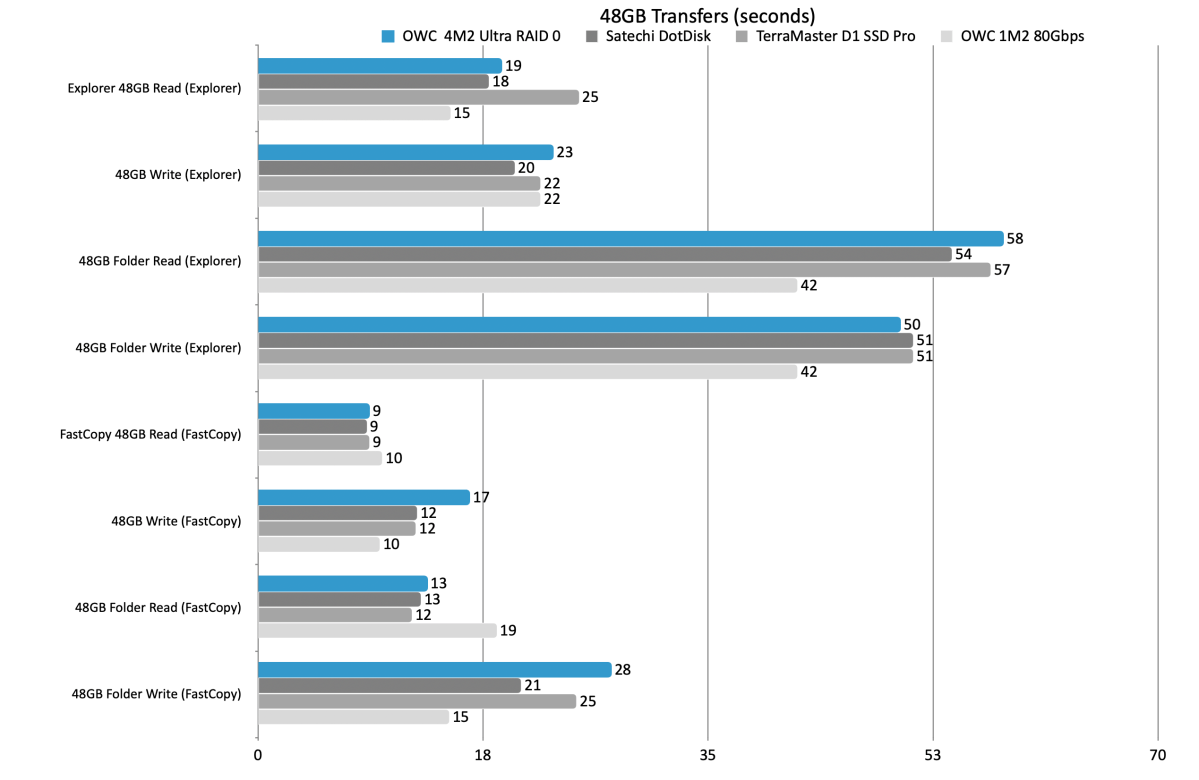
I also ran the 4M2 Ultra through PCWorld’s battery of tests for comparison purposes. However, the other drives shown: the Satechi DotDisk, TerraMaster D1 SSD Pro, and OWC’s own 1M2 are 80Gbps single drive enclosures, which makes these comparisons a tad unfair. But the charts do show what you stand to gain or lose by going the RAID route.
The 4M2 Ultra did well in some CrystalDiskMark 8 (the code base for AmorphousDiskMark) tests, while in others, not so much. And with four SSDs to stripe writes across, the 4M2 Ultra’s write performance is a tad disappointing.
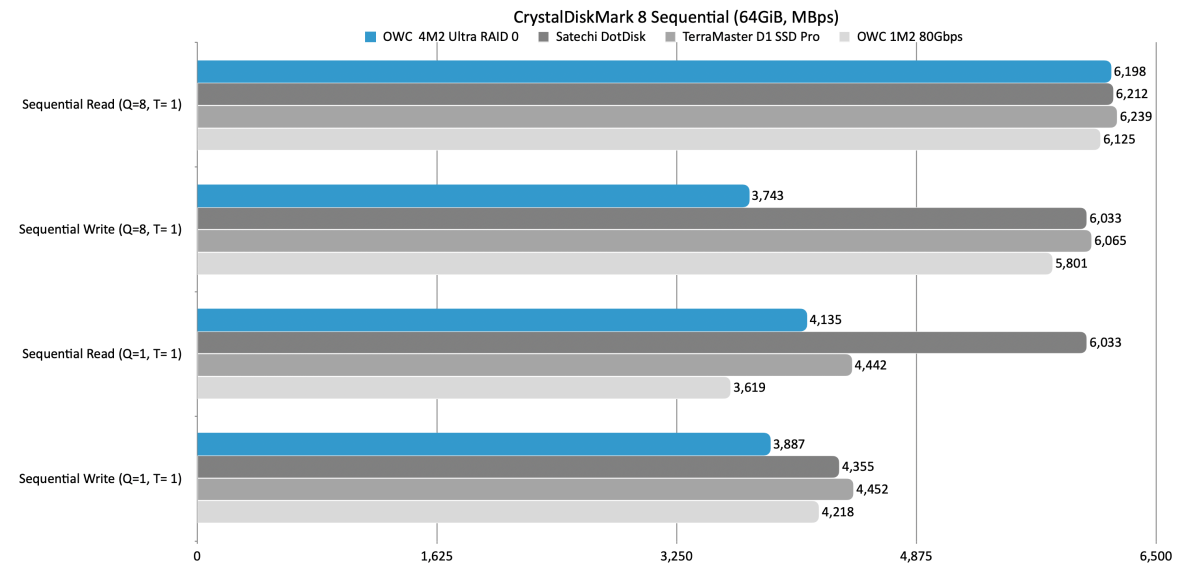
The 4M2 Ultra lagged a bit in CrystalDiskMark 8’s 4K tests, but it’s still fast in the grand scheme of external storage.
In PCWorld’s real life 48GB transfers, the 4M2 Ultra was quite close to the competition, and even tied for first in one test.
PCWorld’s 450GB write test proved the 4M2 Ultra to be a very fast solution when transferring very large files using Windows Explorer, but didn’t perk up, as is usually the case, with the fantastic FastCopy utility.
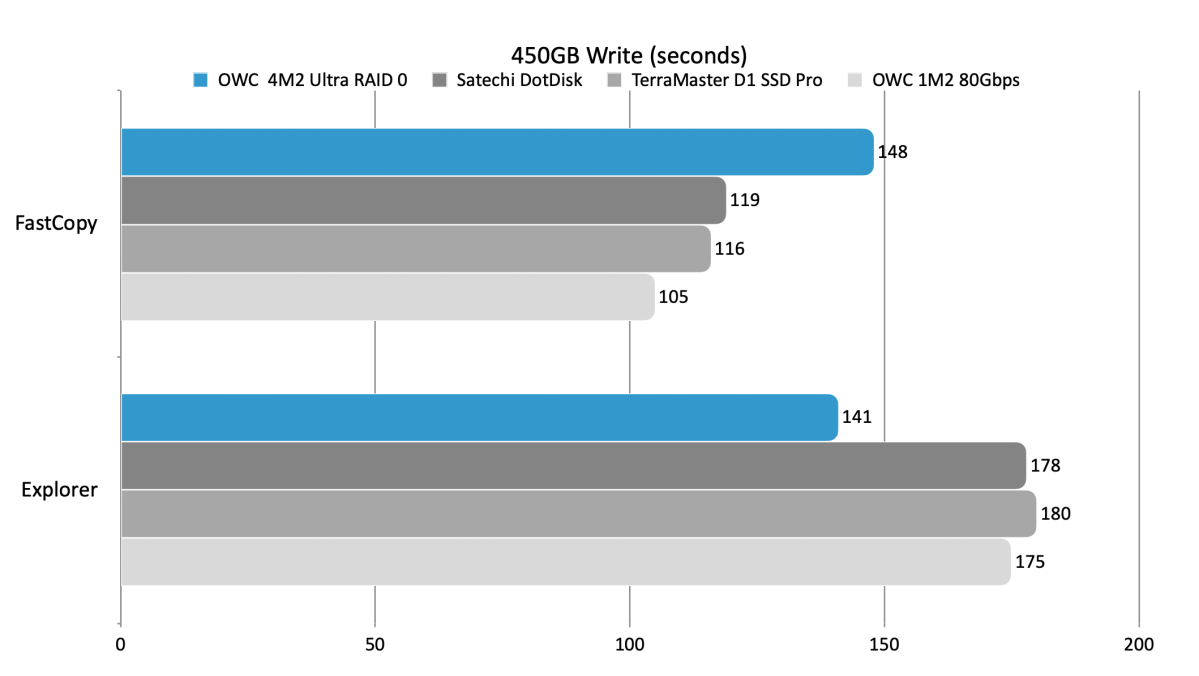
All told, the 4M2 Ultra is fast, and a great improvement over the older 40Gbps 4M2. However, it’s not as fast as single enclosures, so its most salient strength is combining smaller SSDs into a single large volume, up to 32TB with 8TB SSDs.
Note that while testing, it was discovered that Phison E26 controllers apparently require more power than my M4 Max Studio can provide under heavy loads at 80Gbps (10Gbps and 40Gbps are fine). Using these in the 4M2 Ultra was a rocky experience–they would disconnect under load. This did not occur with the 4M2 Ultra on PCWorld’s Wintel test beds. If you’re a Wintel user who has E26 SSDs, you’re safe. Have an 80Gbps Mac? Avoid them.
Should I buy the 4M2 Ultra?
If you want fast, super vast external storage, the 80Gbps 4M2 is a great way to create speedy large volumes from smaller SSDs. Just avoid E26-based SSDs.


