At a glance
Expert’s Rating
Pros
- Supports both M.2 and E.1S NVMe SSDs
- Excellent throughput via Ethernet (10Gbps) and Thunderbolt (20Gbps)
- Unique semi-retro look
- Myriad NAS/server software features
Our Verdict
If you’re looking for fast, versatile workgroup storage, the highly capable TBS-h574TX deserves close scrutiny. It can be accessed directly via Thunderbolt or remotely via the network and offers all the software capabilities NAS/server boxes bring to the table.
Price When Reviewed
This value will show the geolocated pricing text for product undefined
Best Pricing Today
Price When Reviewed
$1,449 without SSDs
Best Prices Today: QNAP TBS-h574TX Thunderbolt SSD NAS
$1449
QNAP’s combo NAS/DAS (Network/Direct) attached TBS-h574TX storage box gives you the best of both worlds. It allows any number of users to connect to it over the local network at 10Gbps (or 2.5Gbps) and leverage it as shared storage or employ the myriad NAS/server apps and capabilities. But you can also attach it to your Mac’s Thunderbolt port for twice-as-fast 20Gbps (network bridge) local access to the data on board. Sweet.
The TBS-h574TX is a somewhat retro-looking, squat rectangle of a NAS (network-attached storage)/direct-attached box measuring 2.36 inches thick, 8.46 inches wide, by 7.83 inches deep. It’s a most substantial piece of metal-based kit, weighing in at just a hair under 5 pounds. With the no-slip feet, there’s little chance of knocking this puppy off the desk. Just the same, make sure all cables are secured at some point before they reach the box. I’ve seen more instances of tripping on wires, pulling hardware off its perch, than actual displacement of the equipment itself.
There are five bays with easy-access drive trays on board that accept state-of-the-art E.1S (see the explanation below) or M.2 (4.5mm heatsinks or thinner) NVMe SSDs. You can access the bays/tray from the front of the TBS-h574TX after removing the locking, pop-off, top half of the front cover.
The SSD slots are PCIe 3.0, though you may use PCIe 4.0 or 5.0 SSDs, which are, of course, backwards compatible. I recommend PCIe 4.0 as PCIe 3.0 SSDs are becoming pricey and hard to come by, and PCIe 5.0 is expensive overkill.
Along with the convenient Type-C Thunderbolt port on the face are another 10Gbps Type-A port, quick copy and power buttons, as well as power and activity indicator lamps.
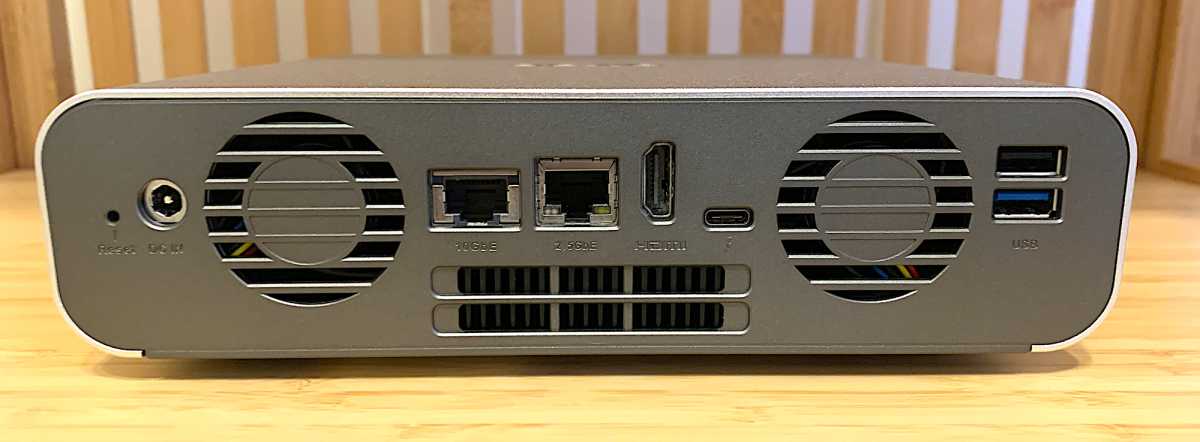
The Thunderbolt port on the back is PC/Mac connect-only, so you can’t use external devices or peripherals with it. Also on the back are 2.5Gbe and 10Gbe ports, a 10Gbps Type-A USB and 5Gbps Type-A port, as well as HDMI output. Then of course, there’s the coax power port.
Note that you do not need to shut down the TBS-h574TX just to swap out a bad drive. If you use a suitable RAID mode (1, 1+0, 5, etc.) the array will remain available and rebuild in the background. Remember that when you configure the storage in any RAID-capable device.
As a fully functional NAS box/server, the TBS-h574TX we tested sported a 4.5Ghz, Core i5-1340PE (12 cores, 16 threads) and 16GB of DRAM, plus 5GB of NAND for basic functionality before you install the full operating system. Note that this differed from the a 4.4GHz Core i5-1235U CPU listed on the product page.
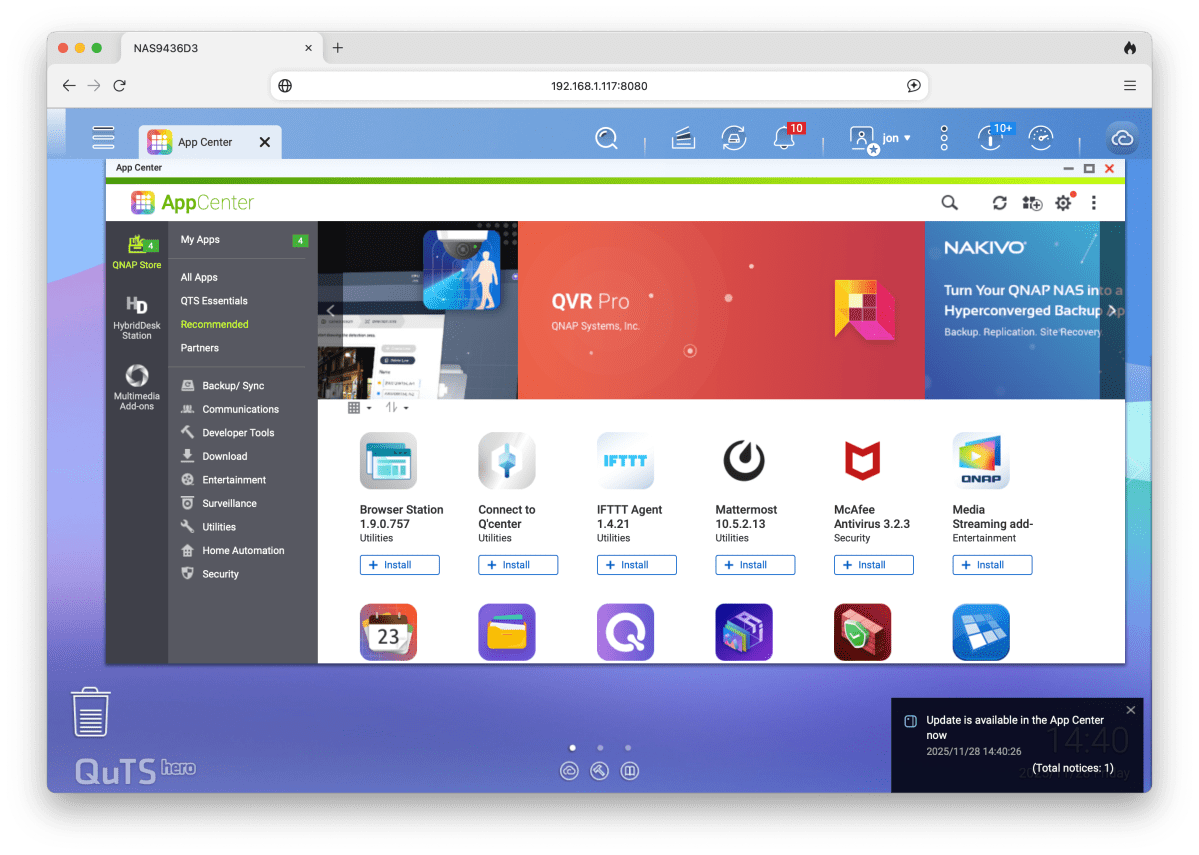
If you’re not familiar with NAS and wonder “Why a CPU?”… The TBS-h574TX’s capabilities go far beyond simple storage. QNAP’s full-on QuTS hero OS, née (QTS NAS OS) and apps let it serve as a multimedia server, multimedia playback unit (via HDMI), a backup engine, virtual machine and docker host, surveillance station, and a lot more.
I’ve used QNAP NAS boxes for years, and the backup capabilities (both local and cloud) are outstanding. Note that surveillance requires purchasing more licenses if you have more than one IP cam.
What are EDSFF and E.1S?
EDSFF stands for Enterprise and Data center SSD Form Factor and covers several sizes of thermally enhanced designs. E.1S is the smallest, meant for SMB and end-user devices. E.1S is 33.5mm wide, 118.75mm long, and from 9mm to 25mm thick. The connector is the same M.2 you’ll find on consumer NVMe SSDs, hence the interchangeability.
Better heat-shedding is the main thrust of EDSFF. That’s to handle the heavier loads that many enterprise storage devices experience, warding off any thermal throttling that might occur with less robust thermal designs.
How much does the QNAP TBS-h574TX cost?
The unpopulated (no SSDs) Core i5 version of the box that I tested runs a rather hefty $1,500 (£3,299 in the U.K.). There’s a Core i3 version available for $1,200. Those prices are considerably higher than the average consumer NAS box. QNAP itself markets 2-bay models for less than $200, and 5-bay (3.5-inch) models for less than $700 that offer the same OS and software, if not hardware features.
However, given five E.1S-compatible SSD bays, Thunderbolt connectivity, and very powerful CPUs, we’re not sweating the TBS-h574TX’s cost. It’s worth it if you have the need.
Just remember that you’ll need to populate the box. With normal M.2 SSDs, that could be well under $1,000. E.1S could get very expensive–several thousand dollars expensive. In fact, the one 7.6TB Kioxia XD7P model we found at CDW was over $7000. CDW is a high-quality service, not a bargain basement outfit, but yowser!
How fast is the QNAP TBS-h574TX?
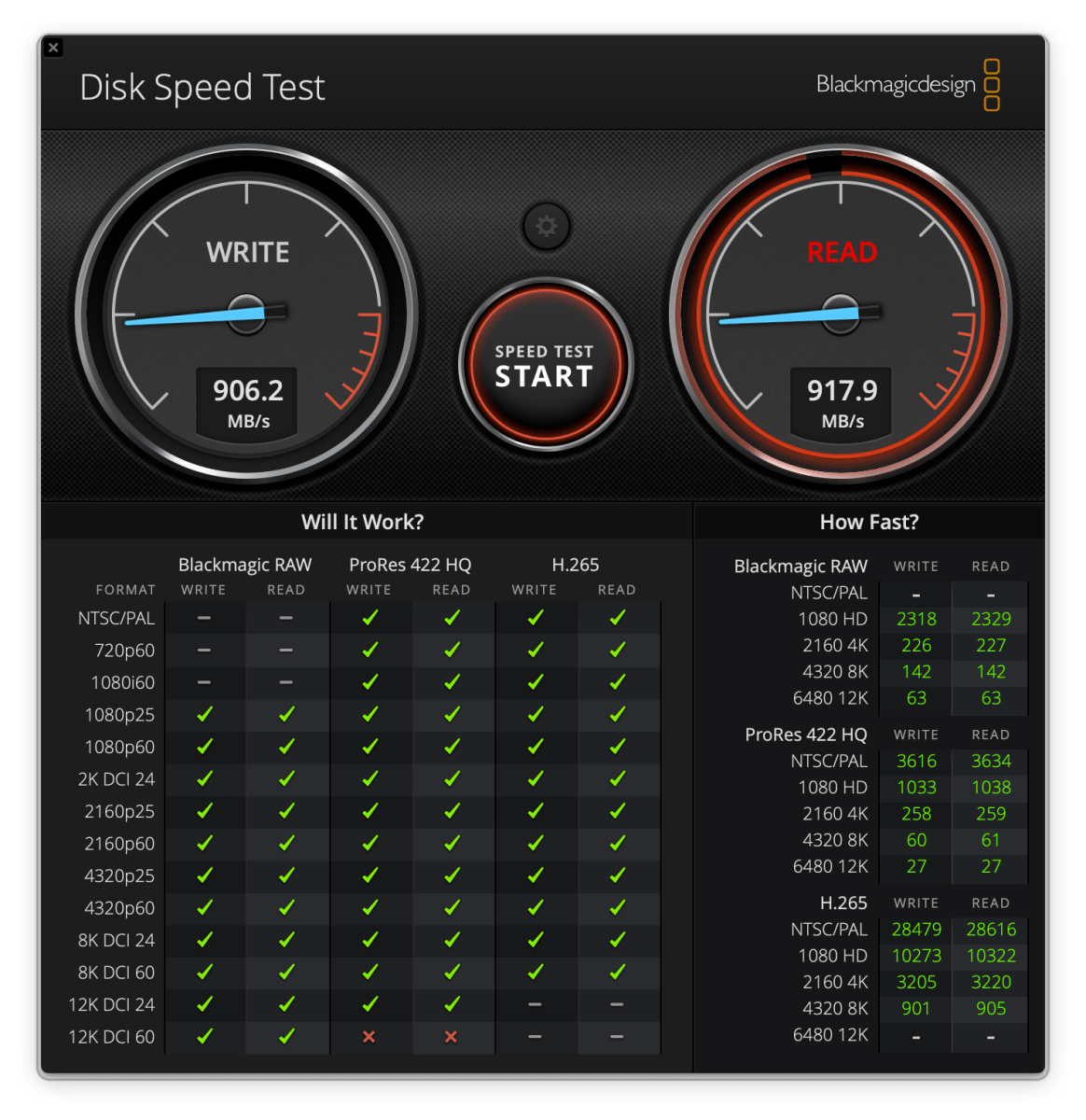
The TBS-h574TX is fast in both modes: roughly 10 gigabits/1GBps across the network (given 10Gbe) and 20 gigabits/2GBps using the Thunderbolt bridge. Think Gen 2 USB and Gen 2×2 USB.
I tested using a single 8TB WD 8100, but it’s easily capable of saturating the PCIe 3.0 bus as well as the Thunderbolt bridge and 10Gbe.
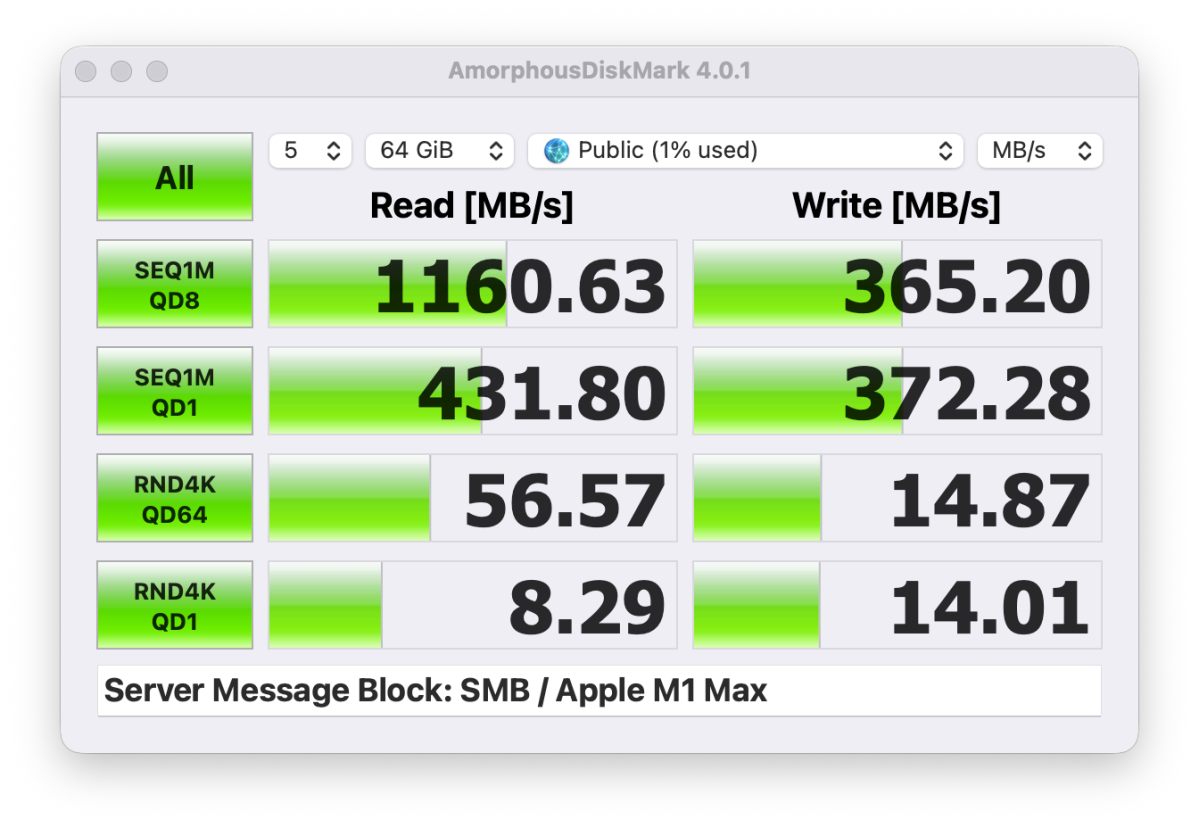
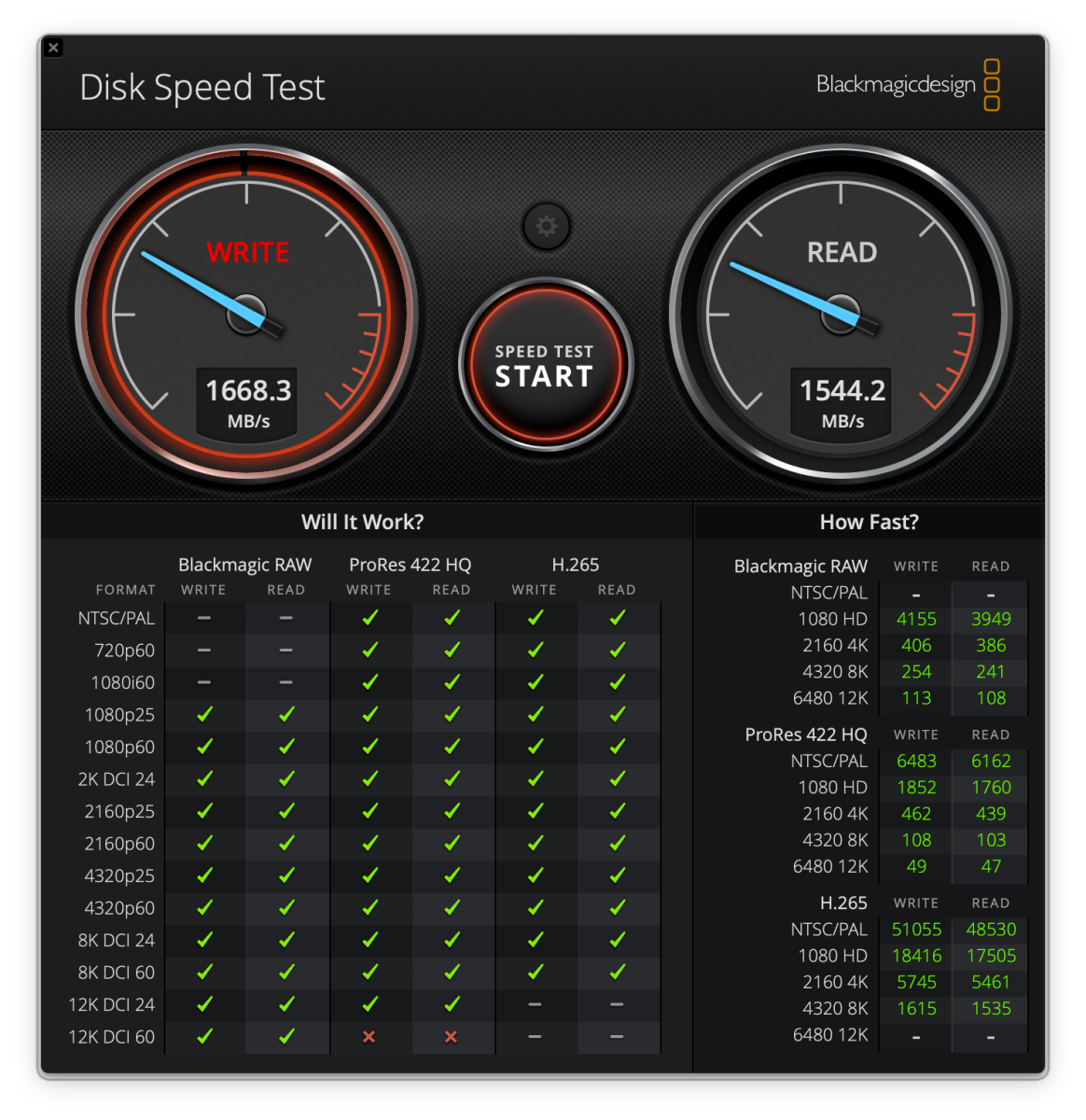
Immediately below are the benchmark results using 10Gbe ethernet. BlackMagicDesign’s Disk Speed Test shows about what you’d expect from a 10Gbps protocol with networking overhead.
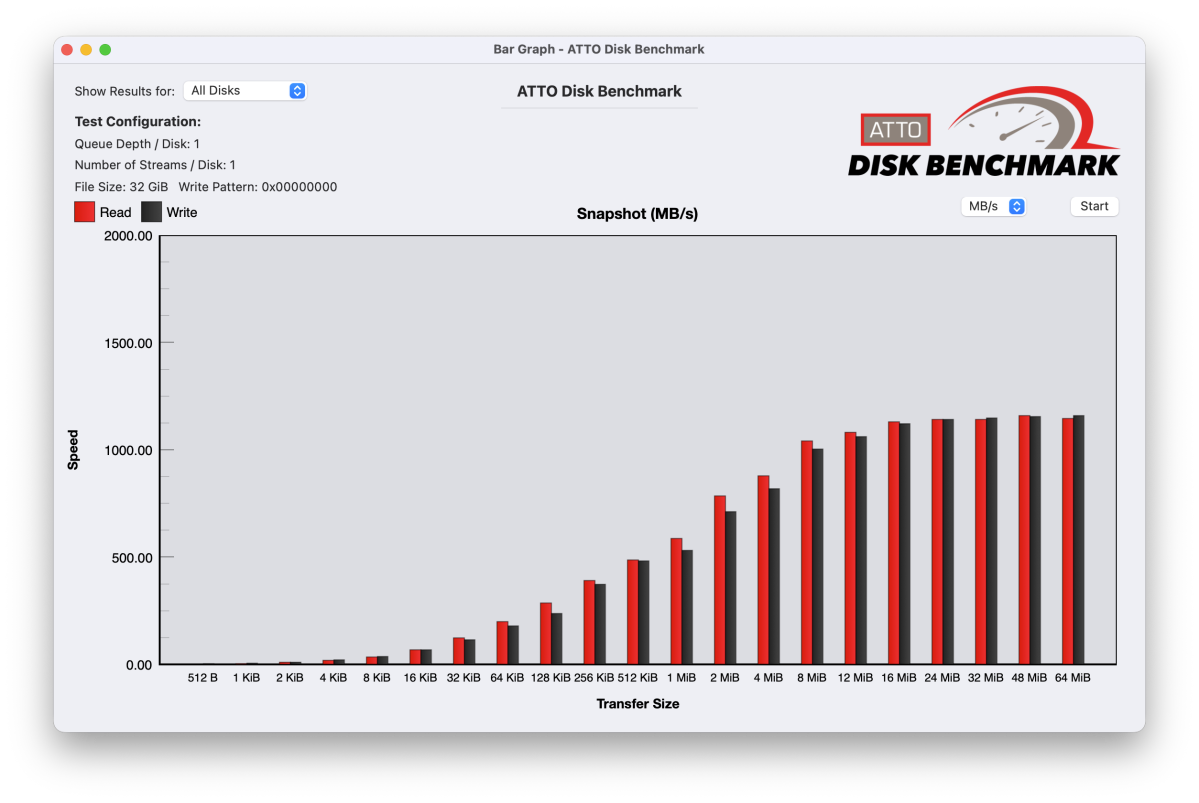
ATTO showed even better 10Gbe numbers. More in line with what you’d see from direct connected USB Gen 2 10Gbps. Nice.
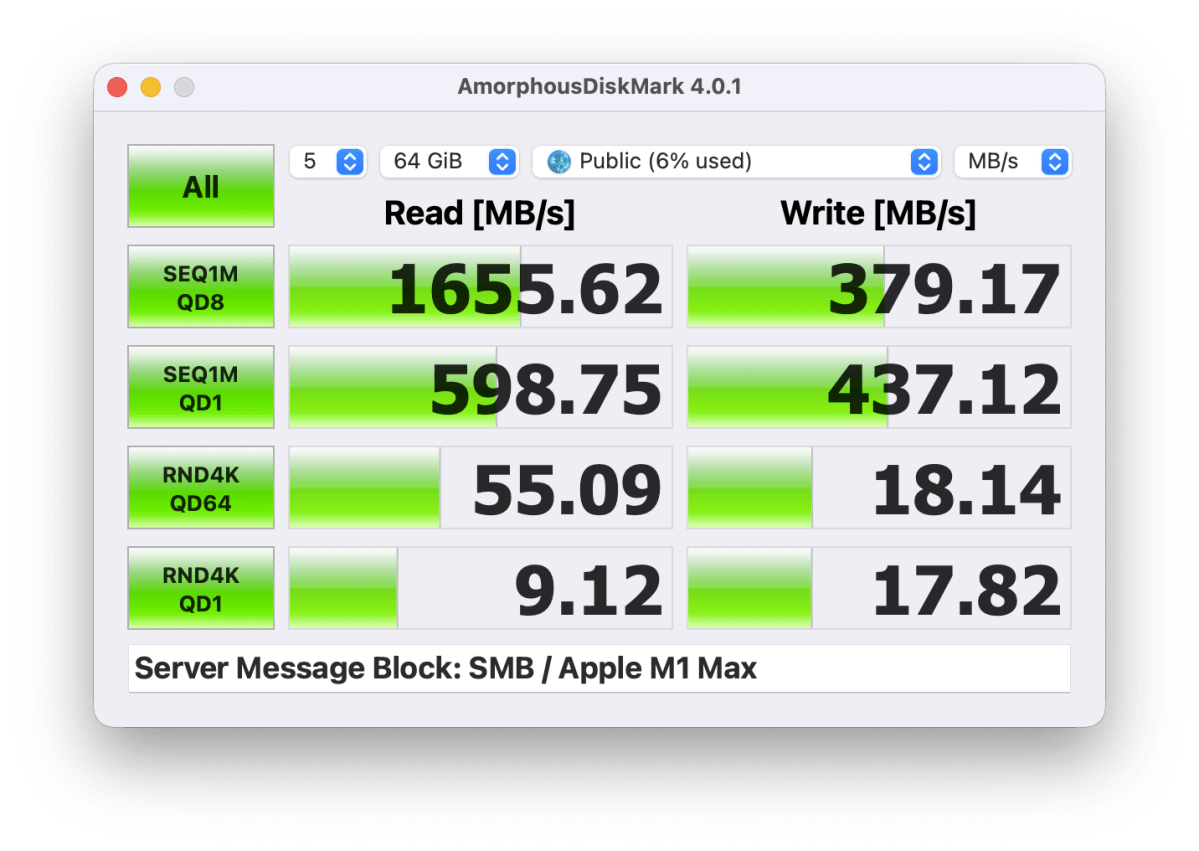
I’m not sure why AmorphousDiskMark is so pessimistic about the TBS-h574TX’s write speed over ethernet. The other benchmarks and our real-life experience say it’s faster.
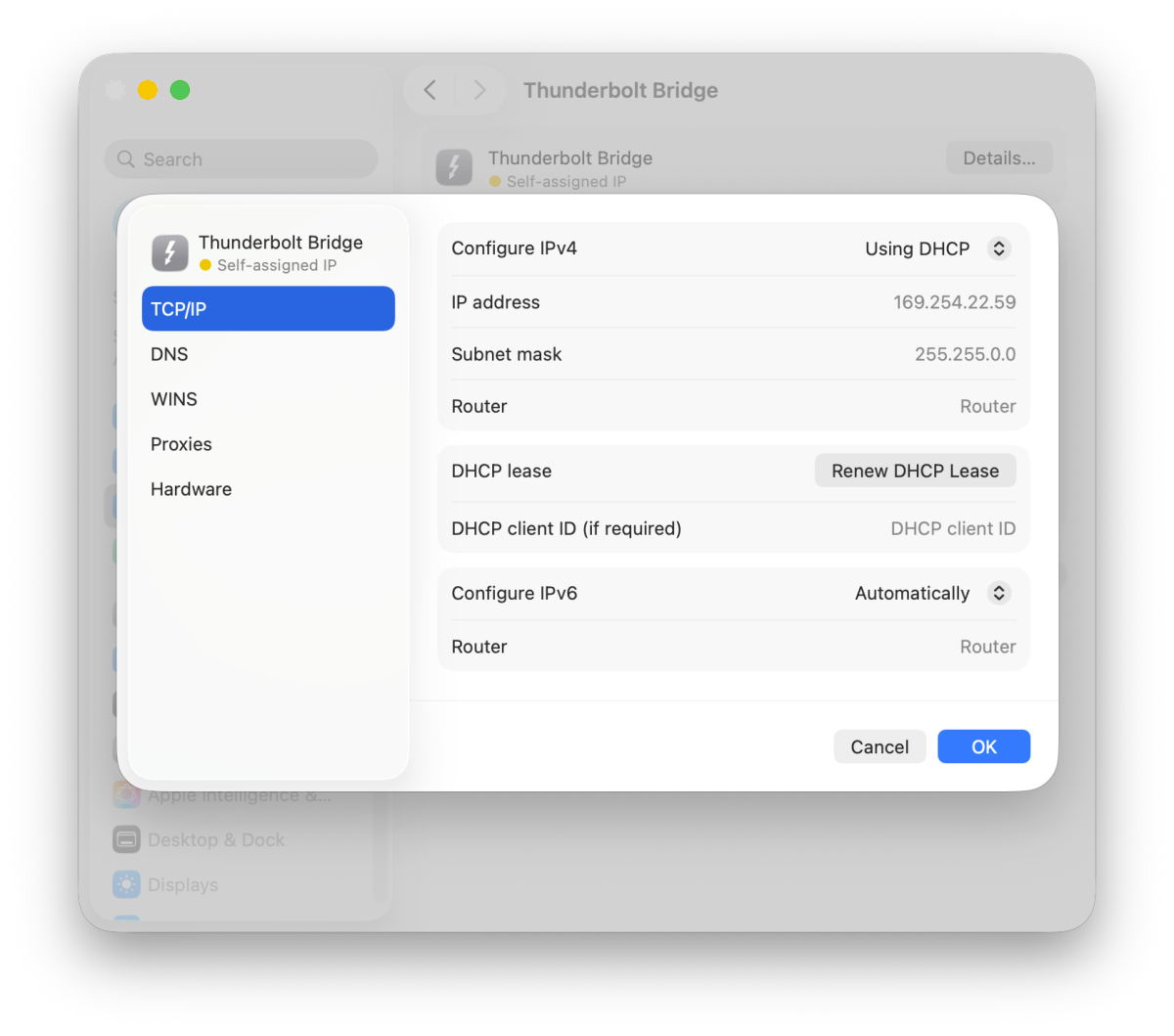
While not the fastest 20Gbps numbers we’ve seen, those shown below certainly prove that the TBS-h574TX direct-attached using a Thunderbolt Ethernet bridge is a lot faster then over 10Gbe.
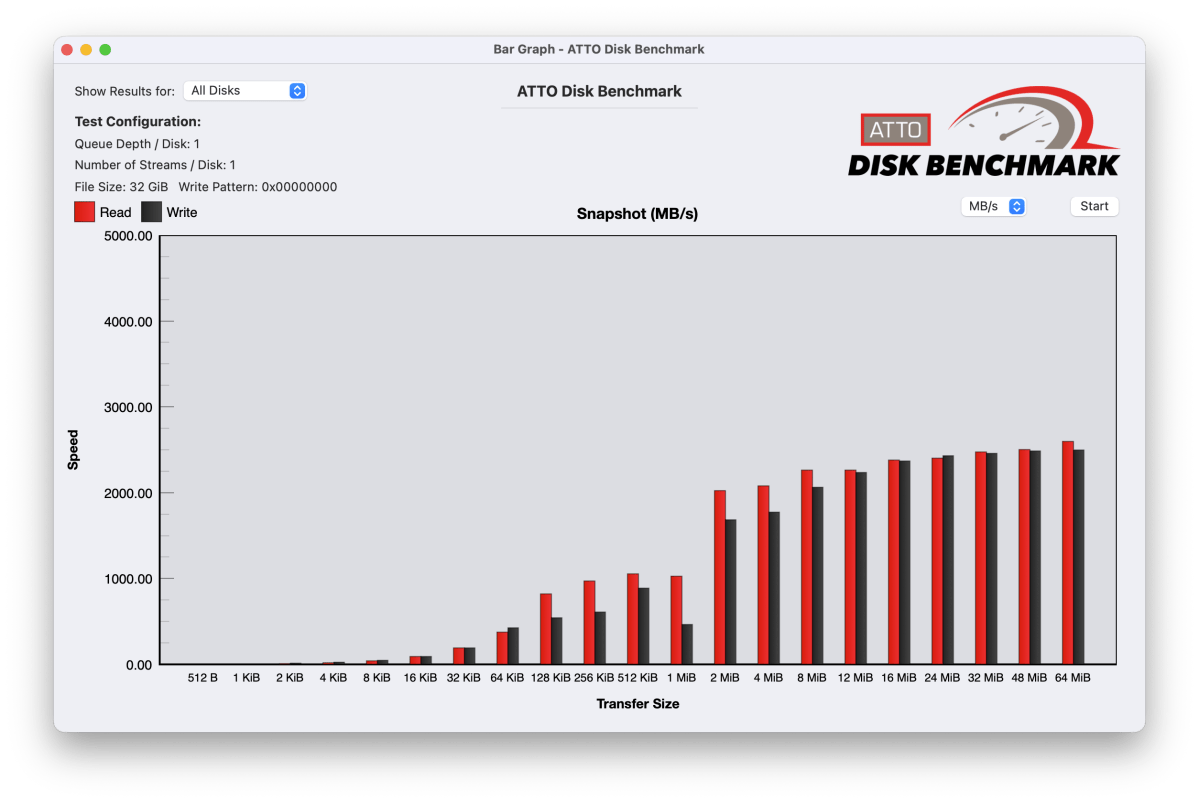
ATTO rates the TBS-h574TX even faster than Disk Speed Test with larger transfers. Well over 2GBps.
Again, for some reason AmorphousDiskMark delivers far slower write numbers using ethernet protocols than the other benchmarks.
The TBS-h574TX doesn’t generate a lot of heat the way many Thunderbolt storage devices do. The case has a lot of surface area for shedding warmth, and the twin fans also (very quietly) remove a lot of it as well.
As far as the performance of the HTML interface and the various functions such as backup, Docker, streaming etc. The relatively robust Intel CPU and 16GB of memory handle them quite nicely. I found all functions quite a bit sprightlier than with my older 253 series boxes. Not amazingly, but noticeably so.
Should you buy the QNAP TBS-h574TX?
The connective versatility of the TBS-h574TX makes it an excellent choice for artistic workgroups and creators. Share files over the network, use it directly attached for better performance, and leverage its numerous NAS/server features as needed. It’s business-grade equipment in a more prosumer-friendly form factor.
That said, if you’re flying solo and don’t need to share content, straight Thunderbolt or USB4 storage will be both cheaper (not actually cheap…) and faster. You can then add NAS features with a cheaper box if needs be.


