Summary created by Smart Answers AI
In summary:
- Macworld examines whether Apple Watch’s three-ring activity system remains the best fitness metric, consulting health experts on its effectiveness and potential improvements.
- Experts generally praise the rings concept for simplifying daily health goals, though they note it works best for moderately active users rather than highly engaged or disengaged individuals.
- Proposed enhancements include replacing current metrics with nutrition, exercise, and sleep tracking, adding customizable rings, and incorporating strength, mobility, and recovery measurements for comprehensive health monitoring.
Right from the start, the Apple Watch eschewed the popularly recommended target of clocking 10,000 steps a day — and for good reason. For one thing, the 10,000 steps goal is entirely arbitrary: there’s no science behind it, and it was first chosen largely because it’s an easy number to remember.
The thought was that it would make a good round number that could motivate people to become more active. But as Apple’s former vice president of fitness technologies Jay Blahnik said back in 2017, most people walk around 2,500 to 3,500 steps a day.
That’s where the rings come in. Apple’s Fitness app measures your daily progress using three metrics: movement, exercise and standing. These are represented as rings: the more progress you make towards each daily objective, the closer each ring comes to being closed.
But a decade after Apple Watch blew up the 10,000 step objective , are rings still the best way to understand your current health and fitness? We asked the experts what they had to say, from fitness app developers to academics studying the impact of wearable tech on human health. And what we learned might end up surprising you.
A good starting point
Kriss Smolka has always loved the Apple Watch. The iOS developer and creator of wellbeing apps such as FitnessView and WaterMinder told Macworld that he has used the Apple Watch “since day one.” Despite trying other fitness devices, Smolka explained that “none was up to Apple’s quality.”
Part of that loyalty comes down to the Watch’s ring system, Smolka contends. He describes it as his “partner in keeping me accountable” and says its metrics are “very useful in my personal life.”
Apple gamified exercise with its system of visual daily goals—but are they still the best way to measure activity?
Foundry
Smolka adds that that feeling extends to the users of his apps, too. “We receive feedback from our FitnessView app that [people] use the ring calendar to view monthly progress,” he told us. “People love seeing closed rings.”
That resonates with researchers. According to Yang Wei, Professor of Wearable Technology at Nottingham Trent University in the U.K., the idea of “closing your rings” is a good one. As Wei put it, Apple’s approach works “because it turns behavior change into a simple daily goal system and gives frequent feedback about progress.”
However, that might not be true in all cases. Wei told us that while Apple’s ring system works for many people, that won’t be true for everyone. “People respond differently, as those already active may not need it,” Wei argued. “Those strongly disengaged might ignore it, but people in the middle often benefit most from nudges and clear targets.”
Wei has the data to back up his assertions. “From an evidence perspective,” he says, “wearables and activity trackers can increase physical activity on average but typically with modest-to-moderate effects and wide variation by person and context. One major review reported effects roughly equivalent to [approximately] 1,800 extra steps [per] day and [approximately] 40 minutes [per] day more walking on average, plus small improvements in weight and fitness.”
While it might not change your world completely, a feature like the Apple Watch rings can help to push people in the right direction. Because as Wei points out, while self-motivation matters, “it is rarely sufficient on its own.”
Indeed, even something like an on-device motivator such as the ‘close your rings’ system might not be enough. “Wearables tend to be more effective when combined with additional components like goal setting, coaching, counseling or structured prompts, rather than being used alone,” Wei contends, adding that, “Most people do better with a support system that makes the desired behavior easier and more rewarding.” That can mean personalized goals, accountability, social motivation and reducing friction through making exercise the ‘default.’
In other words, closing your rings is a good starting point for a lot of people, but it works best as part of a broader package of fitness work and support.
The Apple Watch’s Activity Rings have become a centerpiece of the fitness tracker’s utility.
Foundry
Sound design
Like everything Apple does, design has played a key role in the use of rings to quantify your day on the Apple Watch. As Blahnik described, “Typical activity trackers also measure metrics but they tend to do them in numbers. We’ve built our entire design around a visual. Well, what’s interesting about a visual is numbers continue to get bigger. No matter how big they are, they can always be bigger. But a ring is either closed or not closed. So we’ve found there’s a real addictive behavior in making sure that final ring gets closed.”
For Brandon Ballinger, co-founder of heart wellness company Empirical Health, separating health goals into three rings makes sense; after all, “Health is multidimensional, so the concept of a multidimensional score is sound,” he told us.
However, Ballinger noted that “the specific visual representation matters less than the specific dimensions you choose.” To illustrate the point, Ballinger explains that Empirical Health displays your progress as rainbows rather than rings.
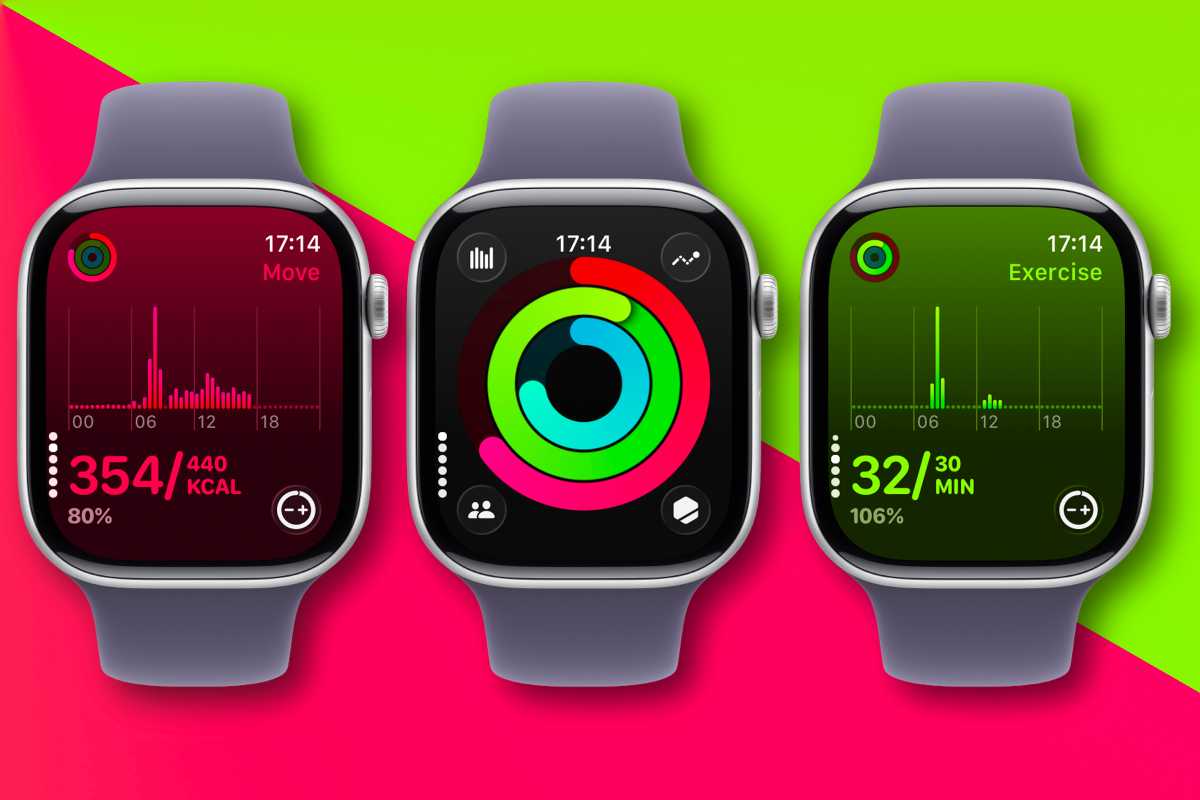
The Apple Watch’s Activity Rings could use a modern update.
Foundry
Still, Ballinger believes Apple could improve the data it presents by replacing calories, exercise minutes and stand hours with nutrition, exercise and sleep. If we were to restrict the choices purely to physical activity, Apple could choose “total minutes of cardiovascular activity, minutes spent in zone five (high intensity cardio), and strength,” which all have strong support in the medical literature, Ballinger adds.
But Apple could take things even further, Wei says, by allowing users to set a custom ring with their own choice of metric. Or the company could “Shift emphasis from daily streaks to weekly consistency,” which is “often more realistic and less guilt-inducing.” And while calories make for an “intuitive” metric, Wei says they can be “noisy and sometimes demotivating.” A better alternative might be frequency or consistency of activity.
Food for thought
Ultimately, all three experts we spoke to believed that Apple’s idea of closing your rings is a good one, albeit one where improvements can be made.
For Ballinger, whose own app is centered on strengthening users’ heart health, a greater focus on nutrition would go a long way to improving people’s health and tackling heart disease. Wei, meanwhile, says that closing your rings is a good motivator for people who are ready for change, but might not be the most effective way to get healthier if you’re totally disengaged from your own wellbeing.
Still, closing your rings provides the incentive to get up and move for millions of people around the world. As Smolka put it, the Apple Watch is “a great tool and motivator to stay healthy.” Much of that is thanks to its now-iconic ring design.
But while Wei feels that while Apple’s selection of metrics is good, “it can be improved.” While “the three rings target three meaningful drivers of health,” other options would be “strength, mobility, recovery, sleep, and long-term sustainability.”


