At a glance
Expert’s Rating
Pros
- The fastest PCIe 4.0 SSD I’ve tested to date
- Especially excellent 4K performance
- 2230 form factor fits handheld gaming devices
Cons
- Really, really expensive
Our Verdict
If you want the absolute best SSD performance for your handheld game machine, or for that matter, any PCIe 4.0 device, SanDisk’s new Optimus GX 7100M is it. It’s the fastest PCIe 4.0 SSD I’ve tested and doesn’t slow down tragically during long writes. But expect to fork over mucho moolah for the privilege.
Price When Reviewed
This value will show the geolocated pricing text for product undefined
Best Pricing Today
Price When Reviewed
1TB: $230 I 2TB: $450
Best Prices Today: SanDisk Optimus GX 7100M NVMe SSD
Some products actually live up to the PR hype, and SanDisk’s small (2230) but mighty Optimus GX 7100M is one of them. With a press release chock full of terms such as “exhilarating” and “level-conquering,” it had a lot to live up to. And live up to, it did
As you might infer from the second adjective, the GX 7100M is aimed at the handheld gaming crowd. Not to spoil the ending, but you can’t do better than this SSD at the moment for handhelds or any other type of PCIe 4.0 computing device.
Read on to learn more, then see our roundup of the best PCIe 4.0 SSDs for comparison.
What are the Optimus GX 7100M’s features?
To reiterate, the GX 7100M (Mini?) is a 2230 (22mm wide, 30mm long) form factor, PCIe 4.0/NVMe 2.0 SSD. The controller is SanDisk in-house and the NAND is layered TLC (Triple-Level Cell/3-bit).
The drive is an HMB (Host Memory Buffer) design that uses some of your system memory (typically 64MB to 72MB) as primary cache. A healthy portion of the NAND (at least 25 percent from our testing) is employed as secondary cache by writing to it as if it were on/off 1-bit SLC (Single-Level Cell).
In case you weren’t aware, the “level” in NAND nomenclature actually refers to the number of bits a cell can represent. Confusingly, the actual number of voltage levels that a cell may contain corresponds to the largest number that this misnomered quantity of bits may represent.
SLC has either no voltage or some; MLC (Multi-Level Cell, which should’ve been DLC, or Dual-Level Cell) can be written at four possible levels; TLC (Triple-Level Cell) can be one of eight, and QLC (Quad-Level Cell) can contain one of 16 possible voltage levels.
The difference in these voltage levels is beyond minute, and requires a lot of error checking to make sure they were written correctly. This can slow down the write process drastically. But I digress.
SanDisk offers a five-year warranty on the GX 7100M, which is mitigated by a 600TBW per terabyte of capacity rating — i.e., five years or 600 terabytes worth of writes — whichever comes first.
Note that when SSDs exceed their write cycle endurance (this may be more than the rating), they may still be read. You simply can’t write to them any more.
How much is the Optimux GX 7100M?
You’re probably not going to like this… I didn’t. But the Optimus GX 7100M is roughly $240 in the 1TB flavor, and $450 at 2TB. Even given today’s high SSD prices, that’s an ask and a half.
If the drive weren’t such an excellent performer, I might ding SanDisk for it. But it is super fast, and the best always costs more.
How fast is the Optimus GX 7100M?
How fast? Very. The 2TB GX 7100M that SanDisk sent us finished first among all the PCIe 4.0 SSDs (of any form factor) we’ve tested. So while its pricing is daunting, your cash, again, does buy you the best.
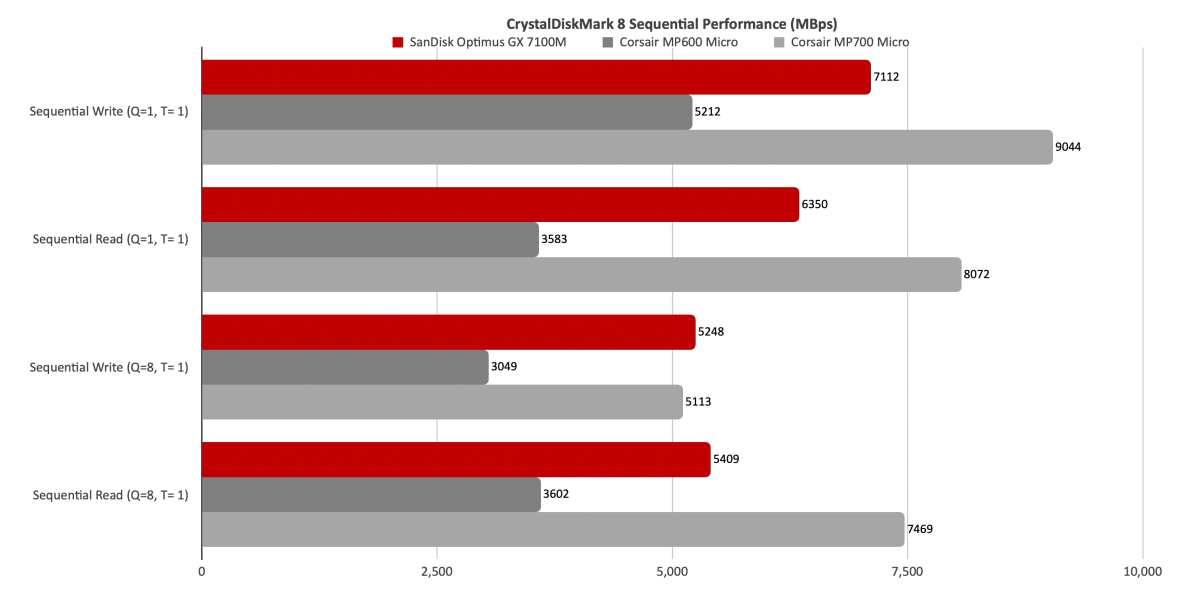
At first I was hesitant to compare the PCIe 4.0 GX 7100M to the PCIe 5.0 Corsair MP700 Micro, but darned if it didn’t match its rival in many tests and whomp it in CrystalDiskMark 8’s 4K tests. Not to bang on Corsair, but the MP700 Micro is not nearly as fast as most PCIe 5.0 SSDs.
Below, you can see just how close in performance the GX 7100M was to the MP700 Micro. The latter is faster, but not nearly as much as you might think. Note that we’ve seen 2280 PCIe 5.0 SSDs reach 15GBps.
The 4K result below is the one that really surprised us. A 33 to 61 percent advantage to the GX 7100M over the MP700 Micro. Newer controller, newer NAND.
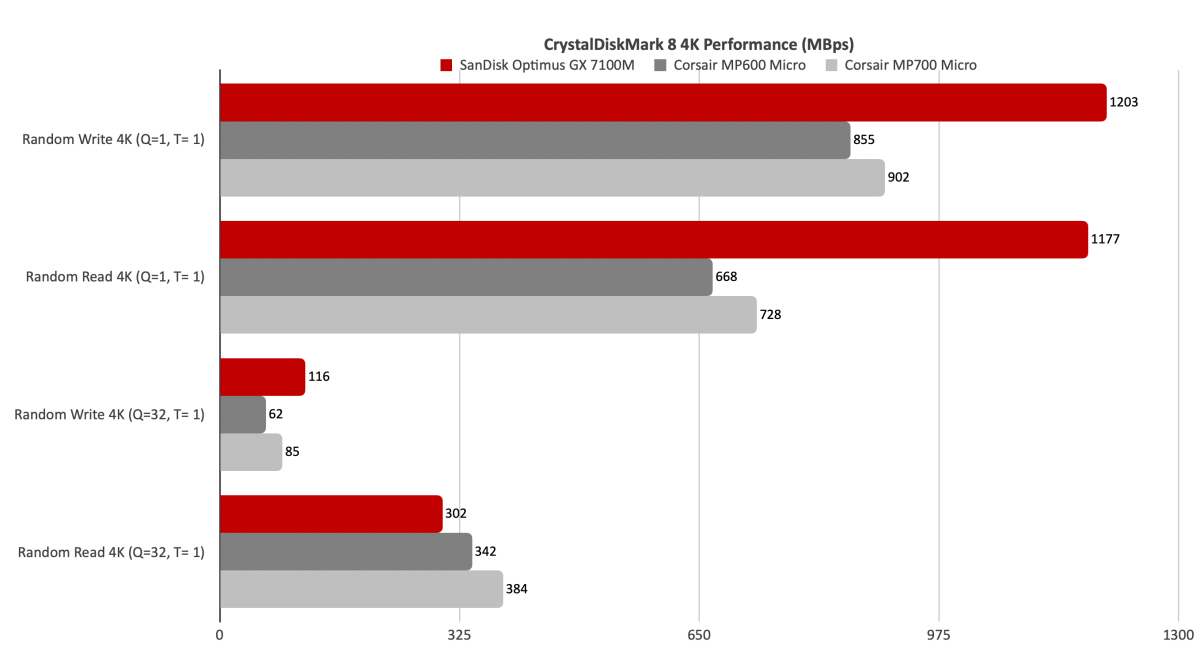
Keep in mind that all three drives are HMB (DRAM-less) designs. 4K ops have been one of the slower aspects of HMB until now. Only the Lexar 2280 previously turned in 4K numbers like this.
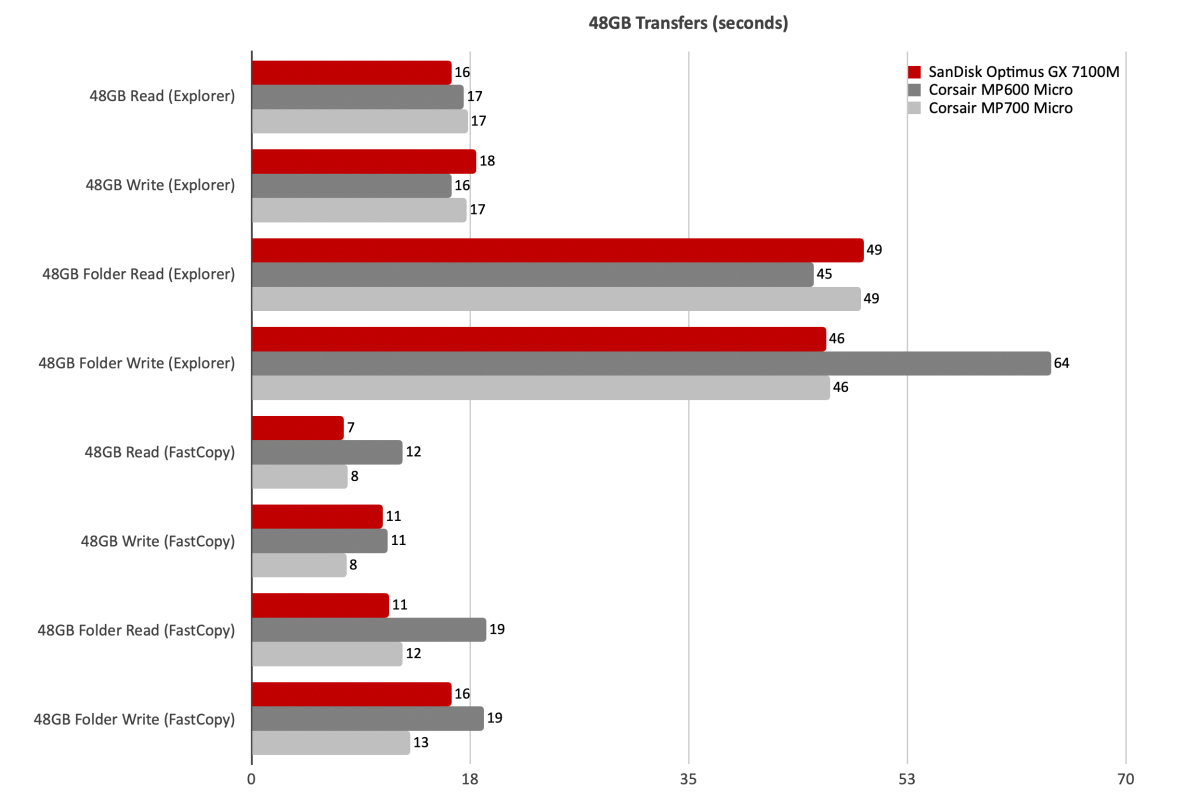
In the real world of our 48GB transfers, the difference between the three drives is far less noticeable, though the older Corsair MP600 is clearly the slowest of the three with small file-laden folders.
We’ll call the 450GB write a tie between the GX 7100M and the MP700 Micro with the latter slower under Explorer, but holding a 15 second advantage when the superior transfer utility — FastCopy — is employed.
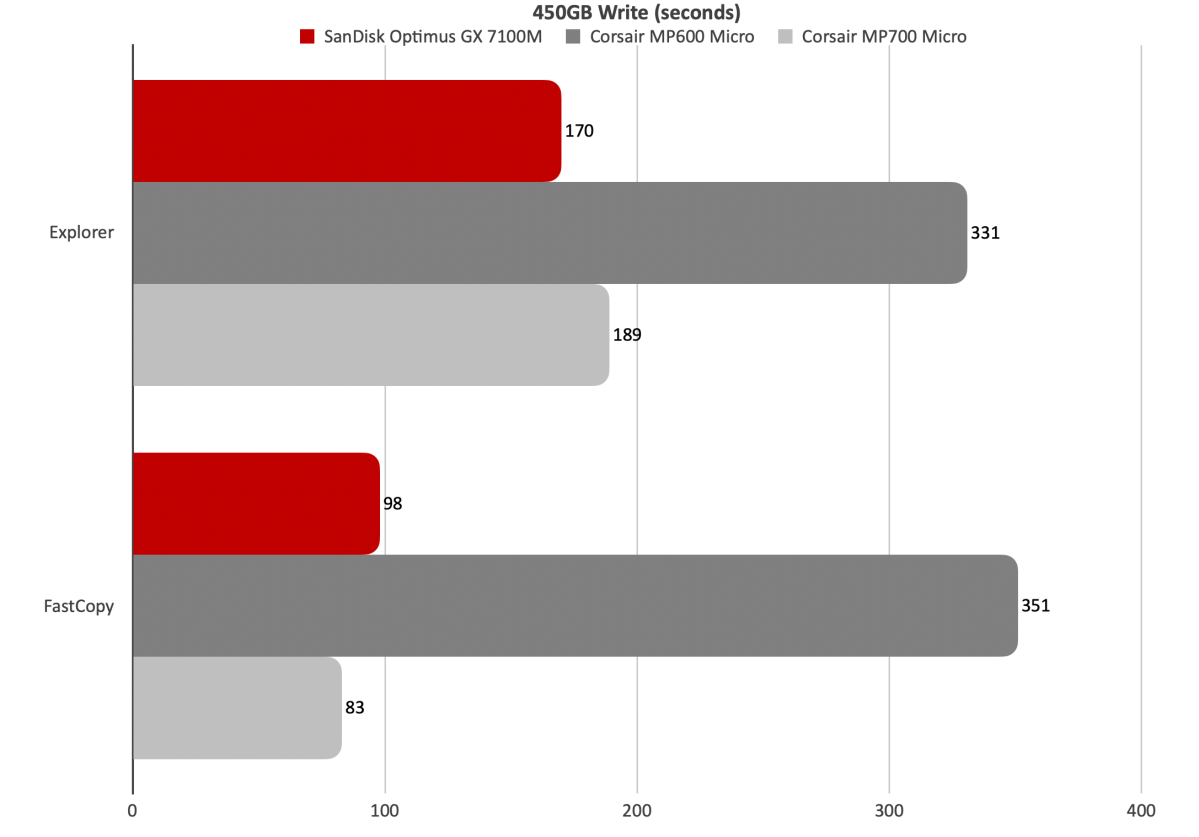
While we consider 450GB about as much as any user will write at one time, we did write another 900GB contiguous file to see just how the TLC (Triple-Level Cell/3-bit) NAND would behave.
It slows to a varying range between 600MBps and 800MBps. Not the fastest we’ve seen, but hardly tragic as with some forms of QLC (Quad-Level Cell/4-bit) or older TLC.
All in all, the GX 7100M is a top-flight performer and the fastest PCIe 4.0 NVMe SSD we’ve tested to date. However, given the price I’m compelled to expound on expenditure versus return.
Given that most slots either SSD will occupy, will be PCIe 4.0 (or 3.0) anyway, the GX 7100M might be a faster drive than the MP700 for your system. It’s certainly far faster than the Corsair MP600 Micro in nearly every way.
Big numbers are always better, and big numbers are always tempting, but all NVMe (even PCIe 3.0) is so fast it’s impossible to tell the difference unless you’re transferring huge amounts of data. Buy accordingly.
Should you buy the Optimus GX 7100M?
In terms of performance, you’re not going to find anything better in a PCIe 4.0 SSD. 2230 form factor or otherwise. So yes, if you’ve got the cash and want the best.
That said, there are cheaper options that are more than fast enough to scratch your high-performance storage itch.
How we test
Drive tests currently utilize Windows 11 24H2, 64-bit, running off of a PCIe 4.0 Samsung 990 Pro in an Asus Z890-Creator WiFi (PCIe 4.0/5.0) motherboard. The CPU is a Core Ultra i5 225 feeding/fed by two Crucial 64GB DDR5 5600MHz modules (128GB of memory total).
10Gbps, 20Gbps USB, and Thunderbolt 5/USB4 are integrated into the motherboard. Intel CPU/GPU graphics are used. Internal PCIe 5.0 SSDs involved in testing are mounted in an Asus Hyper M.2 x16 Gen5 adapter card sitting in a PCIe 5.0 slot. External enclosures are tested using a Crucial T710.
We run the CrystalDiskMark 8.04 (and 9), AS SSD 2, and ATTO 4 synthetic benchmarks (to keep article length down, we report only the first) to find the storage device’s potential performance. Then we run a series of 48GB transfer and 450GB write tests using Windows Explorer drag and drop to show what users will see during routine copy operations, as well as the far faster FastCopy run as administrator to show what’s possible.
A 25GBps two-SSD RAID 0 array on the aforementioned Asus Hyper M.2 x16 Gen5 is used as the second drive in our transfer tests. Formerly the 48GB tests were done with a RAM disk serving that purpose.
Each test is performed on a NTFS-formatted and newly TRIM’d drive so the results are optimal. Note that in normal use, as a drive fills up, performance may decrease due to less NAND for secondary caching, as well as other factors. This issue has abated somewhat with the current crop of SSDs utilizing more mature controllers and far faster, late-generation NAND.


