At a glance
Expert’s Rating
Pros
- Recharge score winners (5K and 10K)
- Super slim (5K and 10K)
- Built-in USB-C cable (10K model)
- 30W wired charging (10K model)
Cons
- Faster 25W wireless power banks available
- Basic power display
Our Verdict
Whether you are after winning battery performance or close-to-unrivalled slimness, the Ugreen MagFlow Air magnetic wireless power bank range is one you simply must Consider.
Price When Reviewed
This value will show the geolocated pricing text for product undefined
Best Pricing Today
Price When Reviewed
$79.99
Best Prices Today: Ugreen MagFlow Air Magnetic 10K Power Bank
$59.99

$79.99
Ugreen’s MagFlow Air range of magnetic wireless power banks just came in for review. This range of magnetic wireless power banks combine record-setting real-world battery performance with ultra-slim designs, making them more efficient and portable than most MagSafe-style rivals.
- Get the 5K model if you want the thinnest, lightest everyday backup battery.
- Choose the 10K if you need more charging capacity, faster wired charging, and better travel versatility.
We test every power bank that enters the Macworld Lab, recharging a spent iPhone in multiple separate tests to reach a recharging score to compare the best.
The recharge score isn’t everything we look for in a power bank. We also rate wireless charging speed, input power to see how fast the power bank can be recharged itself, physical thinness and weight, battery monitor display, and features such as extra USB ports and integrated USB-C cables.
Ugreen’s MagFlow Air range of magnetic wireless power banks offers the highest-ever scores for 5000mAh (5K) and 10000mAh (10K) battery packs.
Power bank specs
Simon Jary
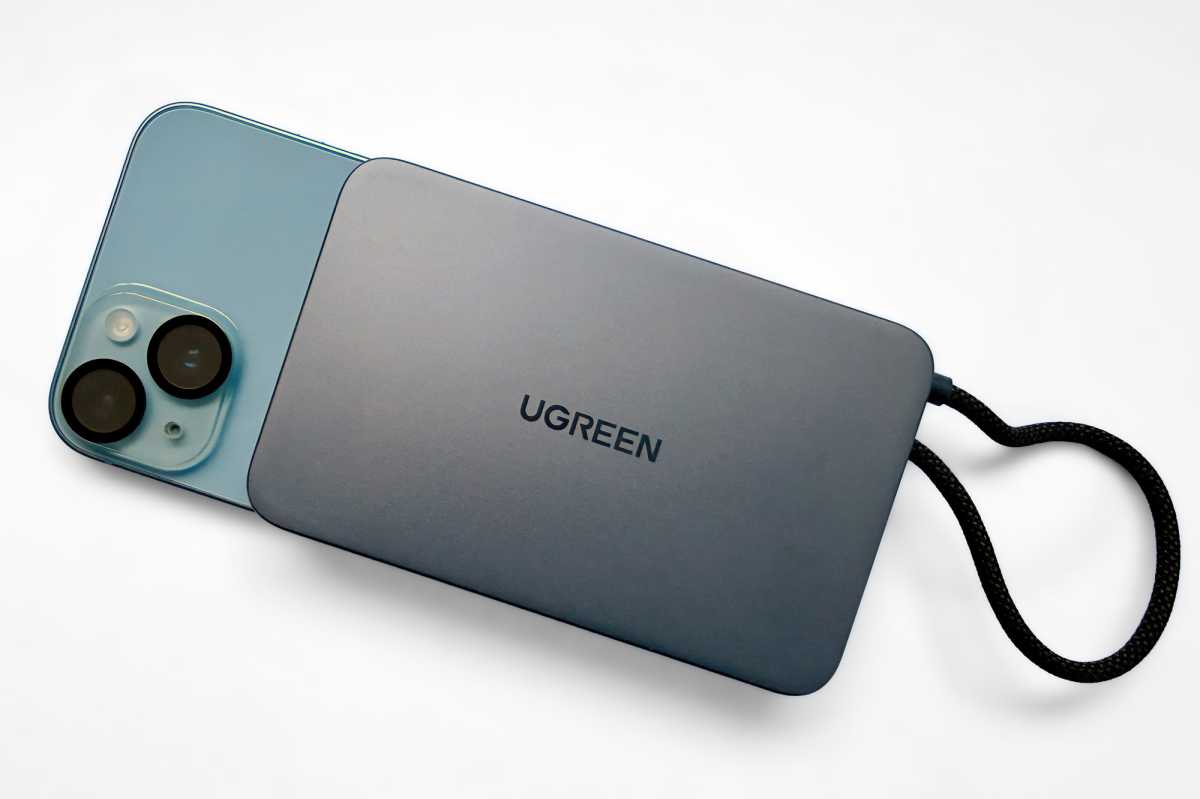
MagFlow Air 10K
- Capacity: 39.2Wh (10000mAh)
- Input charger: USB-C (30W)
- Output charger: Wireless (15W) & USB-C (30W)
- Macworld Recharge Test Score: 208%
- Weight: 7.55oz (214g)
- Dimensions: 4.1 x 2.7 x 0.53 inches (112 x 70 x 13.9mm)
- Colors: Gray, Blue, White
Simon Jary
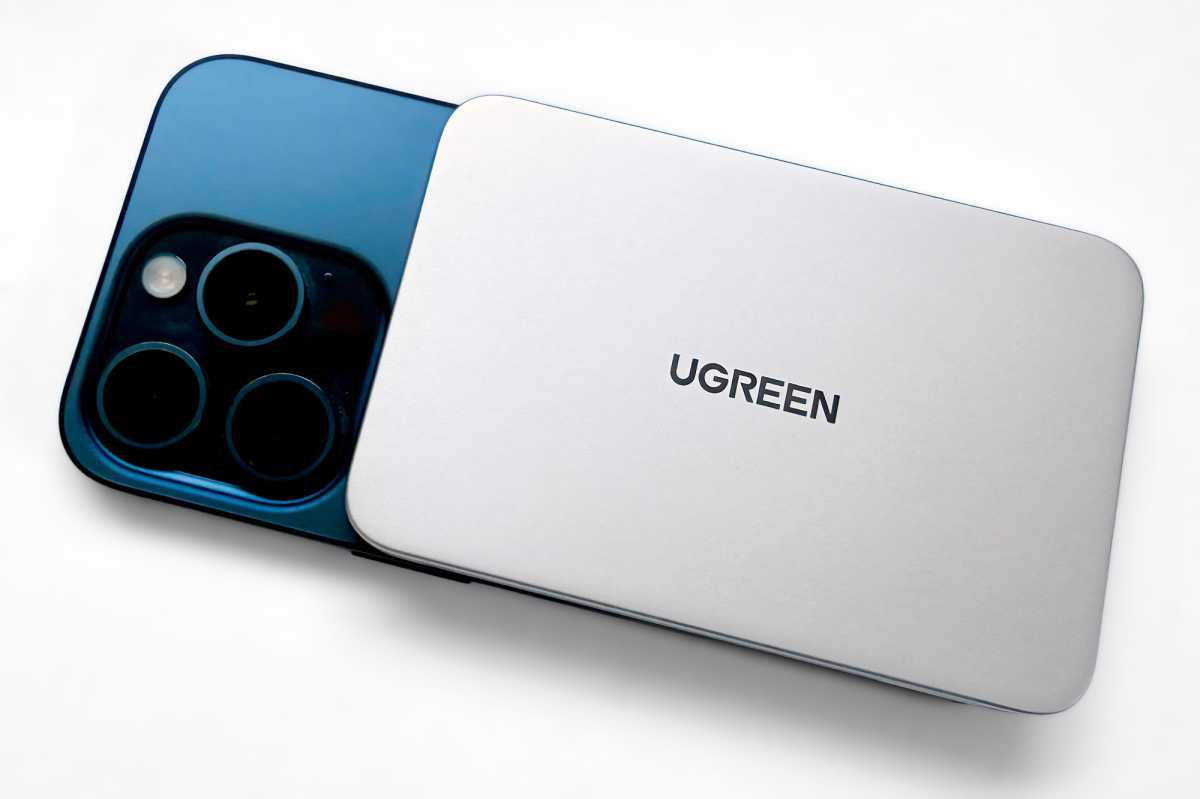
MagFlow Air 5K
- Capacity: 19.6Wh (5000mAh)
- Input charger: USB-C (20W)
- Output charger: Wireless (15W) & USB-C (20W)
- Macworld Recharge Test Score: 90%
- Weight: 4.48oz (127g)
- Dimensions: 4.1 x 2.7 x 0.53 inches (105 x 70 x 8.6mm)
- Colors: Gray, Blue, White
Performance
We must start with performance as this is one of the areas where the Ugreen MagFlow Air is a triumph.
We run down our test iPhone 16 Pro to 0% and clamp on the power bank until it reaches 100% or as close as it can make it. If there’s still power left, we wait till the iPhone is back to zero and go again.
The Ugreen MagFlow Air 10K made it to 100% twice over and eked out another 8% on the third charge. That gives it a Macworld Recharge Score of 208% (100%+100%+8%).
Before this test, our top-scoring 10K power bank (the 15W EcoFlow RAPID 10K) reached 190%, with an average score for 10K battery packs of 165%. That makes the MagFlow Air 10K not far off 10% faster than the closest scorer in our tests.
The MagFlow Air 5K also scored highest in its category, although not by such as high margin. It scored 90%, in comparison to the previous high scorer BMX SolidSafe Air that reached 89%—close enough to go either way depending on environmental factors such as temperature.
Both are outstanding, though, as the average Macworld Recharge Score for 5K power banks is 77%.
Simon Jary
Capacity
10000 milliamp hours (mAh) and 5000mAh are two of the standard battery capacities (shortened to 10K and 5K) of magnetic power banks. Belkin makes an 8K power bank, but that’s very much an outsider.
The Ugreen MagFlow Air comes in these two expected capacities: 10K and 5K.
A more accurate way of measuring power bank capacity is in watt hours (Wh) rather than the less specific milliamp hours (mAh). Both are over average, with the 5K MagFlow Air rated at 19.6Wh against an average of 19Wh; and the 10K MagFlow Air at 39.2Wh vs the average 38Wh.
While above average the stated capacities are not so high that they alone account for the excellent performance in our tests. Some of that advantage must be down to other factors in the power bank construction.
Ugreen
Design
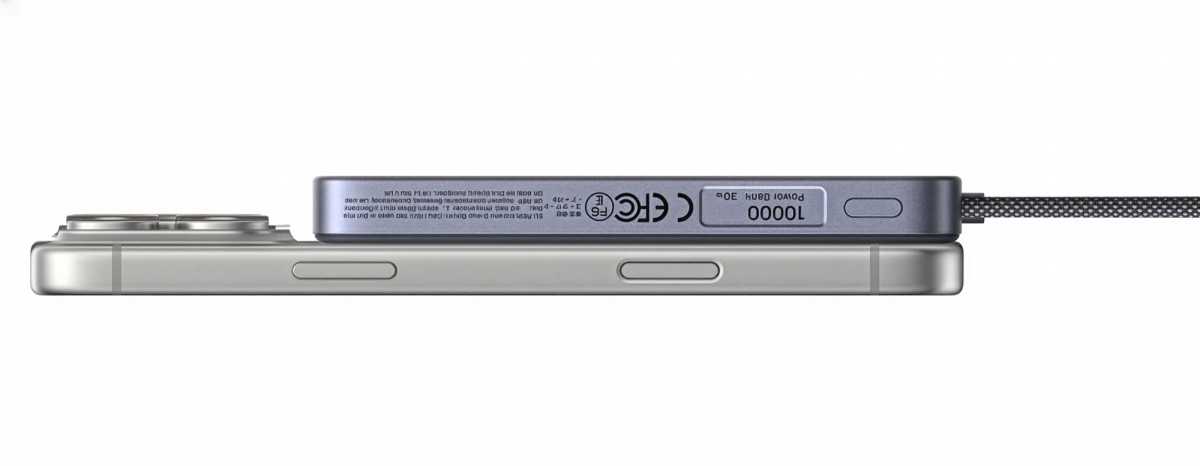
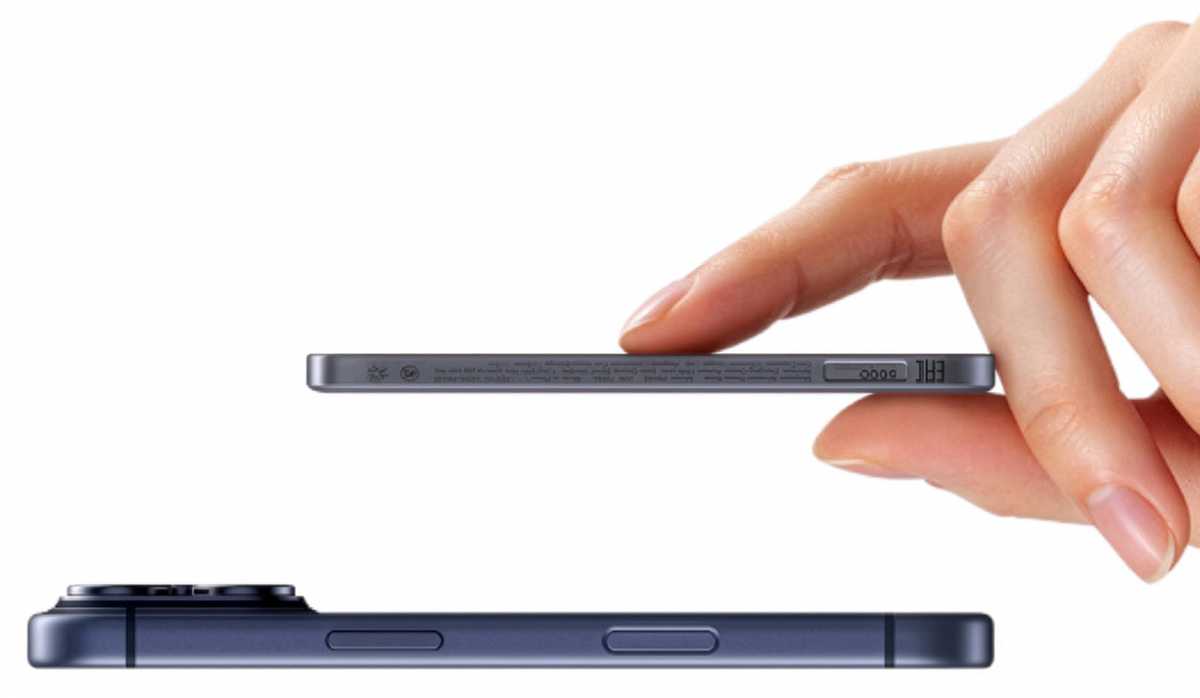
Both models of the MagFlow Air are impressively slim. Indeed, the 10K MagFlow Air (shown above), measuring 13.9mm deep is only a sliver thicker than the slimmest 10K power bank we’ve ever tested, the 13.7mm Kuxiu S4. The S4 scored an impressive 182%, but the 10K MagFlow Air blows even that out of the water. It should be noted that the S4 boasts 25W wireless charging compared to the MagFlow Air’s 15W—more on which later in this review.
Ugreen
The 5K MagFlow Air (pictured above) is 8.6mm deep, the same as the Anker Nano MagGo Slim that for a long time was the slimmest 5K power bank we’ve tested. Both, however, are made to look chunky next to the BMX SolidSafe Air at 6.8mm.
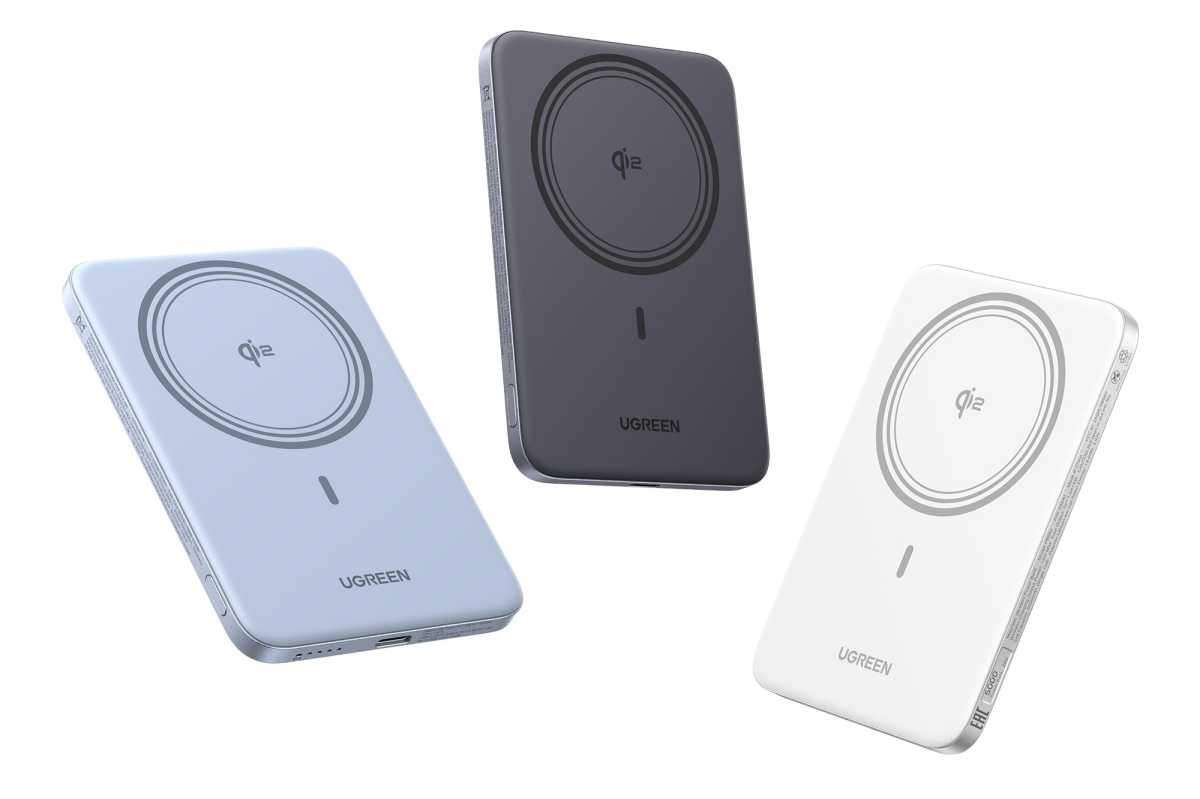
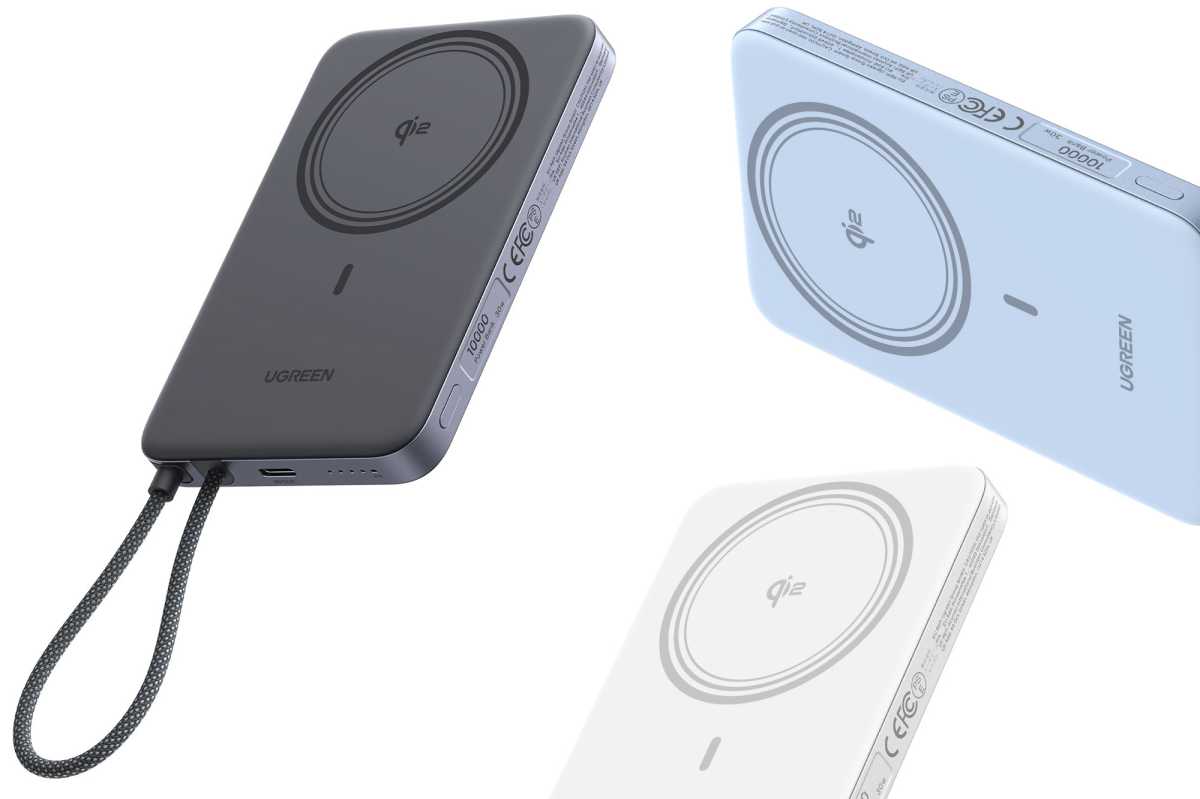
Both models of the Ugreen MagFlow Air are available in three colors: Gray, Blue, and White.
The 10K MagFlow Air weighs 214g, against an average of 223g for similarly sized power banks. The 5K model tips the scales at 127g vs the average 132g.
Some magnetic power banks—such as the EcoFlow RAPID and Kuxiu S4—feature a pull-out kickstand, which can be useful for handless viewing. This likely won’t be a deal-breaker but if it’s important to you, note that neither of the MagFlow Air models come with one.
Simon Jary
Power outputs
The MagFlow Air joins Ugreen’s existing MagFlow power banks. Curiously, the new Air power banks have a lower—and therefore slower—wireless power output of 15W vs 25W.
A 25W power bank can recharge an iPhone 16 or later from 0% to 50% in just over 30 minutes, compared to 45 minutes for a 15W power bank. iPhones 15 and earlier max out at 15W, so there’s no difference when charging one of these older phones with either a 15W or 25W power bank.
Simon Jary
The very fastest way of charging any iPhone is to connect with a cable rather than wireless, as that more direct connection is less prone to energy wastage. Magnetic wireless charging has got much more efficient and therefore quicker in the past year, but it’s still no match for the traditional wired method.
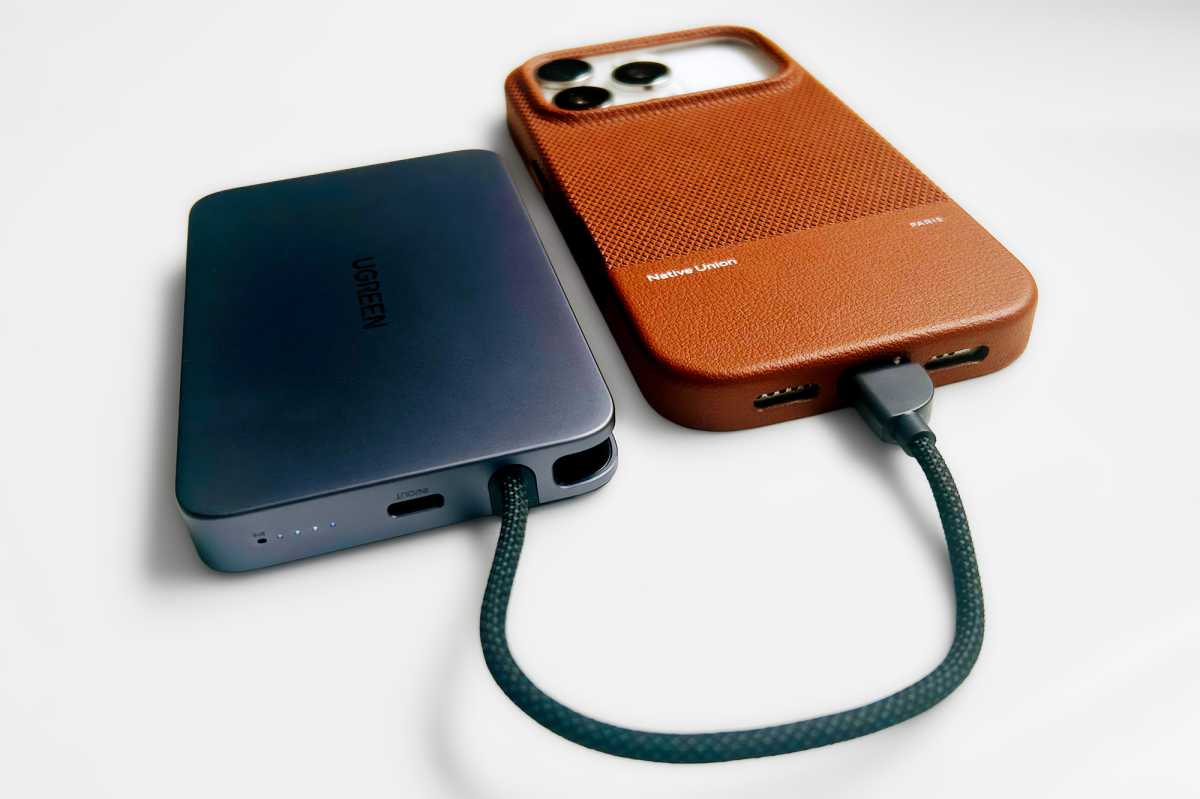
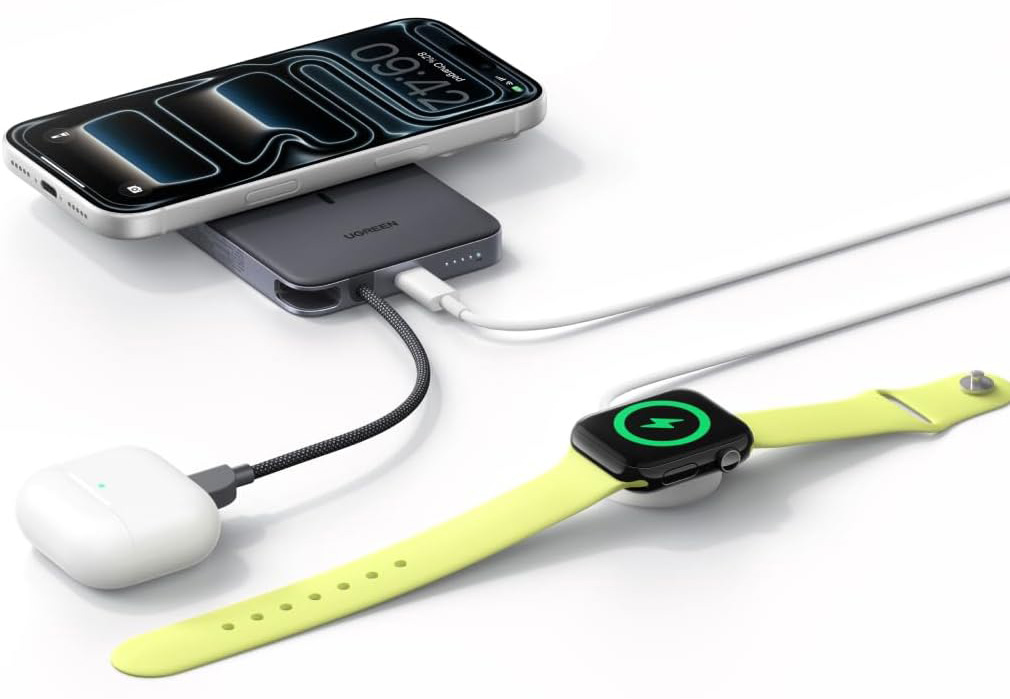
The 10K MagFlow Air has an integrated USB-C cable (7 inches / 180mm) and spare USB-C port, both of which support 30W of power output—so beating even 25W wireless anyway. You can still clamp the 10K MagFlow Air to an iPhone for convenience but slot in the cable for charging speed. Remember, though, that only the iPhone 15 and later host a USB-C charging port, with iPhone 14 and earlier still using Apple’s older Lightning port.
Users of those older iPhones can still use the built-in cable to recharge the power bank itself, again at a speedy 30W. It should take around two hours to get the 10K power bank ready to take out on the road again.
Ugreen
Only the Baseus PicoGo AM52 Power Bank has a faster wired connection, at 45W. The newer the iPhone, the more that watts matter. An iPhone 17 Pro Max might support up to 40W during the early stages of charging, while the 16 is happy with 30W, the 15 with 27W, and the 14 with 20W.
The inclusion of the 30W cable in many ways nullifies the lack of 25W wireless charging.
The 5K MagFlow Air doesn’t have the built-in cable and has a USB-C port rated at 20W instead of the 10K’s 30W. If you are not in a panicked hurry to recharge your phone 15W wireless or 20W wired is fine even if you own a 17 Pro Max.
Display
Most power banks display their remaining battery capacity with a row of four tiny LEDs, and the MagFlow Air models follow suit. It’s a fair way of checking the charge left, but it’s not a very precise one with each dot representing a full 25% charge. It might show three lit LEDs and you think you’ve got 75% left, but that may turn out to be just 50% a few minutes later.
Full digital displays showing the actual percentage are rarer but much more useful, and you can find such displays on the Anker MagGo 10K and Kuxiu S3 and Kuxiu S4 power banks.
If you are impressed with the capacity and slimness of the MagFlow Air, such as detail probably won’t deter you.
Price
The Ugreen MagFlow Air is priced at $59.99 / £64.99, with the 5K model at $44.99 / £44.99. At the time of writing, there were launch discounts available.
For their category-winning performance, these prices are more than reasonable, especially for the 10K model with its built-in USB-C cable.
The closest rival to the 10K MagFlow Air is the $79.98 Kuxiu S4 Power Bank, which is marginally slimmer, boasts faster wireless charging and a better display but is not as super-impressive on performance (it’s good but not this good!) and lacks the integrated USB-C cable. The S4 is based on safer, more durable semi-solid-state technology, but we also trust Ugreen’s products on safety and reliability.
Competition for the 5K crown is closer, coming from the semi-solid-state $54.99 BMX SolidSafe Air Power Bank that is skinnier and scores almost the same on performance.
For more options we have tested and reviewed the best magnetic wireless power banks.
Should you buy the Ugreen MagFlow Air Magnetic Power Bank?
With its unrivalled recharging performance (according to Macworld’s tests) in a super-slim case, the 10K MagFlow Air is a compelling option. Yes, it’s 15W rather than 25W but its built-in 30W USB-C cable can go faster still.
The 5K MagFlow Air is also one of the slimmest you’ll find and also is the current victor in our recharging tests.
Whether you are after winning battery performance or close-to-unrivalled slimness, the Ugreen MagFlow Air magnetic wireless power bank range is one you simply must consider.


