If your devices are unable to connect to Wi-Fi or data transfer suddenly slows to a crawl, the cause can often be difficult to pinpoint. The problem may be caused by out-of-date or corrupted drivers, an overloaded or incorrectly configured router, interference from neighboring wireless networks, or the device being too far away from the router.
To help diagnose those issues, Windows includes a special tool that provides you with a detailed overview of your network in a matter of seconds. To do this, you’ll need the Command Prompt or PowerShell. Launch the relevant program by typing Command Prompt or PowerShell into the search box on the taskbar.
Make sure the correct result is highlighted, then click Run as Administrator on the right-hand side. In Command Prompt, type the command netsh wlan show wlanreport and press Enter. Windows will generate the Wi-Fi report and save it as wlan-report-latest.html in the folder C:\ProgramData\Microsoft\Windows\WlanReport.
Foundry
It’s best to select the path directly in Command Prompt, then copy it to the clipboard using Ctrl+C. Open Windows Search on the taskbar, paste the path using Ctrl+V, and press Enter. Windows will open your default browser and display the HRML report. If that doesn’t work, open the location manually in File Explorer.
However, the folder is hidden by default, so you’ll need to make it visible in File Explorer’s settings first. Then double-click the HTML file to open it in your browser. At the very top of the report, you’ll see an overview of Wi-Fi events from the last 48 hours. You can hover over individual connections with your mouse to view additional details.
The events are marked with colored dots and letters. For example, a black X on a red background indicates an error, while N indicates that the connection to a Wi-Fi network has been lost. Further down, under Report Info, you’ll find the date the report was generated and the period covered by the report.
Foundry
The General System Info section provides details on the hardware, BIOS, and Windows version. This data can be helpful in the event of compatibility issues. The User Info section contains some basic user data.
The Network Adapters section lists the installed network adapters, including both hardware and software adapters–for example, those used for VPN connections, Bluetooth, or virtual adapters. Under Script Output, you’ll find the results from various Windows troubleshooting tools.
For example, the command ipconfig /all provides details of the current network configuration for all adapters. The command netsh wlan show all shows information about installed network drivers, details of your Wi-Fi network, and the access points that have been used in the past.
Foundry
In addition, Windows runs the certutil command for the report, providing you with further details about the various Wi-Fi profiles. Further down, the Summary section shows you an overview of successful and failed Wi-Fi connections. It also lists the reasons why connection was lost.
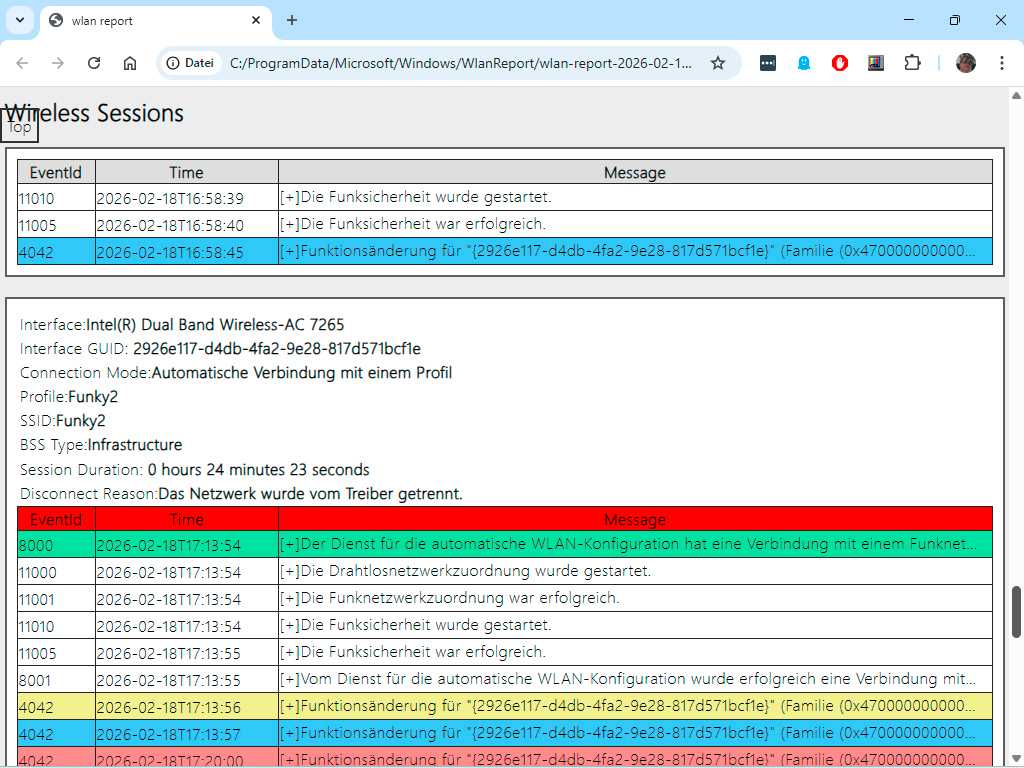
This information can be particularly helpful when troubleshooting network issues. At the very end of the report is the Wireless Sessions section. Here, information such as the connection method and the Wi-Fi network’s SSID is assigned to the Wi-Fi adapters. Furthermore, this section contains the event IDs and descriptions of the events that occurred while establishing the connection.


