When an in-demand product gets scarce, the vultures of consumerism descend. Resellers insert themselves between something people want and suppliers, sucking up every possible dollar to be made. So it went with GPUs and webcams and toilet paper in the pandemic, so it goes with RAM in 2026. For at least one retailer, over 90% of the web traffic for RAM listings came from “scalper” bots.
That’s according to Jérôme Segura, security researcher and VP of Threat Research at DataDome. In a LinkedIn post he claims that over a two-week period, DataDome blocked 91 percent of traffic, identifying it as “bad bots,” with only the remaining 9 percent coming from genuine shoppers or other sources. This is following a report from March (spotted by VideoCardz.com), wherein DataDome found that bots were hitting the same kind of listings at a six-to-one ratio over genuine buyers, detected via a complex series of variables and blocked where possible.
This sort of behavior “suggests automated price monitoring for reselling opportunities.” In English, that means people are using bots to find the lowest-priced RAM kits so they can buy them and relist them at higher prices. It’s nothing revolutionary, or even illegal — this is ye olde “buy low, sell high” in its purest form. But the web surveillance tools being used by unscrupulous resellers are allowing them to squeeze PC consumers at a time when they’re at their most vulnerable.
It’s just another factor making it the worst time in decades to build a new PC, as prices for consumer RAM kits soar 500 percent year-over-year. Storage is affected almost as much, but the knock-on effects of the “AI” data center boom (and suppliers tripping over themselves to feed that ravenous maw) are driving up prices on basically everything electronic. GPUs and CPUs are likewise affected, so prices for finished computers have risen approximately 50 percent. It’s a trying situation for giant manufacturers like Dell and Lenovo, but it’s absolutely hammering smaller companies like Framework and Raspberry Pi.
A simple lack of availability is certainly causing the lion’s share of this problem. But for those of us on the bottom of the totem pole trying to find parts to build a PC, scalpers are exacerbating an already horrible situation. Segura didn’t say which retailer’s data he was using for his post, so I dug a little into Amazon and Newegg, using the RAM in my desktop right now.
I have a 4x16GB DDR5 6000Hz setup, specifically the G.Skill Flare X5 AMD Expo series. It’s hard to estimate exactly how much I paid for it when I had my last major PC upgrade in January 2024, because of multiple sources and Newegg bundles. But this price tracker said without those savings it would have cost about $200 on Newegg. A 2x32GB set costs $468 today, $932 for 64GB, on Amazon. Newegg has it at $490/$980. Ugh.
But big online stores don’t just sell from one source, not in the era of dropshipping. The primary Newegg listing is sold directly from Newegg, but you also have reseller options from three more sources: JB Rapid, Halfmoon Tech, and Tulibao-US. Two of these are roughly at the same level as Newegg, actually beating it by $10 in retail price, possibly costing more with shipping and handling. But Tulibao is selling that RAM for $658.79, a 34 percent markup. That store has the lowest rating by far, incidentally.
Over on Amazon, the primary seller on the 2x16GB listing at the moment is RapidShip, not Amazon itself. There are no less than ten sellers offering the same G.Skill RAM, ranging in price from $465.93 (with slightly slower shipping) all the way to $892.56. At that price the memory I paid less than $200 for a year and a half ago would cost almost two thousand US dollars.
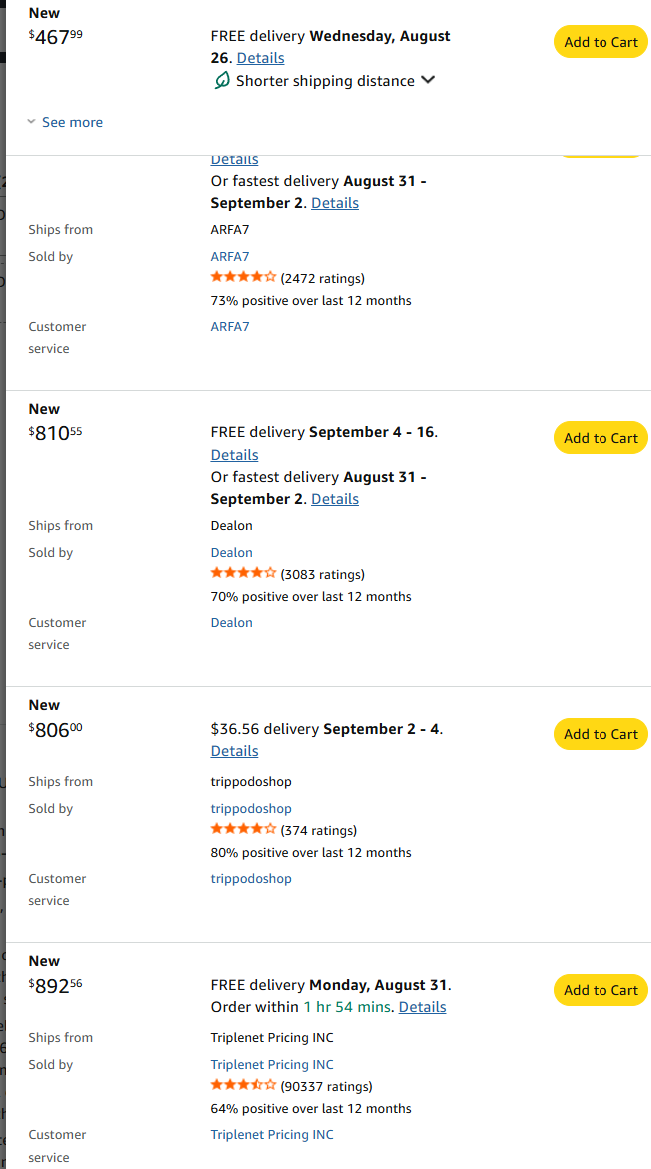
Amazon
I’m not an e-commerce expert. But I’m assuming that the hope here is that as these in-demand RAM kits go out of stock at the nominal “street price,” Newegg and Amazon’s automated systems will slip in those high-priced third-party listings, raising the effective price for buyers in a more or less automatic process.
So if you’re operating a bot that managed to find a single package of the RAM at, say, $450, and you’re patient and lucky, you could flip it for almost double. That’s a best-case scenario for a scalper, but it’s yet another mechanism driving up prices for home PC builders.


