Summary created by Smart Answers AI
In summary:
- Google launched the Googlebook, an AI-powered Chromebook with Magic Pointer feature, as a direct competitor to Apple’s MacBook Neo this fall.
- Macworld reports that the Googlebook’s phone mirroring and file sharing capabilities are more limited compared to MacBook Neo’s comprehensive iPhone integration.
- Despite premium build quality, the Googlebook may struggle against the more affordable MacBook Neo priced at $599, potentially helping Apple sell more units.
Google isn’t shy about experimenting with wacky concepts. The company is well known for releasing and killing dozens of products each year, with its virtual graveyard now housing more than 300 of them. Its latest public beta test arrived this week: an AI-powered Chromebook dubbed the Googlebook.
Googlebooks, not to be confused with Google Books, Alphabet’s ebook storefront, are a new line of premium laptops with Gemini Intelligence at their core. Launching this fall, the devices will offer five distinct features in what Google hopes will set a new standard in desktop computing. The whole concept appears to be a response to the threat Apple’s MacBook Neo poses, updating the Chromebook brand with modern architecture and features.
A closer look at Google’s announcement and marketing materials, however, reveals how the new brand suffers from an identity crisis. The Googlebook seems to be missing a clear direction or purpose, and it risks further increasing the decades-old device fragmentation that plagues Android. With Chromebooks, customers knew what they were getting, but with the Googlebook, that’s not really the case.
Rather than keeping users from jumping to Apple, Google seems to be making the decision to buy a MacBook Neo easier than ever.
Sticky software situation
Like the Chromebook, the Googlebook’s key selling point is its software. The laptop will run an upgraded variant of ChromeOS, featuring native AI integrations. The marquee feature, according to Google, is Magic Pointer, which triggers Gemini to answer questions and perform tasks. So, if you circle a date in an email, for example, you’ll be able to directly add a relevant event in the Calendar app. You could also mouse over multiple images and have Gemini generate a mashup, or hover over a series of numbers to instantly create a chart.
Google’s new Magic Pointer is a fancy version of what Mac users can already do.
It’s all very slick, but Magic Pointer isn’t really an original concept. macOS has long allowed users to instantly create Calendar events by selecting dates detected in text and images. And Apple Intelligence already allows you to inquire about on-screen elements using the native ChatGPT integration (and soon, new Siri). As for fusing images using AI, most desktop users don’t need a tool like this on a daily basis, and the ones who do could easily upload the desired images to ChatGPT or Gemini and prompt them to make the needed adjustments.
Beyond AI, the Googlebook’s OS is essentially an AI-upgraded version of ChromeOS. As such, it suffers from the same main restrictions found in Chromebooks, which include the limited library of professional desktop tools, while alienating users who need a stripped-down, lightweight UI. It’s not the comprehensive desktop operating system you get with a MacBook Neo.
It’s also worth noting that the Googlebook will require an active internet connection for the AI features to work. This suggests that the Magic Pointer could’ve easily been implemented in existing Chromebook models through a basic OS update. The new brand seemingly doesn’t bundle any meaningful hardware upgrades that warrant the exclusivity. It’s almost like Google is desperately searching for new ways to force the AI buzzword onto its products.
The second Googlebook highlight is support for creating custom widgets using AI. For instance, you could ask Gemini to build a widget for your upcoming vacation, which would compile personal data, including relevant reservations, photos, a countdown timer, and so on.
The MacBook Neo already supports desktop widgets, allowing users to add small data bites from their favorite apps. And users can create custom widgets that incorporate different elements using third-party apps. While macOS widgets may not be as intuitive or personalized as asking an AI chatbot, they work effectively. Plus, how often does one change their desktop layout and create or add new widgets?
You’ll be able to access your Android apps on your Googlebooks—just like iPhone users can do with MacBook Neo.
Limited phone mirroring
Speaking of software, Googlebooks also support nearby Android phones. MacBook Neo users are probably familiar with iPhone Mirroring, Apple’s version of the feature. With an iPhone nearby, you can easily access a live view of your notifications, Live Activities, apps, and widgets—right on your Mac’s screen.
Based on Google’s demo, Googlebook’s implementation of phone mirroring appears to be more restricted. While notification forwarding is supported, users seemingly can’t launch and interact with a virtual view of their phone. Instead, it limits you to opening apps installed on it. It’s more like app mirroring than phone mirroring, and it gives users less control over the actions they can perform on their smartphones using their laptops.
Wireless file access
Wireless file access is another Googlebook perk. The feature allows you to instantly browse your Android phone’s local files from your laptop. While handy, Apple already offers convenient file syncing and sharing, as well as an array of Continuity tools on iOS and macOS.
Many Apple users store all of their iPhone files on iCloud, which, by default, makes them and any tweaks they make available on their Macs at all times (and vice versa). For larger local files, AirDrop is a solid tool that utilizes Bluetooth and Wi-Fi Direct for swift data transfer. You can also copy and paste text and images between iOS and macOS, or drag and drop files between an iPad and a Mac. By opting for a MacBook Neo, you’re not really missing out on much here.
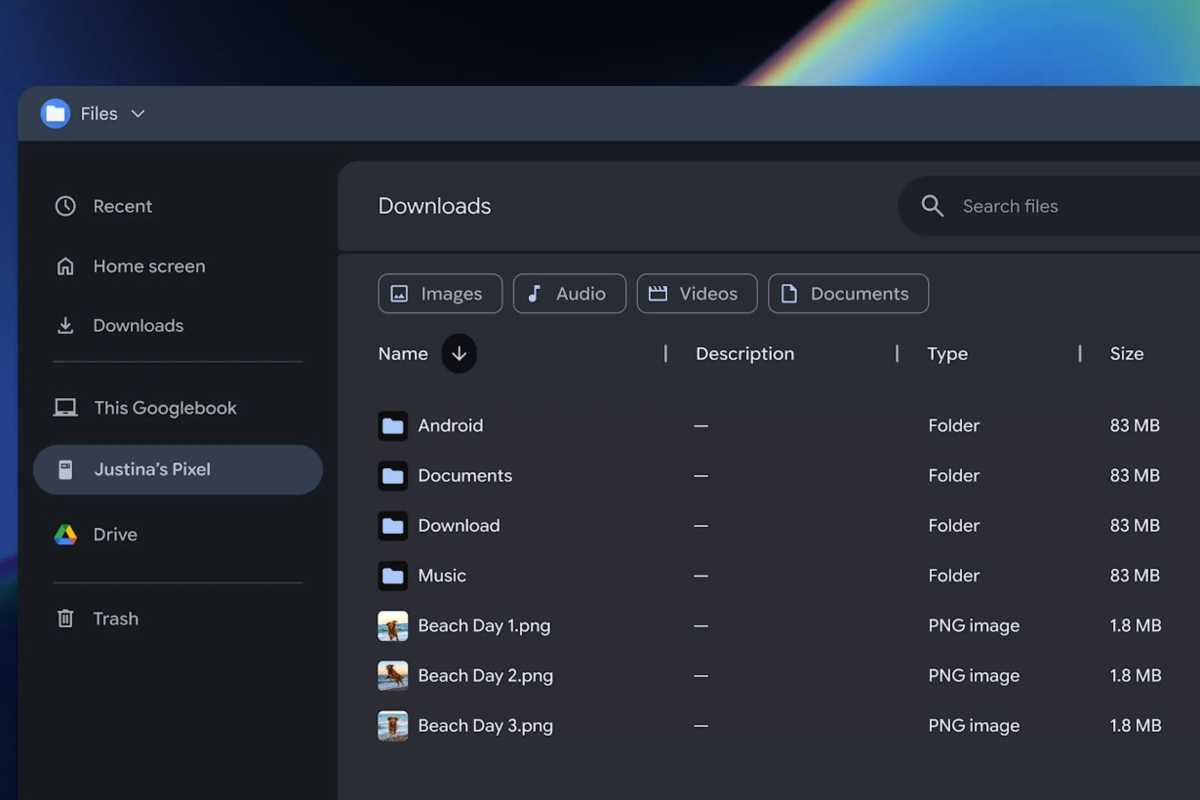
Google is embracing wireless file sharing with Googlebooks.
Premium branding
The Googlebook’s final highlight is its premium build, which probably means they’ll cost more than the standard Chromebook. Even if they look and feel as good as a MacBook Neo, it’s doubtful Googlebooks will be able to undercut Apple’s laptop on price.
That’s Google’s main advantage over the Neo. Many customers tolerate Chromebooks’ limitations because of their affordability. Giving Googlebooks a premium quality while maintaining the constrained operating system doesn’t justify the increased costs.
And given that the MacBook Neo can already do everything a Googlebook can at a mere $599 (or $499 for students), it seems more likely that Google will be pushing people toward the Neo, not away from it.


