At a glance
Expert’s Rating
Pros
- Excellent performance
- Attractive design
- Decent battery life
Cons
- Basic camera setup
- Lack of always-on display
Our Verdict
The iPhone 17e is an affordable phone with many good points (performance, looks, battery life, and, of course, the advantages of iOS) and several noteworthy compromises, such as the notch and cameras. But at least, in contrast to the iPhone 16e, they’re mostly the right compromises. This would make a solid choice for someone upgrading from an older handset, such as the iPhone 12 or 13, switching from Android, or buying their first smartphone.
Price When Reviewed
This value will show the geolocated pricing text for product undefined
Best Pricing Today
Price When Reviewed
$599
Best Prices Today: Apple iPhone 17e
$599
Apple needed to get this one right.
Starting at $599, Apple’s “e” phones are, by far, the cheapest iPhones it sells, and as such, represent many prospective customers’ best way to enter the Apple ecosystem. They’re also Apple’s chance to enter the budget phone market, albeit at the upper end. But despite the MacBook Neo, Apple hasn’t always done a good job of delivering iPhone value at lower price points.
Last year’s iPhone 16e was, in my view at least, a bit of a disaster. It was $170 more expensive than the iPhone SE it nominally replaced, while offering a feature set hampered by a long list of limitations, from the slower processor and single rear camera lens to the lack of MagSafe and any color options other than black and white.
But hopes were high that Apple had learned from that failure. The iPhone 17e is no cheaper than its predecessor and still has a very basic camera, but it gains MagSafe, a third color, and a faster processor. The MacBook Neo showed that Apple can do budget laptops, but will the 17e show it can do budget smartphones too?
David Price / Foundry
iPhone 17e design: Smart, if a little old-fashioned
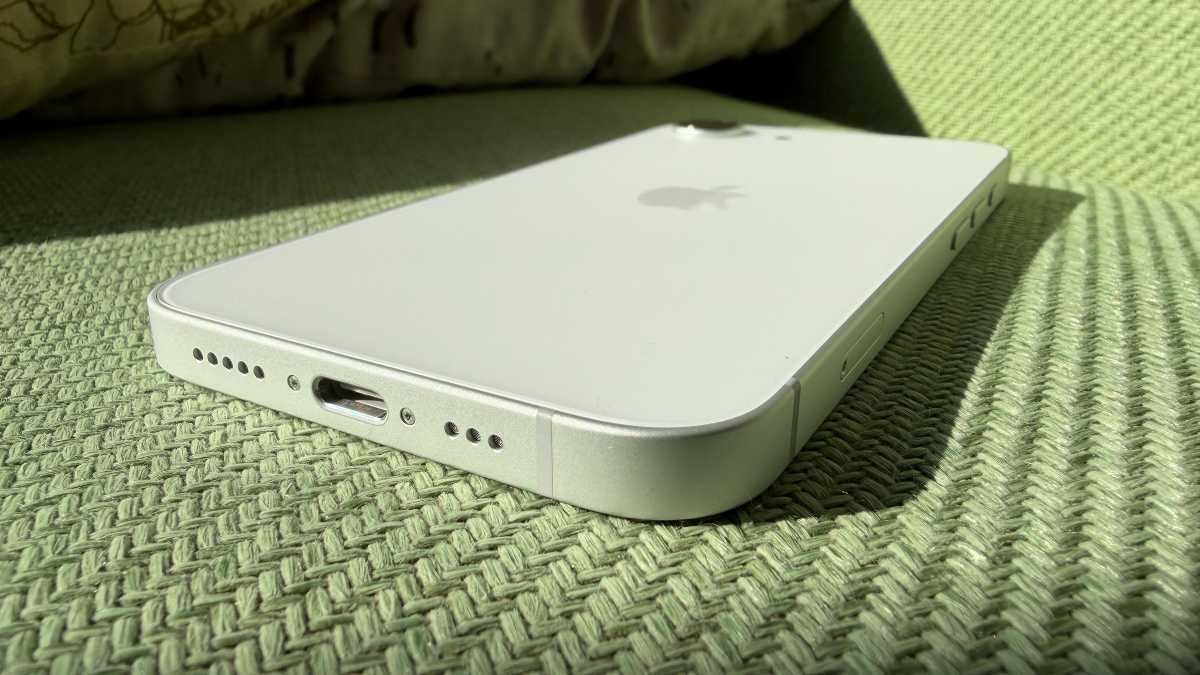
Apple’s policy with the iPhone SE line was to recycle the chassis design of older handsets, and that largely continues with the 16e and 17e. What you’re essentially getting here, at least externally, is an iPhone 14. It’s a slim, attractive phone that feels good in the hand, but compared to recent models there are some old-fashioned touches.
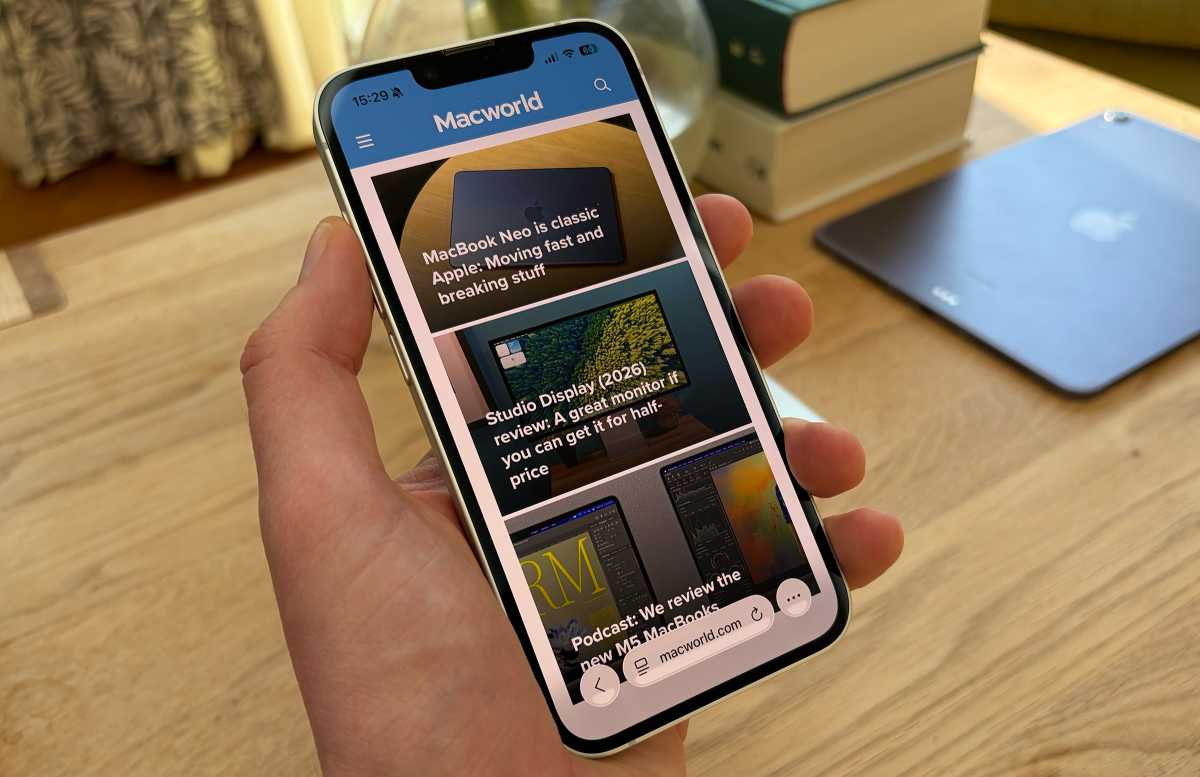
So that means a notch at the top of the screen rather than the later and more useful Dynamic Island, and a 6.1-inch display with thick bezels rather than the 6.3-inch, thin-bezel iPhone 17. There’s also no Camera Control. On the plus side the 17e, like the 14, is only 7.8mm thick, compared to the iPhone 17’s 7.95mm, but I sincerely doubt you’ll notice that. I certainly didn’t.
David Price / Foundry
There are some important differences from the 14, however. You get the Action button, which arrived with the iPhone 15 Pro in 2023 and sits on the left edge above the volume controls. It replaces the mute switch and can simply be used for the same task, but can be reprogrammed to do other functions instead. Nice to have the option, although personally I find the mute function indispensable and leave it as the default almost all the time.
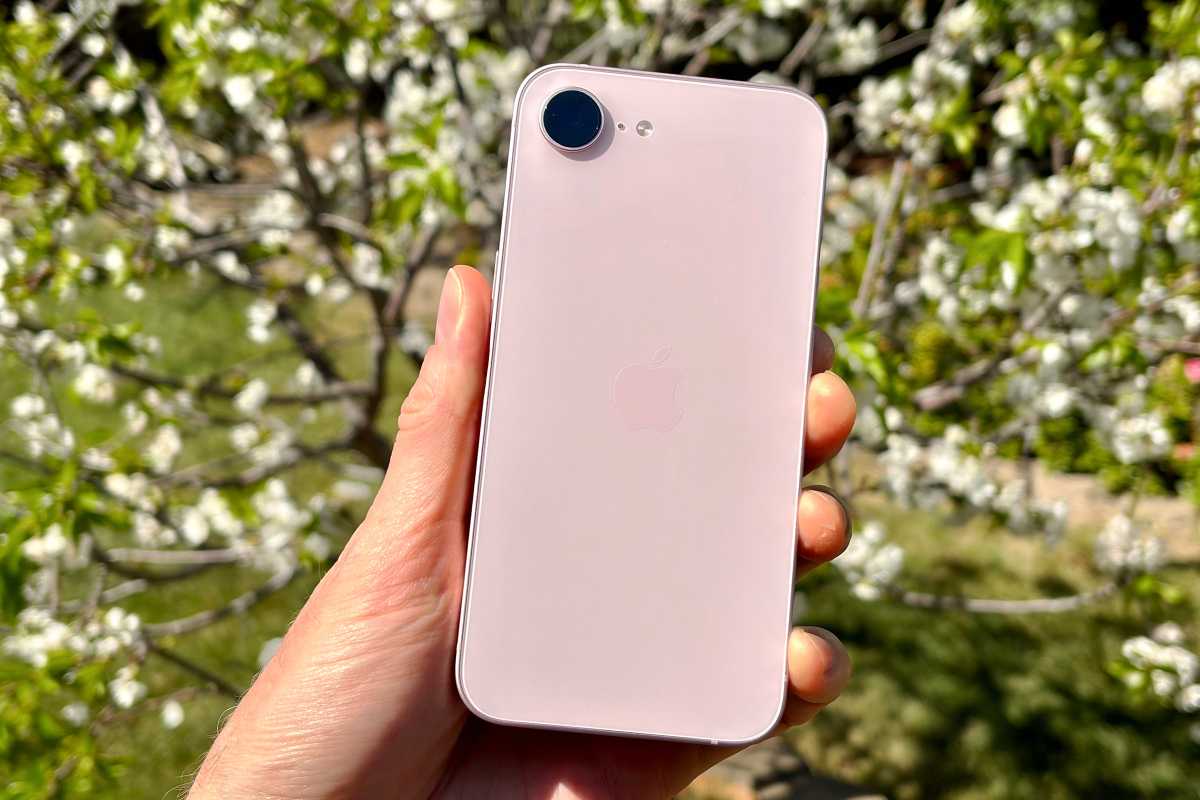
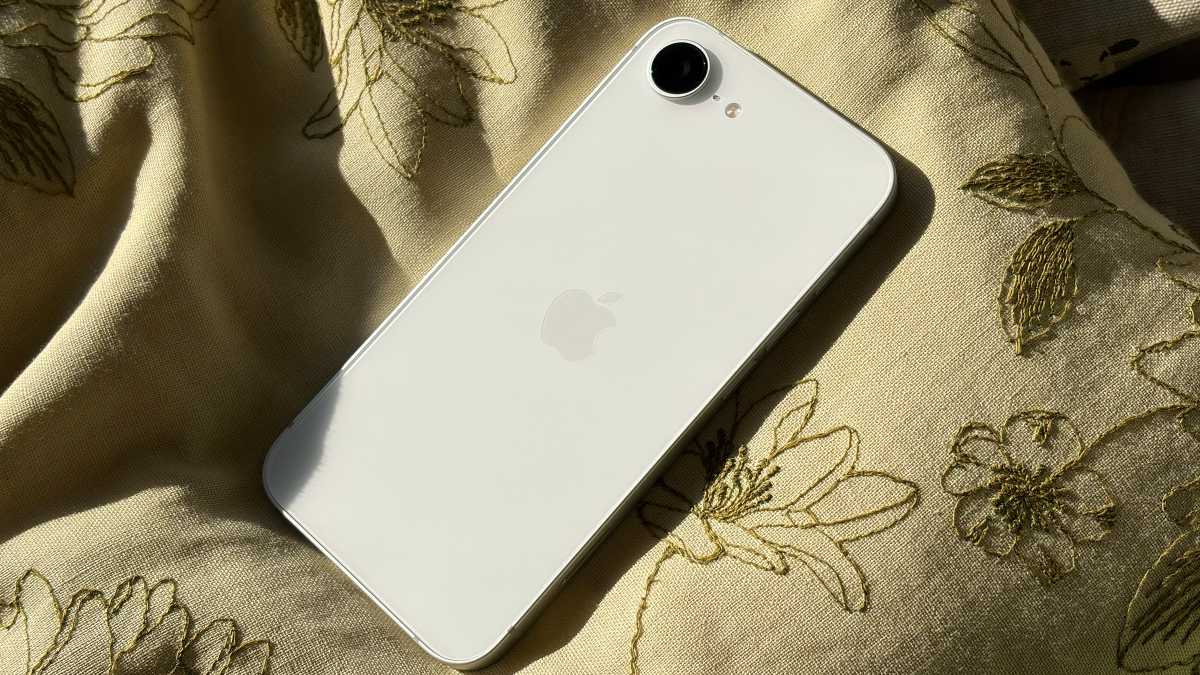
One of several quibbles with the iPhone 16e was that it came, for no obvious reason other than upsell cruelty, in just two colors: black and white. The 17e, pleasingly, gets a third Soft Pink option. Less pleasingly, it’s one of the least vivid attempts at that color in tech history: the emphasis is very much on the soft, not the pink. It would be generous to call it “cherry blossom” and more accurate to call it a “blushing off-white.” If you want your iPhone in pink, this is pink, but only barely, and in some light it looks downright white. If you really want a pink iPhone, you’re going to want to invest in a case with a much bolder hue.
Jason Cross / Foundry
iPhone 17e display: Good but not great
The 17e has an excellent-quality display, and at first glance I assumed it would be one of the product’s crowning glories.
Theres plenty of visual real estate (the screen measures a diagonal 6.1 inches, far larger than the 4.7-inch iPhone SE), with the same super-sharp 460ppi pixel density as even the iPhone 17 Pro at virtually the same resolution, as well as a P3 color gamut. Games, movies, and TV shows, Instagram posts, YouTube videos… everything looks vibrant and sharp on the 17e’s screen. Multitouch gestures are quick and responsive. And while I didn’t risk any especially destructive tests, the 17e’s screen picked up precisely zero scratches during my time with it, while Apple’s testing offers reassurance that the 2nd-gen Ceramic Shield will ensure it collects very few in the future.
Sure enough, for almost everyone who’s likely to be interested in an iPhone 17e, the screen will do you proud. Compared to the 3rd-gen SE, the 14, or the 16e, the quality will in every way be either the same or better than what you’re used to. It’s only if you’re coming to the 17e from something more expensive, such as the iPhone 17, that you’ll notice any issues. But why would anyone do that?
David Price / Foundry
Well, they might do it if they’re a phone reviewer. I came to the 17e from the iPhone 17, and was surprised by the number of small annoyances. Going back from the Dynamic Island to the notch kept confusing my muscle memory—when I wanted to jump back to the top of webpages, I often missed the correct place to tap at the top of the screen— and it’s appreciably more of a hindrance to the enjoyment of movies in particular. I wasn’t really aware of the lack of ProMotion (serious gamers are more likely to notice this), but I very much missed the 17’s always-on display, and found it oddly frustrating having to wait even a fraction of a second to wake up the screen. Visibility is also a little weaker when using the device outdoors.
As I say, these annoyances should only be noticeable to reviewers and those who downgrade their phone for financial or accident-related reasons. But it’s worth knowing the ways in which your experience could improve if you were able to spare a little more cash.
iPhone 17e camera: A manageable weak spot
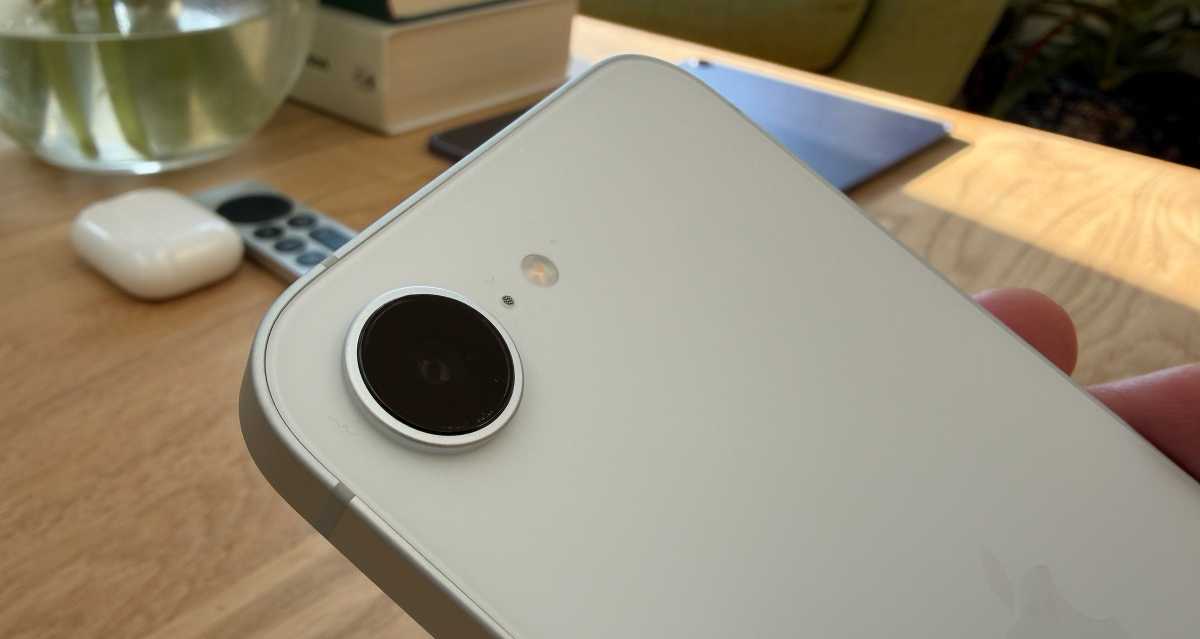
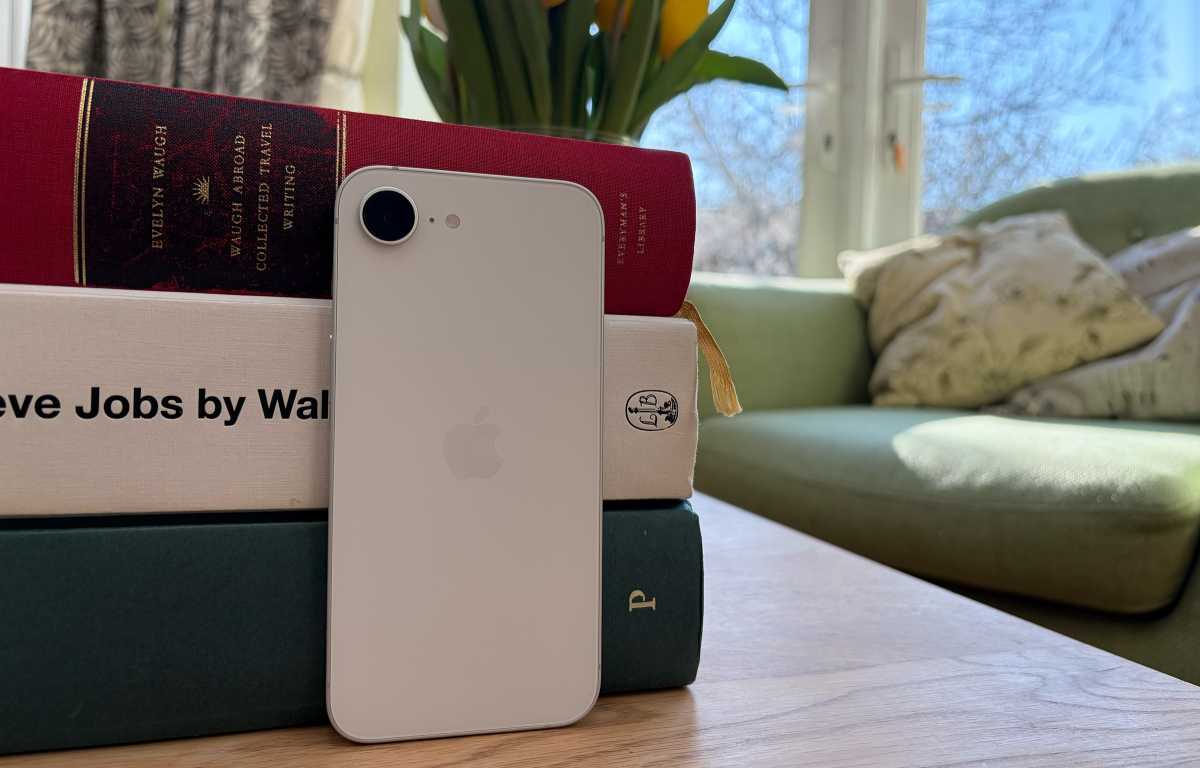
The iPhone 16e’s biggest weakness was its camera setup, which makes it disappointing to discover that virtually nothing has changed in that department. The 17e still has only a single (standard) camera lens on the rear compared to two on the 17 and three on the 17 Pro, and while Apple has done its best to work around this impediment, the experience isn’t quite the same.
David Price / Foundry
Of the two lost lenses, the more worrying is the ultrawide, which is on both 17 and 17 Pro. Without this, there’s no 0.5x anti-zoom, a wonderfully handy option for landscape shots. You also lose the macro mode for better rendition of close-ups.
The biggest loss, however, is the 17e’s inability to do “proper” Portrait photos, by which I mean using a second lens; instead, the bokeh effect is created with software trickery, and it isn’t quite as good. In most of the Portrait photos I took, it was possible to find at least one point where the phone got confused about the edge of the subject’s clothing or hair and smudged the boundary between the two. These are generally very minor errors, however, and not obvious unless the viewer is specifically looking for them.


The lack of the iPhone 17 Pro’s telephoto is less of an issue, but it does mean a significantly weaker overall zoom. Optical zoom tops out at 2x rather than 8x, and even the 2x is created by cropping rather than switching to a different lens. In practice, the 2x zoom is fine, since 48MP is more than enough detail to sustain a little cropping, but long-distance photography isn’t really an option here or on the iPhone 17.
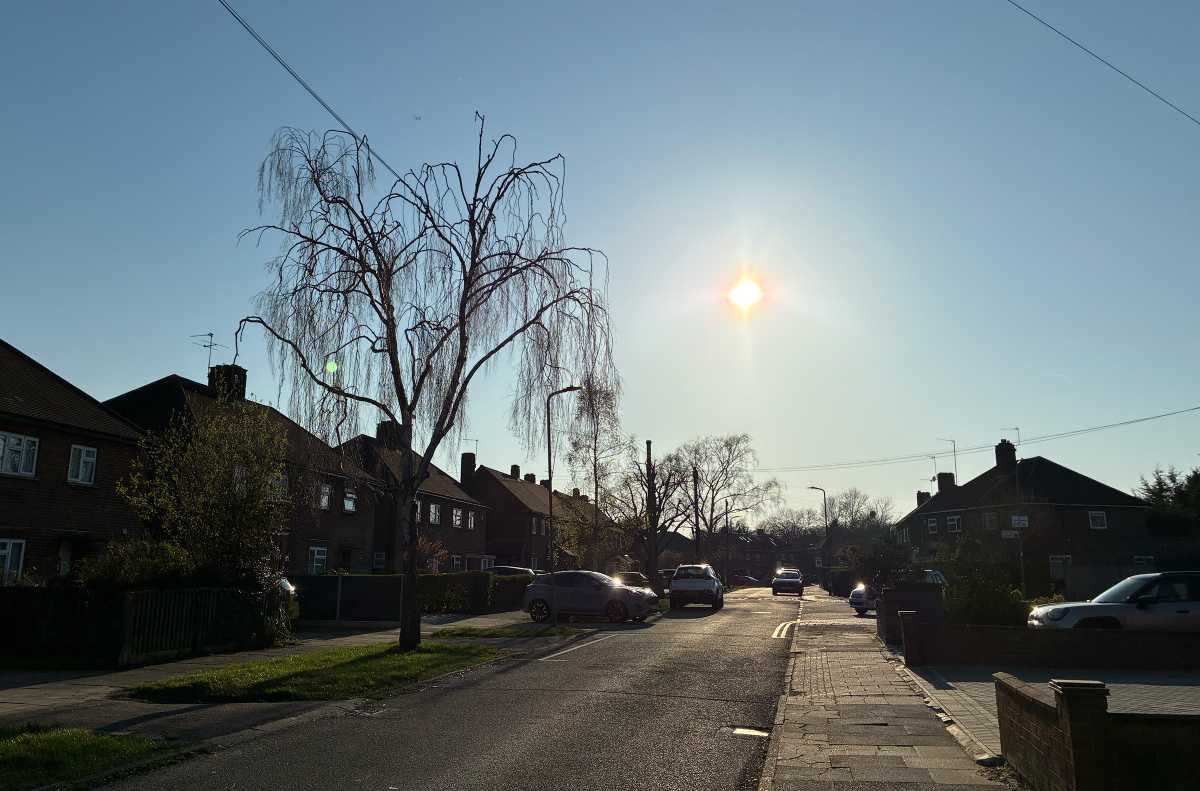
So the weaknesses of the camera setup are still there. But it remains the case that for the majority of your photographic needs, the iPhone 17e will be fine. Portraits are more than passable, even if landscapes are more of a challenge; the 2x zoom is absolutely fine, although it’s a shame not to have anything more than that; and thanks to Smart HDR 5, the 17e did an excellent job of handling challenging lighting conditions. Even with a bright light source directly behind the subject, it was still able to capture a reasonable amount of detail and color fidelity, and one would hope that most of the time, the phone’s owner will compose shots rather more sensibly.
David Price / Foundry
And when it comes to the easier shots that make up 90 percent of an iPhone camera’s duties, the 17e performed admirably, delivering vibrant, colorful images with plenty of detail. It may not have a great camera, but it does have a camera that’s more than good enough for most users most of the time.
Performance: Binned but brilliant
Performance-wise, the iPhone 17e has an impressive spec list for the price: a processor from the latest A19 generation, along with 8GB of RAM. In fact, it could be argued that the 17e is too powerful. In my 16e review, I complained that the inclusion of a latest-gen chip and 8GB of RAM (a feat achieved, presumably, in order to make the device compatible with Apple Intelligence) meant unpalatable compromises in other areas.
It’s worth pointing out that the A19 chip in this phone isn’t quite as cutting edge as its generation alone might imply. Firstly it’s an A19, as on the iPhone 17, rather than an A19 Pro, as on the iPhone 17 Pro, 17 Pro Max, and Air. And secondly it’s not even quite the same as the A19 in the iPhone 17, because Apple selected binned versions of that processor to save money. This means the chips failed manufacturing tests in some minor way and consequently have one fewer operational GPU core.
Binned chip or not, the iPhone 17e was snappy and responsive throughout testing, no matter which app I ran. Even in dedicated benchmarks, which are far more difficult than real-world use, it delivered excellent performance. In terms of pure processing speed, its scores were (as we’d expect) almost identical to the iPhone 17, well ahead of the iPhone 16e, and very close to the iPhone Air.
In graphics tests, the lack of that extra core becomes apparent, but performance was still strong: somewhere between the 16 and the Air, and sometimes coming surprisingly close to the latter.
If you want the very best performance on paper, the iPhone 17 Pro is clearly the model to pick. But in the real world, you’ll struggle to notice a difference between the five iPhones which Apple currently sells: like its costlier siblings with their extra cores, the 17e does everything asked of it at an impressive speed.
The main reason to pay more for a non-binned A19 or A19 Pro (or for a phone, like the iPhone 17 Pro, which has 12GB of RAM) is for the sake of future-proofing. The apps of the coming months and years will steadily become more demanding as the hardware available to run them grows more capable; the 17e will start to struggle, particularly on high-end games, video-editing apps and the like, a year or two earlier than 17 Pro. But if you only intend to use the phone for basic tasks, you’ll get sick of its camera setup or diminishing battery life long before performance becomes an issue.
iPhone 17e Battery performance: Solid, not spectacular
There’s a chunky battery inside the 17e, clocking in at a capacity of 4,005mAh. That’s the same as the 16e, and bigger than the iPhone 17 (3,692mAh) and Air (3,149mAh). So we should be expecting terrific battery life, right? Not so fast.
Battery life isn’t simply a function of battery capacity. The iPhone Air has a tiny battery by recent standards but performs reasonably well in benchmarks because Apple’s engineers devoted so much effort to making the components work more efficiently. So good a job did they do, in fact, that the Air lasts longer than the 17e in the Geekbench 4 battery test.
The iPhone 17e managed a solid but unspectacular 14 hours and 14 minutes: some way ahead of the 16e (13 hours, 38 minutes) and some way behind the Air (14 hours, 40 minutes). The Pro models are way off in the distance.
Whether this somewhat mediocre performance is an issue for you depends on what you intend to do with the 17e and how much of your time is spent away from a power supply. Bear in mind that the Geekbench 4 test, while reliably consistent for phone-to-phone comparisons, is not necessarily reflective of real-world usage and tends to be a lot more demanding.
In practice, I found that the phone comfortably made it through a single day’s use, ending up with anywhere from 25 percent to 50 percent of remaining charge when I went to bed. (If you plan to do a lot of gaming, be aware that this tends to burn through the 17e’s reserves more rapidly than other activities.) As the battery health declines over the life of the phone, those numbers will go downwards, so keep that in mind too.
David Price / Foundry
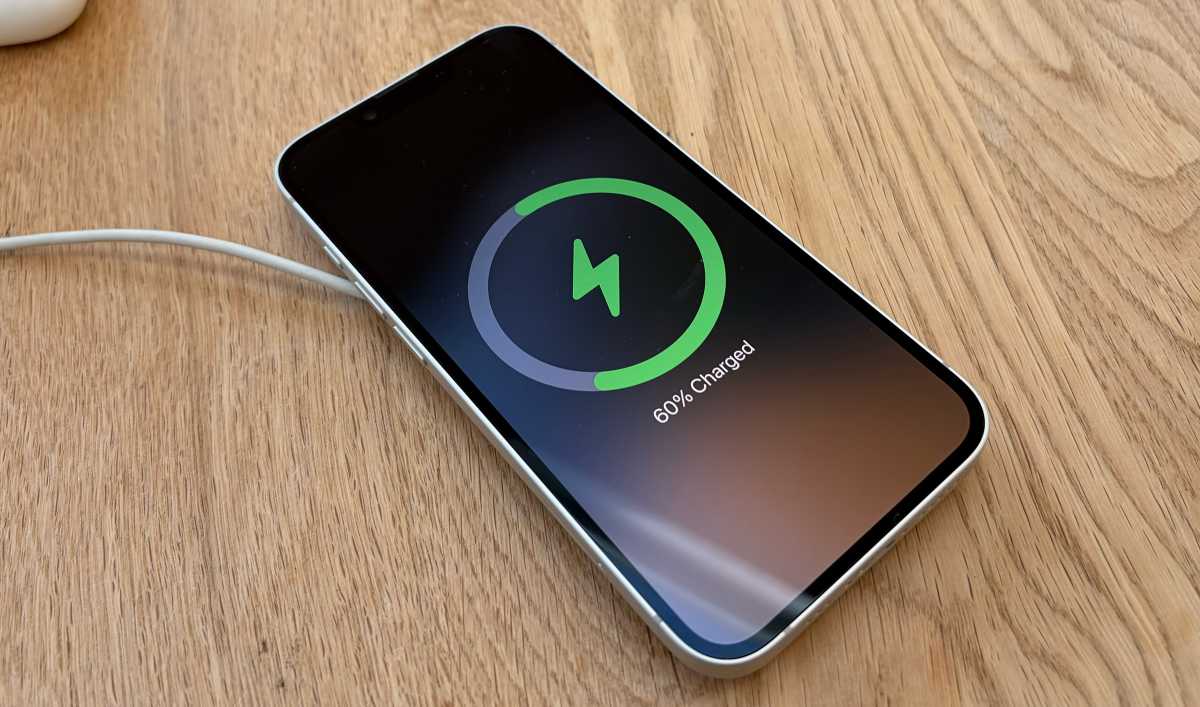
As for charging, here comes the single biggest piece of good news this review will contain: the iPhone 17e supports MagSafe. This is a hugely appreciated upgrade that means you can wirelessly charge the phone without having to worry about a) placing it on the charging puck’s sweet spot or b) making sure you don’t accidentally nudge it off. The magnets will pull it into the correct placement and hold it there securely, and I couldn’t be happier with the added convenience this brings. (If this seems like an overreaction, read this piece about my frustration with the 16e’s lack of MagSafe.)
This is a budget phone we’re discussing here, so of course, it’s not all good news. For unknown reasons, Apple chose to equip the 17e with a slower version of MagSafe than is common on other recent iPhones; it’s capped at a maximum charging speed of 15W, compared to 25W on the iPhone 17 and 17 Pro, 22W on the iPhone 16 and 16 Pro, and 20W on the iPhone Air. I ran some tests and discovered that this means the iPhone 17e takes around an hour longer than the iPhone 17 to charge from zero to full capacity.
Is this ideal? No. If Apple offered to send round a team of engineers to upgrade my iPhone 17e to 25W MagSafe at no charge, would I accept? Of course. But is this a disaster? Absolutely not. Wireless charging is all about convenience. Whenever speed is a priority, you can use a cable.
As I explain in a separate article, the inclusion of 15W MagSafe strikes me as a very sensible compromise: exactly the sort of sensible compromise that was missing from the iPhone 16e. Having no MagSafe at all was annoying and added unnecessary friction to a common action. Having 25W MagSafe is a luxury that’s nice to have in a few situations, but mostly won’t make any difference. This, I think, was a good decision.
iPhone 17e Price: Unexpected generosity
MagSafe is a big deal, but so is Apple’s decision to double the starting storage. We now get 256GB for $599, and that could be a game-changer. The 16e’s 128GB storage was fine, but we recommended upgrading to 256GB, especially with Apple Intelligence eating up a good chunk of it. So that’s essentially a $100 price cut. But now you’ll need to spend $200 to bump the storage:
- iPhone 17e (256GB): $599/£599
- iPhone 17e (512GB): $799/£799
David Price / Foundry
Should you buy the iPhone 17e?
When Apple announced the iPhone 17e, my first thought was that it was too similar to last year’s disappointing 16e. The price (still a shade higher than I’d like) and camera setup (still rather basic) haven’t changed at all, and for many budget phone buyers, these will be two of the most important criteria. Other negatives, such as MagSafe support and the range of color options, have changed, but with limitations–namely, the speed of MagSafe and the insipidity of the pink finish.
But with time and familiarity, I’ve grown fonder of the iPhone 17e. Upon reflection, MagSafe’s charging speed is far less important than its convenience, and having even 15W MagSafe is a major upgrade. The starting price may be the same, but you now get twice the storage as last year, and the step up from 128GB to 256GB is an important, even game-changing one. When you add in the faster (albeit binned) A19 chip and improved scratch resistance, this becomes a worthwhile upgrade on what I felt was a misguided predecessor.
This is an affordable phone with many good points (terrific performance, attractive design, decent battery life, and of course the advantages of iOS) and several noteworthy compromises, such as the notch, the lack of an always-on display, and the cameras. But at least, in contrast to the iPhone 16e, they’re mostly the right compromises. It feels like decisions were made for the benefit of the customer, rather than the company that made them.
If photography is your top priority, look elsewhere. Otherwise, this would make a solid choice for someone upgrading from an older handset such as the iPhone 12 or 13, switching from Android, or buying their first smartphone.
David Price / Foundry


