Jensen Huang is gone. Nvidia’s gaming problem isn’t.
Jensen Huang built Nvidia into a technological powerhouse on the backs of PC gamers, then turned it into an AI empire that barely needs our money anymore. Now, after 33 years, he’s out. Could Nvidia’s next CEO finally give GeForce some much-needed love?
Don’t hold your breath. The leather jacket may have left the building, but the business incentives that pushed gaming aside aren’t going anywhere.
Welcome to The Full Nerd newsletter—your weekly dose of hardware talk from the enthusiasts at PCWorld. Missed the surprising topics on our YouTube show or the latest news from across the web? You’re in the right place.
Want this newsletter to come directly to your inbox every Friday? Sign up on our website!
Huang’s legacy in PC gaming is extraordinary. Nvidia popularized the term “GPU” with 1999’s GeForce 256 (a member of Full Nerd’s PC Hardware Hall of Fame), helped usher in programmable shaders, and pushed real-time ray tracing, DLSS, and neural rendering into gaming. Nvidia’s graphics engineers have spent decades pulling off technological feats that once seemed impossible, and I’ve spent much of my career marveling at their work.
But Huang’s biggest achievement may be recognizing that GPUs could do far more than render games. CUDA opened Nvidia’s processors to general-purpose computing in 2006, laying the groundwork for the accelerated computing revolution that eventually made Nvidia the dominant force in AI hardware. That took vision, patience, and an enormous appetite for risk.
Gaming helped build Nvidia. Somewhere along the way, it became a side hustle.
The cryptocurrency booms gave enthusiasts an ugly preview of what happens when somebody with actual money on the line wants graphics cards more desperately than gamers do. AI has taken that dynamic to another level, though the hardware situation is different. Data centers aren’t simply buying GeForce cards off store shelves, but their enormous demand influences manufacturing investment, supply chains, and Nvidia’s priorities.
Just follow the money. Nvidia’s latest quarterly results: $89 billion from data centers. $96.2 billion in total. That means data centers account for 92.5 percent of total revenues.
…and that’s why you can’t find GeForce RTX 5090s anymore, even for $7,000 or more. Those dies are going to AI data centers now.
Adam Patrick Murray / Foundry
Dr. Ian Cutress, chief analyst at More Than Moore, estimates that gaming accounts for roughly 5 to 7 percent of Nvidia’s revenue, possibly less. That’s billions of dollars, but against Nvidia’s AI empire? Cutress told me via email that some investors would rather see GeForce gone entirely.
Here’s the irony: The man who made gaming a footnote at Nvidia may also have been one of the biggest reasons GeForce still matters inside the company.
“Gaming exists because it’s the core of Nvidia’s legacy, however that legacy is directly tied to Jensen,” Cutress said. Huang was a gamer himself, and Cutress believes that personal connection matters. An Nvidia veteran like CUDA co-creator Ian Buck “would probably feel the gaming side of the company in their veins and keep it continued as a business unit” more than an outsider brought in to squeeze every possible dollar from the business, he said.
Nvidia’s gaming technology also benefits from the company’s broader AI research. DLSS is a spectacular example cited by Cutress. There’s plenty of technological overlap worth preserving, even if the business incentives increasingly favor data centers.
Nvidia may make its own graphics cards, but it’s reliant on a large manufacturing funnel to actually create them, from TSMC dies to memory manufacturers and beyond.
Thiago Trevisan / IDG
Nvidia doesn’t manufacture its own chips or memory. TSMC fabricates much of its silicon, while companies including SK Hynix, Samsung, and Micron make memory. AI accelerators typically use high-bandwidth memory (HBM) and advanced packaging, while GeForce cards rely on GDDR and different packaging technologies. These aren’t interchangeable production lines, though they compete for some upstream resources and investment.
Cutress describes the manufacturing problem as assembling a “matched set.” Missing one component? Nothing ships. An HBM shortage could kneecap AI accelerator production without touching GeForce, but Nvidia can’t just flip a switch and start pumping out gaming GPUs.
And if you want to know where the memory industry’s head is at, don’t listen to what they’re saying. Listen to what they’re not talking about.
“When I speak to memory vendors, there are only two words on their mind. HBM and DDR (or LPDDR),” Cutress says. “We never hear them talk about GDDR… GDDR8 hasn’t been standardized yet and is expected more towards the end of the decade, if anyone makes any at all. Memory vendors make what is demanded of them, and right now that’s a shed-load of HBM and a barrel or two of DDR, not GDDR.”

The same reason you’re paying exorbitant amounts for DRAM is the same reason memory manufacturers aren’t focusing heavily on the fast GDDR memory used by graphics cards: AI is sucking all the air out of the room.
Nvidia can’t simply tell its suppliers to stop making AI hardware and start cranking out affordable GeForce cards. But Nvidia isn’t some helpless bystander. It decides what to build, negotiates capacity, and throws around enough money to shape what its suppliers make.
Just last month, Nvidia announced sweeping expansions of AI-oriented packaging, substrates, and testing capacity, highlighted by a $1.1 billion advance supporting new testing facilities. Those commitments will continue long after Huang’s departure. So will the financial incentives behind them.
A new CEO could push for more GeForce cards, better memory configurations, and prices that don’t make weary gamers wince. But every dollar spent chasing gamers is a dollar tomorrow’s Nvidia could put towards its AI gold rush.
Nvidia hasn’t stopped innovating for gamers. DLSS has transformed how games render frames, and neural rendering aspires to push graphics even further, despite early pushback. You can admire Nvidia’s face-melting technology while being utterly fed up with the prices and product compromises required to enjoy it. The GeForce RTX 5090’s $1,999 launch price is a pretty spectacular example. At $1,999, the GeForce RTX 5090 felt less like a flagship for gamers than a luxury tax on the privilege of owning Nvidia’s best silicon.
Nvidia says its existing product roadmap will continue uninterrupted under interim CEO Colette Kress. That’s reassuring for anyone excited about the next generation of graphics technology (like me!), but it doesn’t tell us whether the company intends to make its advances more accessible for the gamers who helped build Nvidia GPU by GPU over the decades.
Jensen Huang didn’t stop making GeForce better. He built a company that no longer has to make GeForce a better deal. We’ll see what his eventual successor thinks.
In this week’s episode(s) of The Full Nerd
It’s been a hell of a week for PC hardware news, meaning we shot not one, but two episodes over the last few days. I’m tired, boss.
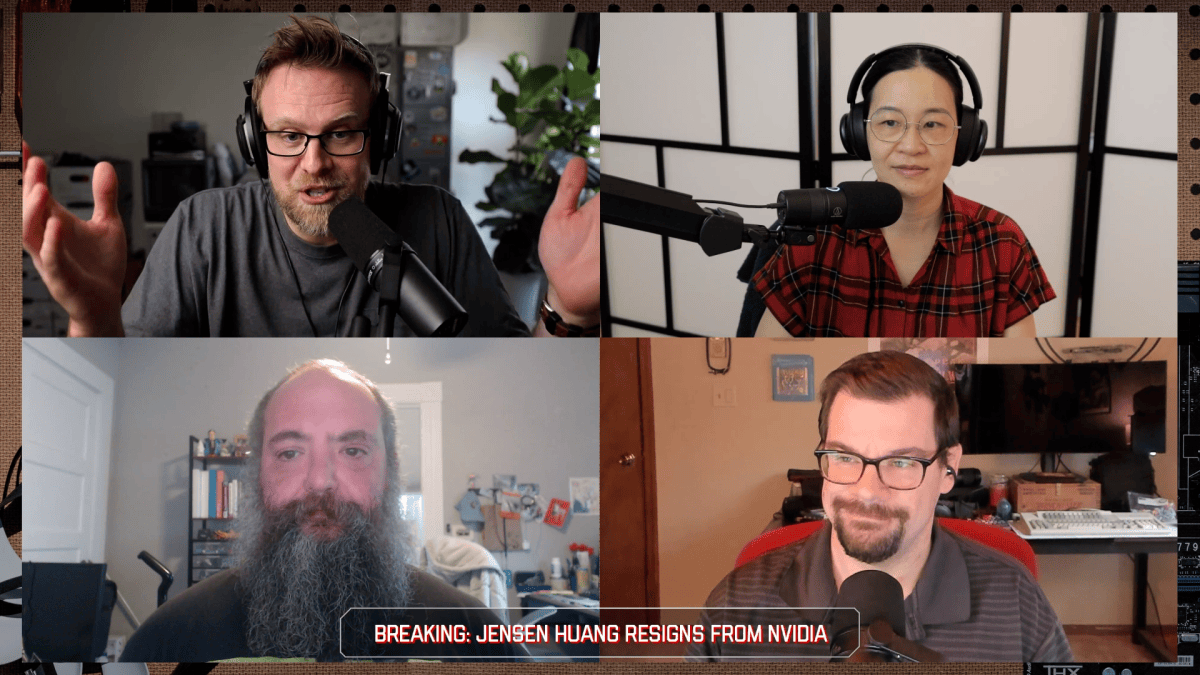
Jensen Huang’s sudden resignation was big enough that we fired up the cameras for an emergency episode of The Full Nerd Thursday. We dig into Huang’s extraordinary legacy, Nvidia’s future without its founder at the helm, and the question PC gamers really care about: Will any of this actually change GeForce’s fortunes? There’s plenty to unpack (a lot of which I just unpacked above, but not all of it).

And don’t miss our regular episode from earlier this week, featuring special guest Jake Roach of Tom’s Hardware! Jake’s a fantastic hardware journalist with a deep understanding of CPUs, and it was a blast having him join the gang to chew over AMD’s Zen 6 developments, Valve’s latest moves to push Steam beyond traditional PCs, and the week’s other hardware news. Big thanks to Jake for hanging out with us!
More nerdy goodness
Over the past week, I dug deep into Valve’s audacious plan to break Steam free from Windows and traditional gaming PCs, including exclusive insights from Valve engineers about a future where your Steam library doesn’t care what chip or operating system you’re using. I also uncovered Valve’s clever plan to squash Arm gaming stutter before you even launch a game. I’m fascinated.
And a huge shout-out to our Full Nerd guest Jake Roach over at Tom’s Hardware, who got his hands on AMD’s next-gen Zen 6 chips and published a monster deep dive packed with actual benchmarks. He also talked to AMD’s architects about the industry’s sudden obsession with “agentic AI” CPUs. Great reporting from a great guest! I took at stab at the announcement as well, detailing how with Zen 6, AMD’s next great gaming CPU could truly have it all.
Aaaaaaaaand that’s it for this edition of the Full Nerd. Be sure to sign up for the Full Nerd newsletter to get it shipped directly to your inbox every Friday, and subscribe to our Full Nerd and PCWorld YouTube channels to watch the deep dives as they happen. Stay tuned for a debut dispatch from Adam Patrick Murray next week!


