What a funny coincidence that celebrations of Apple’s 50th anniversary would hit the same month that the company introduced the MacBook Neo, a $599 laptop that has the potential to take the Mac to new heights.
The facts that Apple was founded in 1976 and the MacBook Neo exists in 2026 shouldn’t have anything in common but that they both involve a corporation called Apple. But that’s not right: Apple’s product philosophy is more continuous than you might imagine, and that string that starts with the Apple I ends, 50 years later, in a colorful new MacBook Neo.
Apple was born in a chaotic world. Dozens of personal computer companies were building early devices, and each of them was its own island with its own software running on custom hardware. New chips and new hardware innovations like floppy disk drives (did you know that the earliest Apple computers could only read data from audio cassettes?!) meant that as a computer company, you evolved rapidly or you died.
Most of them died, of course. But Apple didn’t, in part because it was always adopting the next big thing in order to survive. It was a mindset that I always connect to Steve Jobs, a man with absolutely zero sentimentality. Apple has always been a company that knows that it needs to move forward rapidly to survive.
Steve Jobs believed in always moving forward and not getting sentimental about the past. That philosophy has served Apple well.
Apple
This has been a factor that has remained in the corporate culture, to varying degrees of strength, for 50 years. It’s not that Apple doesn’t care about taking care of its customers–it’s managed three chip transitions and one operating system transition on the Mac while providing solid support over a transitional period.
One reason this culture got reinforced is that Apple has never been the dominant ecosystem player in any market it’s competed in. (The iPod was dominant, but not really much of an ecosystem.) When you’re dominant, like PCs driven by Microsoft’s DOS and Windows operating systems, the name of the game is compatibility. Once you’ve got the bulk of the market, it’s all about consolidation.
Over time, stability and compatibility became a major reason why Microsoft was so successful. Old Windows apps just kept running. Microsoft built an entire culture about supporting its enormous base of customers, many of whom were using ancient hardware and software.
The problem with that strategy is that it’s a really bad fit for times of great opportunity. As former Microsoft executive Steven Sinofsky wrote recently, Microsoft’s greatest strength suddenly became its greatest weakness. “The pull and push of forever compatibility was not just ‘Windows DNA,’ but it was the soul of what made Windows successful and was sacred.”
Apple has the freedom to make game-changing moves to make better products.
Apple
The funny thing is that Sinofsky wrote that in the context of praising the MacBook Neo, of all things. Here’s why: Apple has constantly upgraded its operating system and ecosystem, from drivers to APIs to apps to the chips that run them. It’s been able to drag its technology forward in ways Microsoft never could.
Part of that was embracing touch interfaces with the iPhone and iPad. It’s not that Microsoft didn’t have some great ideas about touch interfaces–some of the stuff it did was really cool!–but that in the end, its loyal customers pulled it backward into the abyss. The first touch-savvy version of Microsoft Office ran on the iPad. Microsoft’s own touch-friendly devices backslid to the old mouse-driven versions.
The crowning achievement of all this was Apple’s embrace of its own, ARM-based chip architecture. Again, it’s not as if Microsoft and its chip partners didn’t see the strength that an Apple-style chip strategy might have. It’s that Microsoft’s customers just weren’t interested in losing compatibility with their enormous investment in Intel PCs, and Microsoft’s commitment to “run everything forever,” as Sinofsky calls it, hampered all attempts to see things differently.
In the other corner: Apple, which for the last five-plus years has been shipping Macs running ARM processors, on top of a version of macOS that spent the years running up to that transition by killing off compatbility with a lot of old software that would’ve made that transition a challenge.
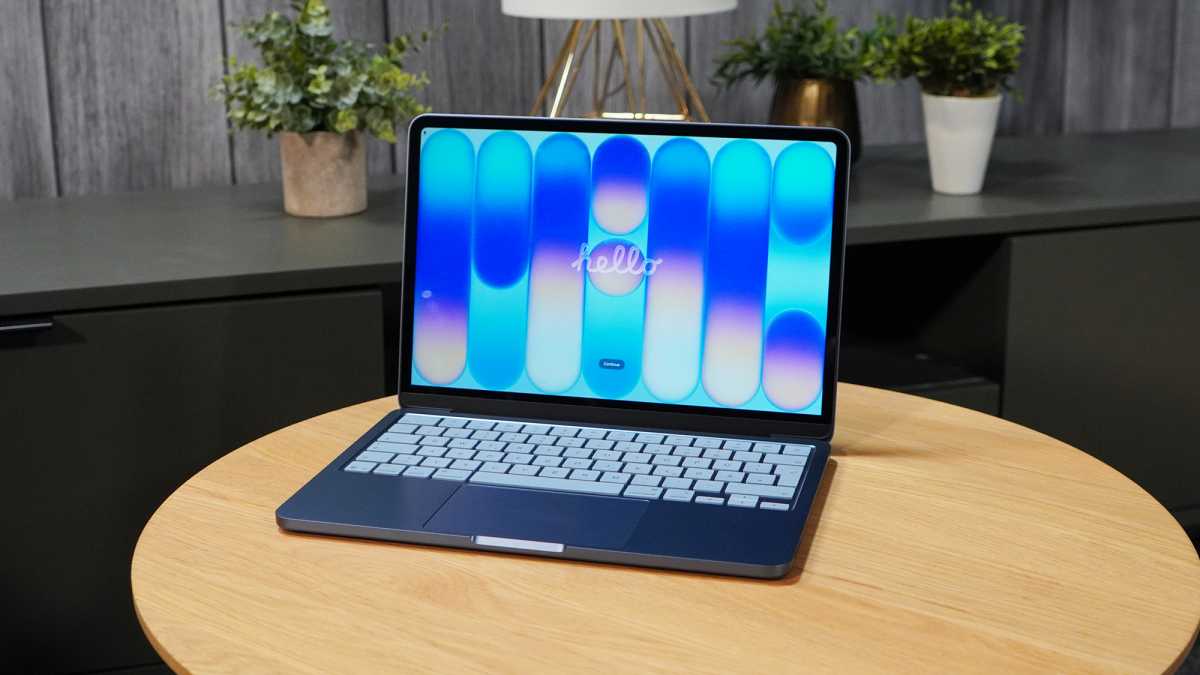
Apple’s ability to advance its technology allows it to create a budget laptop that offers quality that its competitors can’t match.
Eugen Wegmann
This brings us to the MacBook Neo. It is the result of Apple being unafraid to break compatibility with 32-bit apps, with the old Carbon APIs, with Intel processors, the works. Part of the magic is that, as Mac users, we often don’t even notice when Apple does this, because it’s gotten pretty good at making it easy for us to migrate. (Software developers have had a harder time, often spending summers modifying their apps so that they still work when the new OS versions ship in the fall.)
50 years on, this is still Apple’s core approach: Don’t be afraid to change. Don’t be afraid to leave some old things behind. Not because change isn’t painful, because it often is. But because without change, without the ability to move forward, you’ll never be able to take advantage of new opportunities. And if you’re Apple, you’ll never be able to make a MacBook Neo.


