So let me set the scene here.
It’s Friday afternoon, and I’m picking up a few friends for a Taylor Swift-themed hangout later on. But the backseat of my car is covered in dog hair, and I’m in no mood to wrestle one of those long-hosed vacuums at my local car wash. The suction on those things sucks anyway. Literally.
And then it dawned on me.
I’ve got two robot vacuums upstairs. What would happen if I just stuck one of them in the back?
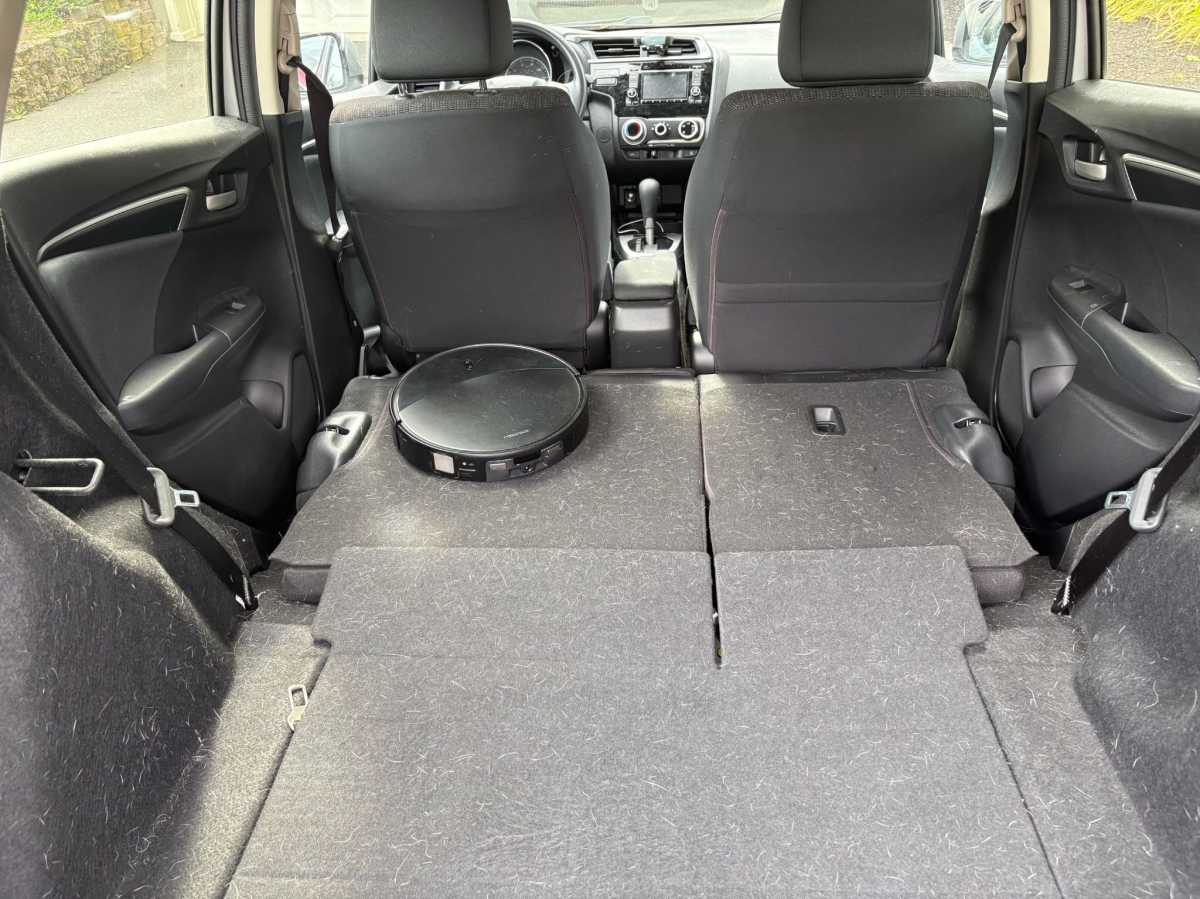
Just to give you a visual here, my car is a hatchback, so it’s shorter than a sedan. I’ve also got a giant greyhound, so I tend to drive with the back seats folded flat (he needs a lot of room!). In other words, it’s a (mostly) flat area. Surely a robot could handle that?
Or so I thought.
First, I plopped the budget robot vacuum in the back of my car. It’s got a suction power of 20,000 Pa, which is pretty good for a budget model. (In case you’re curious, it was the Dreame D20 Air Plus).
Next, I programmed it to run in Standard mode. After it created a small map of the back of my car, it ran for about… five minutes. When the Dreame app told me it was finished cleaning, I scoffed.
No way.
So, I ran the robot vacuum again. But this time I turned up the suction level to maximum power.
Sigh.
Again, it finished in five minutes. I understand it’s a small space, but I expected the robot to spend more time cleaning the area. It’s definitely more thorough when it’s zooming about the house. I don’t think it sucked up a single strand of dog hair, either.
My next plan? Trying a more advanced model with 35,000 Pa of suction. Maybe the trick here is more suction power.
Uh, nope. It did worse than the budget model.
First, it got stuck on a weird ledge and wouldn’t move because the wheels were lifted. It did manage to successfully map the back of my car (hilariously enough, the app labeled this area “Kitchen”), but when I tried to run it again, it got stuck on the same exact ledge. (It’s the Roborock Saros 20, by the way).
Why suction power isn’t the issue
So why didn’t this work?
Well, it turns out that a car is a much weirder environment for a robot vacuum than you might think.
Foundry / Ashley Biancuzzo
Even with the back seats folded down, my car doesn’t have one big, continuous expanse of flooring. The folded seats actually create a small hill in the middle. There’s also a few ledges at the corners where the surface drops down to the floor. This was enough to trip up the more expensive robot (the Saros 20). When one of the wheels lost contact with the ground, it stopped. That’s when I had to step in and physically move it. Unfortunately, it wasn’t able to finish a single cleaning cycle.
These machines are designed to navigate predictable environments. Give them hardwood floors, furniture, a few walls, and they’re pretty good at figuring out where they can and can’t go.
A car is a totally different story.
I don’t think the robot vacuum can tell the difference between a raised ledge it can theoretically climb over and a step it absolutely cannot. It just sees a floor it thinks it can navigate. And when it gets that wrong, all the suction power in the world doesn’t matter.
It’s also worth noting that the carpet in your car is very different from the carpet in your house. Automotive carpeting is usually flatter and more tightly constructed. It’s supposed to be more durable, able to withstand the constant friction from shoes. House carpets have more variation in terms of pile and texture–they can be softer and more flexible. That’s more of a robot vacuum’s bread and butter.
That’s the lesson I took away from this ridiculous experiment. I went into this thinking suction power was the key here.
It isn’t.
A robot can have 20,000 Pa or 35,000 Pa, but suction is only useful if it’s cleaning an area it knows how to handle.


