When the Nintendo Switch 2 remake of The Legend of Zelda: Ocarina of Time dropped its dedicated gameplay trailer, lots of fans (me included) were intrigued by a new interactive element that took advantage of the console’s microphone feature.
When Link plays the ocarina, you can either hum the tune on the screen or play it with an instrument instead of tapping buttons on the controller. The ocarina is a key item in this game – you need to play it to unlock new locations, call on characters for quest advice, change the day and night cycle, and much more.
As someone with a musician in the household, I was eager to give this a whirl and see how the game responded. Sadly, the results were pretty mixed.
Sorry, can you repeat that?
We were too quiet for the Switch (apparently).
Now, I wouldn’t say we’re that far away from our TV unit, which houses our Switch 2. Maybe a few feet at most? The wooden baby playpen that’s in front of it could be blocking some sound, but that’s unlikely.
Nintendo
Nonetheless, we often had to hum rather loudly or move closer to the console to get our sound recognized in the first place. That does detract from the ‘”fun” element. It’s also especially frustrating, as a tech journalist, when you can’t get something to work as intended.
In the interest of fairness, I tried it out in handheld mode. I had much more success with humming, but my husband’s guitar (literally a step away) was deemed “Too quiet.”
Once we did get our tunes heard, we ran into another issue…
Right notes, wrong order
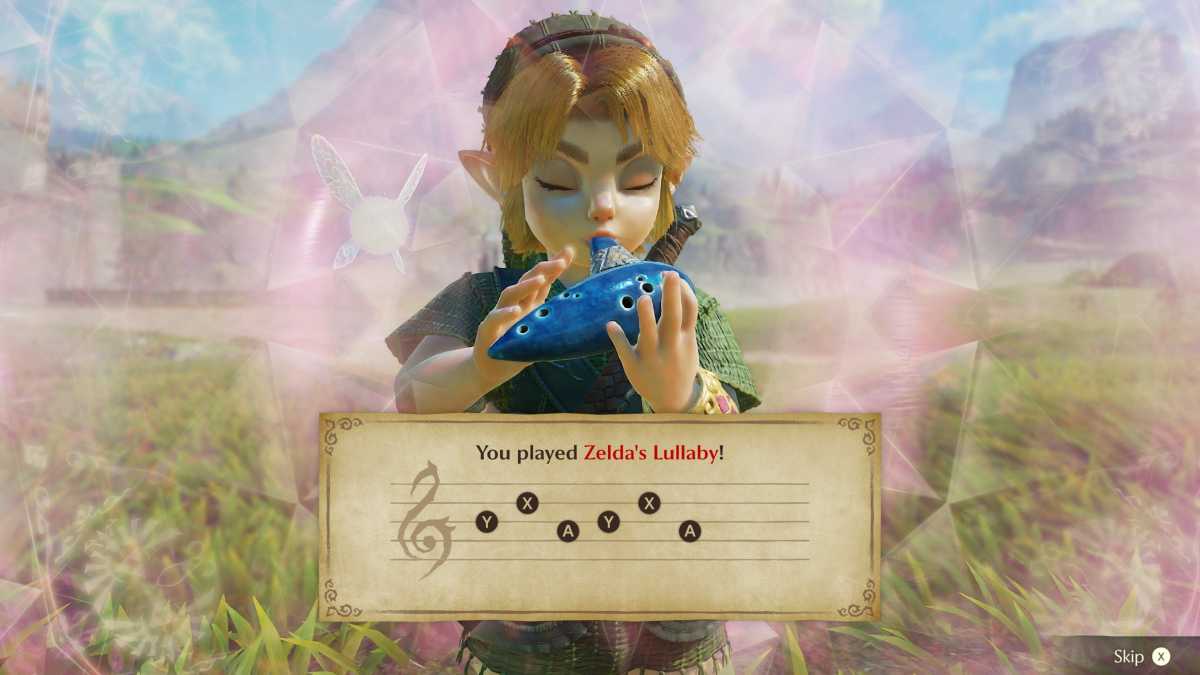
There are twelve songs Link can play on the ocarina. Two of those consist of Zelda’s Lullaby and Epona’s Song. The former is used commonly throughout the story to signal that you’ve been sent on behalf of the crown, while the latter is used to call your horse to your side.
Coincidentally, both have the same notes – just played in different orders, and this may be something that the Switch struggles with. Very often we found Zelda’s Lullaby was mistakenly recognized as Epona’s song, even when we played or hummed loudly. Again, this was only when the Switch was docked–it worked fine in handheld mode.
We started theorizing other reasons why the console was confused, and we thought it could be that it was searching for an actual ocarina sound rather than a guitar. So perhaps… the feature was designed with merchandise in mind?
Nintendo
Gotta catch em’ all
Coinciding with the game’s release, Nintendo created two playable ocarinas. There’s the manual one ($34.99) and the electric one ($49.99).
The former features a songbook with the notes you need for each song, while the latter includes two playing modes that are “designed for use with the sound recognition feature” inside the Switch 2 (according to the website). There’s also a free-play mode that lets you mimic the instrument and an auto mode, which plays the songs at the press of a button.
The playable ocarinas are pretty neat as collector items, but I wonder if they’ll work well (or better?) with the microphone feature. I’ve seen a few streamers and YouTubers using actual ocarinas with successful results.
When we can get the microphone feature working, it’s novel. But it’s usually easier (and quicker) to go down the button mashing route. It’s a cool feature! I just wish it worked better. Is it enough to stop me playing this wonderful game? Absolutely not.
Ocarina of Time is out now and costs $59.99 for the digital version and $69.99 for the physical edition. The Switch 2 starts at $499.99.


